Artist Betye Saar, noted for her exploration of Black culture and spirituality, passed away Sunday morning in Los Angeles at 99. Her family confirmed her death on Monday, just days before what would have been her 100th birthday.
Saar played a key role in the 1960s Black Art Movement, forging new paths with her assemblage boxes—sculptures made from found objects. She famously repurposed Jim Crow-era memorabilia into symbols of Black liberation. Roberts Projects, the Los Angeles gallery that represents her, stated, “Her symbolically rich body of work has evolved over time to demonstrate the environmental, cultural, political, racial, technological, economic, and historical context in which it exists.”
Originally focused on design, Saar switched to art at age 35, creating works well into her 90s. She grew up in Pasadena and was deeply influenced by a community of Black artists in Altadena. Simon Rodia’s Watts Towers were among her early inspirations.
Her artistic methods included painting, printmaking, and sculpture, often integrating items like dolls, washboards, and antiques. Recurring motifs in her work include boats, clocks, cages, and altars. Symbols of the occult and cosmology, such as lions representing her Leo astrological sign, were prominent.
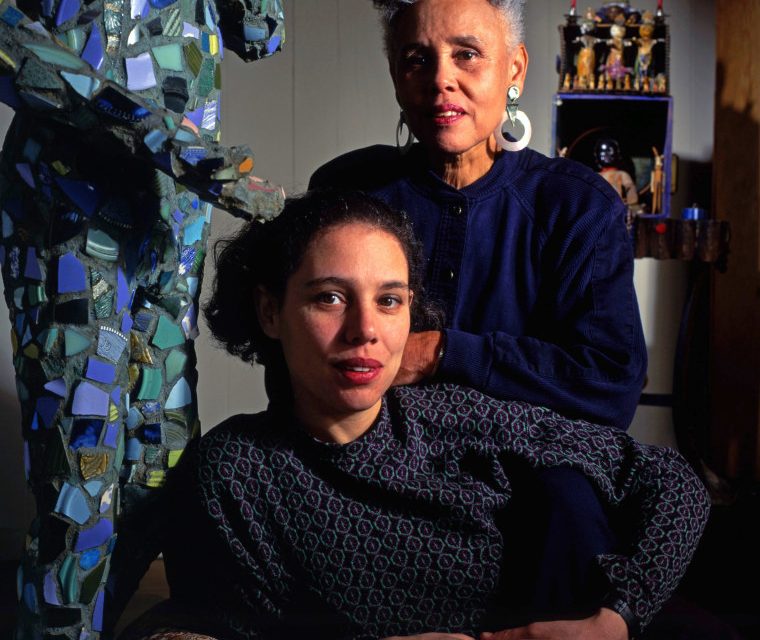
Betye Saar, right, with daughter Alison in Los Angeles, 1994. Ann Summa / Getty Images file
The gallery commented on her unique approach, stating, “Her appropriation of Black collectibles, heirlooms, and utilitarian objects are transformed through subversion. Among the older generation of Black American artists, Saar is without reproach.”
Created in 1969, her work “Black Girl’s Window” was groundbreaking but only gained acclaim decades later. The Museum of Modern Art in New York acquired it in 2019. Reflecting on the 1960s era, Saar noted, “There weren’t that many galleries in Los Angeles at the time and there certainly weren’t any for Black artists.”
“The Liberation of Aunt Jemima,” one of Saar’s key pieces from 1972, tackled racial stereotypes using memorabilia depicting Black people in derogatory ways. Despite the negative imagery, she transformed the figure into a revolutionary, armed with a rifle and grenade. This work was a response to the 1968 assassination of the Rev. Martin Luther King Jr. Saar explained, “King’s death triggered a rage within me, and the mystic transformed into the warrior.” She noted the importance of reclaiming Aunt Jemima, changing her into “a revolutionary figure.”
The Quaker Oats Company retired the Aunt Jemima brand in 2020, acknowledging its racial stereotype origins.
Having mentored many, including painter Kerry James Marshall, Saar’s artwork was featured in a solo exhibition at the Whitney Museum of American Art in 1975. Larger institutions sporadically showcased her work over the decades. However, in 2019, the Los Angeles County Museum of Art and MoMA held concurrent solo exhibitions of her work.
In 2026, Betye Saar was inducted into the American Academy of Arts and Letters. At the 2025 LACMA Art+Film Gala, she was in attendance. Frazer Harrison / Getty Images file
Director Angela Robinson Witherspoon filmed a documentary in 2023 titled “Betye Saar: Ready to Be A Warrior,” featuring interviews with figures like John Legend and Tina Knowles. Robinson Witherspoon shared, “She had boundless energy for making art. I think she had a lot to say and was tired of the art world being dominated by white males… Raising her three young daughters, she wanted to be a part of the Civil Rights Movement.”
Currently, “Let’s Get It On: The Wearable Art of Betye Saar”—focusing on her costume design—is on display at Roberts Projects. Additionally, over 100 of her dolls can be viewed at the New-York Historical Society in Manhattan.
 Converse Apologizes and Withdraws Controversial Ad Amid Criticism
  Lucas Museum of Narrative Art Unveils in Los Angeles
  Lonnie G. Bunch III Reflects on His Legacy at the Smithsonian
  A Decade of Impact at the National Museum of African American History and Culture
  Urgent Archaeological Efforts in Quinhagak Stay Ahead of Erosion
  Kennedy Center Faces Potential Bankruptcy and Closure Amid Controversies