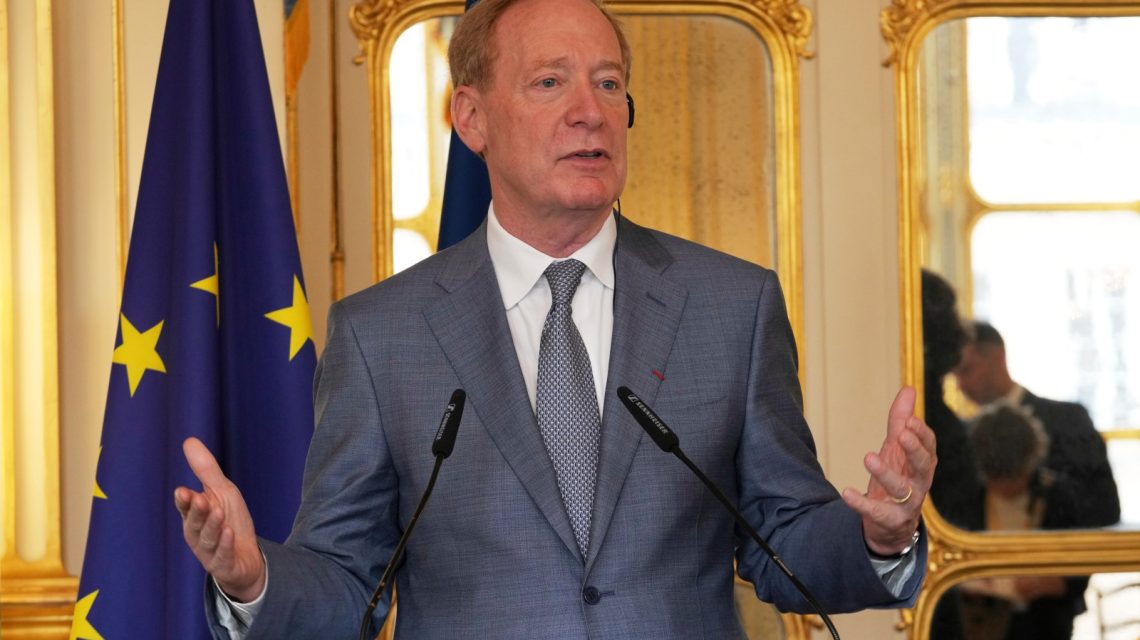
The threat of extensive technology disruptions may stay heightened in the upcoming months as organizations work to fix software vulnerabilities and upgrade outdated infrastructure. Microsoft President and Vice Chair Brad Smith cautioned on CBS News’ Face the Nation.
“I think we have to be prepared, frankly, for the coming months because this isn’t the type of thing that gets done in a couple of weeks,” Smith stated. “The whole information infrastructure of the world is in effect being upgraded right now.”
This warning comes after a turbulent period filled with unrelated technical failures affecting major banks, airlines, air traffic control, and Microsoft’s global cloud services. While officials have dismissed coordinated cyberattacks, the recurring disruptions reveal the heavy reliance of businesses, government agencies, and travelers on interconnected digital systems.
AI and Software Vulnerabilities
Smith highlighted that artificial intelligence has accelerated the identification of weaknesses in computer code. This discovery aids defenders in fixing issues, but malicious actors can exploit the same tools to target systems, leading organizations to deploy updates at an unprecedented speed, leaving less time for testing.
What AI did earlier this year was make it easier for people to find vulnerabilities in code. You can use that knowledge to patch the code, or if you’re a bad actor, you can use it to hack into systems, Smith explained.
The rush to patch vulnerabilities “at a pace we’ve never seen before” contributes to instability, particularly on older systems, he noted. “Especially when you have older infrastructure, especially when you’re trying to patch at such a pace, especially when you have to go so fast that you can’t take as much time to test what you’re changing in the code, you do increase the risk of something going wrong,” Smith added.
Smith urged consumers to promptly install security updates and called on companies to modernize older infrastructure and improve coordination with the government. “If you get an update on your phone or your laptop with a patch, apply it because that’s going to keep your technology far safer,” he advised.
Banking Glitches and Resilience
Treasury Secretary Scott Bessent shared a similar outlook when questioned on Face the Nation about recent disruptions at major U.S. banks. Bessent assured Americans that the stability of financial institutions remains strong, pointing out that banks have extensively fortified their cybersecurity, making them “by far the most resilient companies in the U.S. economy.”
Comparing routine security patches to medical care, he said, “Think of it as a vaccine. Your arm may hurt, you may feel bad the next day, but it boosts your long-term immunity and resiliency.”
Nonetheless, some cybersecurity experts argue that traditional patching is not sufficient on its own. John Walsh, chief technology officer of IGEL, emphasized the need for systems capable of isolating failures before they spread. “For critical infrastructure, the objective must be to keep essential services functioning even when a component is compromised or unavailable,” he stated.
Recent Technical Failures
The recent wave of technical failures began on November 12 and extended into November 13, when a global Microsoft outage affected Microsoft 365, Exchange Online, and Outlook email services for businesses and government agencies worldwide.
Smith mentioned that Microsoft’s outage was due to a “perfect storm” caused by a software update from four months earlier interacting with a newer update and a shift in network traffic. The company has published two reports on the incident and completed nine corrective steps, with 13 more planned.
On November 13, the Federal Aviation Administration (FAA) issued a rare nationwide ground stop following a telecommunications failure that disrupted its air traffic control network for about four hours. This event caused widespread flight delays and cancellations.
According to the FAA, the network became unstable after receiving about 1,000 connection attempts every four to five seconds, disrupting communications and radar feeds across 17 of the agency’s 22 Air Route Traffic Control Centers. Investigators identified two possible sources, including an Arkansas communications site where defense contractor L3Harris was installing a router.
Transportation Secretary Sean Duffy pointed to overloaded switches and routers as the source of the inconsistency in data, attributing the shutdown to outdated air traffic control technology.
Following these events, United Airlines experienced a separate technology failure affecting departures across its U.S. network. JPMorgan Chase encountered a technical glitch that delayed transactions, while customers reported issues accessing online accounts at major banks like Chase, Bank of America, Wells Fargo, U.S. Bank, and Capital One.
Secretary of State Marco Rubio stated there is “zero evidence” linking these incidents to coordinated cyberattacks.
Smith noted that while Microsoft’s outage had different causes, many of the disruptions in the tech sector could be seen as “AI ripple effects” resulting from the global rush to secure vulnerable code.
 Challenges Loom for America’s Power Grid: Analyzing the Equipment Shortfall Crisis
 Handling Identity Theft: Steps for Recovery
 Amazon Enlists NYC Customers Against City Council Bill
 The Controversy Surrounding Jensen Huang and Nvidia
 GAO Finds Federal Agencies Lacking in Cybersecurity Planning
 Grand Theft Auto VI Sparks Relationship Challenges