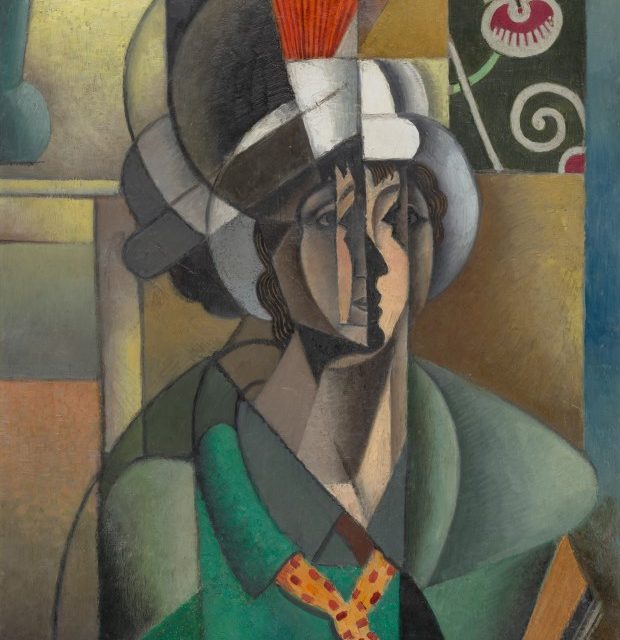
For the last three decades, descendants of Jewish art collectors have pursued the recovery of artworks stolen by the Nazis during World War II. Recently, the Art Institute of Chicago made progress by announcing the return of a 1913 painting, Woman with a Fan, by Jean Metzinger, to the original owner’s heirs.
The museum’s research, led by Jacques Schuhmacher, confirmed that the piece originally belonged to the Lewenstein family, a Jewish family from Amsterdam. The painting was sold under duress in 1940 in Nazi-occupied Amsterdam. Mondex Corp, a Canadian company specializing in recovering artworks, collaborated with the museum. Mondex represented the heirs in this process.
Mondex reports that Emanuel Lewenstein, a notable Jewish art collector, amassed wealth from a sewing machine business. This enabled him to gather a collection primarily composed of Dutch contemporary art, as well as an impressive set of Rembrandt prints. After his death in 1930, and the subsequent passing of his wife, the collection was left to their children, Wilhelmine and Robert, who eventually fled the country due to the Nazi invasion.
The art collection was sold by an auction house infamous for managing sales of looted artworks during the war. Schuhmacher noted the challenges in provenance research, which involves tracing the history of artwork ownership. Information is often fragmented across global archives, with scarce records from previous transactions.
The Art Institute houses approximately 300,000 objects with some having provenance gaps. Such gaps don’t inherently indicate looting. They acquired Woman with a Fan in 1959, describing Metzinger as a leading Cubism artist. The painting remained on display until recently.
Schuhmacher pointed out that attitudes towards provenance shifted in the 1990s following a significant conference organized by the U.S. State Department. This event highlighted Nazi-era looting and energized research into museum collections. The art institute’s inquiry into Woman with a Fan revealed provenance gaps during World War II. This led them to position the painting online, hoping for contributions to fill the gap. Mondex stepped in, providing critical family history details previously unknown.
The discovery was aided by faint pencil handwriting on the painting’s back. Infrared photography revealed the name Paul Citroen, Lewenstein’s cousin, who influenced Emanuel’s collection. Citroen had obtained numerous artworks in Berlin, moved them to the Netherlands, and sold several to Emanuel, including Metzinger’s works.
Connecting the painting to the Lewenstein family corroborated its presence in a forced auction catalog from 1940. This finding contrasted with another case of a disputed Egon Schiele drawing, Russian War Prisoner. New York judges recently reversed the seizure of the drawing, previously owned by Fritz Grünbaum, under flawed legal statutes. Schuhmacher noted that the difference is in evidence; the Metzinger painting was clearly sold under duress, whereas there is no such proof for the Schiele drawing.
The museum believes the Schiele drawing followed a legal family lineage, eventually sold to a gallerist post-war. Schuhmacher, leading the Art Institute’s provenance research for two years, emphasized that dedicated departments for such work are rare in museums. The Art Institute is now arranging the painting’s return to the heirs.
 Chicago History Museum Responds to Protest with Aquí en Chicago Exhibit
  Ari Emanuel’s Memoir Explored
  Benito Juarez Community Academy Students Celebrate Día de los Muertos Through Art
  Celebrating Diversity at Valparaiso’s World Cultural Festival
  Lucas Museum of Narrative Art to Open in Los Angeles
  Exploring the Lucas Museum of Narrative Art