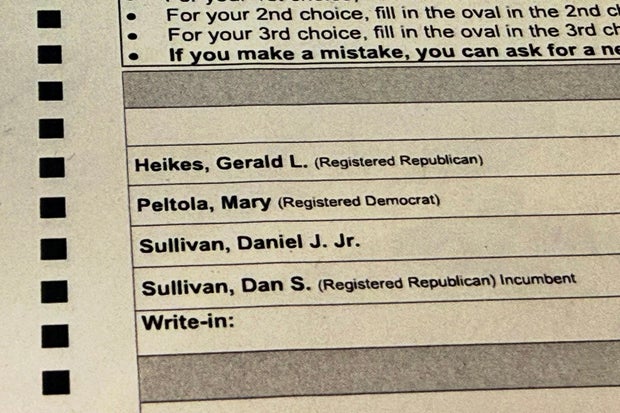
Voters in Alaska are casting their ballots in important elections, including a Senate race that has drawn widespread interest. The focus is partly due to a unique candidate situation involving Dan Sullivan and another candidate with a nearly identical name. This election also highlights Alaska’s innovative voting system that was introduced recently.
Understanding Alaska’s Voting System
Alaska has implemented a top-four nonpartisan primary and ranked choice voting. This system was first used in 2022 to help reduce political polarization. In ranked choice voting, you rank several candidates based on preference rather than choosing one.
On election day, if a candidate receives over 50% of the top-choice votes, they win. If not, the election enters a second counting round. The candidate with the least votes is eliminated, and their votes are redistributed based on the voters’ next choice. This continues until one candidate achieves a majority.
For instance, in the Alaska Senate race, imagine 100 ballots cast. Candidate A is ranked first by 50 voters, Candidate B by 40, Candidate C by 7, and Candidate D by 3. Candidate D would be removed due to having the least votes, and their votes reassigned to second-choice candidates. If one of these votes goes to Candidate A, Candidate A wins with 51 votes.
In a notable 2022 example, a special House election required ranked choice tabulation. Democrat Mary Peltola eventually won after no candidate secured an initial majority.
Senate Candidates in Alaska
The Senate race in Alaska is significant in determining Senate control. Alaska voters have four choices: incumbent GOP Senator Dan S. Sullivan, Daniel J. Sullivan, another Republican candidate Gerald Heikes, and Democrat Mary Peltola.
Senator Sullivan is a Marine veteran and former State Department official during the Bush administration. Peltola is notable for being the first Democrat from Alaska to serve in the House in 50 years. The presence of Daniel J. Sullivan, a retired teacher, has created confusion among voters.
Daniel J. Sullivan entered the race, leading to legal disputes about his eligibility. Despite court challenges, the state’s supreme court allowed him to remain on the ballot. Peltola led in the primary with 49.5%, followed by Senator Sullivan with 41.4%, while Daniel J. Sullivan received 2.5%.
Legal and Election Delays
Daniel J. Sullivan’s candidacy has spawned concerns about voter confusion, prompting legal questions. The Trump administration attempted to block Alaska from certifying results if Senator Sullivan loses but was dismissed by a federal judge. The Justice Department intends to appeal the decision.
The New York Times suggested operatives aligned with Peltola’s campaign might have recruited Daniel J. Sullivan to divert votes. Peltola denied the claim.
Vote Counting Duration
Counting votes in Alaska’s ranked choice system could take several weeks due to Alaska’s broad geography and reliance on mail ballots. Mail ballots are counted up to 10 days after Election Day, sometimes 15 days, delaying the process.
Additional delays result from ranked choice tabulation rounds, which only begin after counting all ballots 15 days after Election Day, extending the process. Alaska officials aim to certify results by Nov. 25. In 2022, Peltola’s term was confirmed on Nov. 30.
 Mississippi State Auditor Shad White Announces Gubernatorial Bid
 Tragic Car Crash in Southern California Claims Teen Life
 Trump Dismisses Third Impeachment Prospects
 Custody Dispute Involving Rep. Max Miller Delayed
 Attorney General Addresses Post-Midterm Democratic Threats
 Senator Elizabeth Warren and the Future of Crypto Regulation