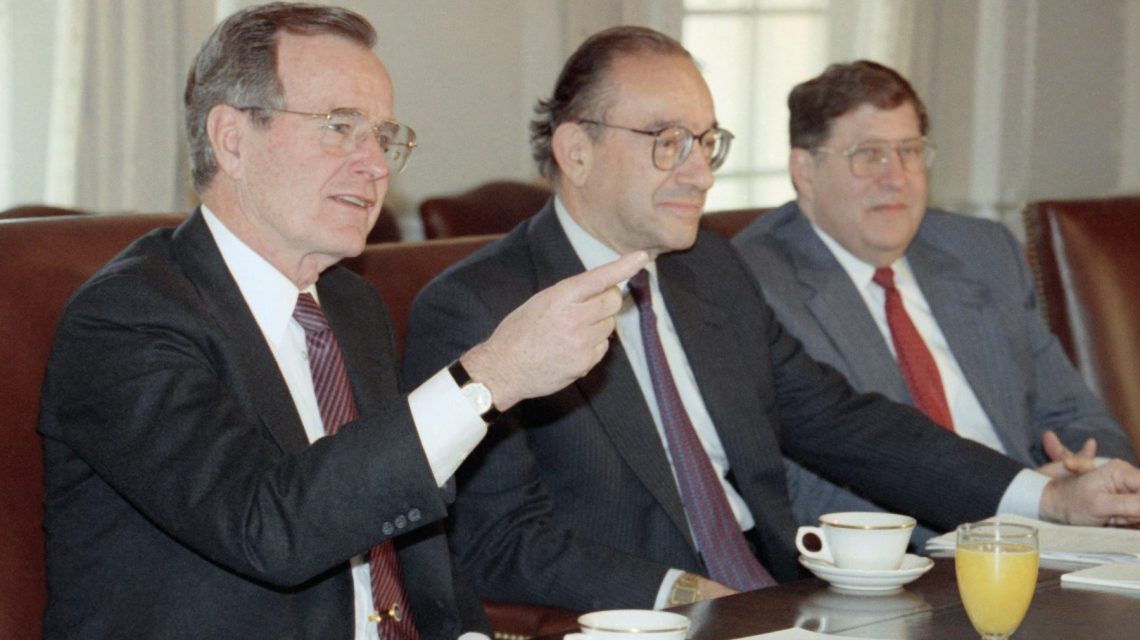
Alan Greenspan, the former U.S. Federal Reserve Chair, passed away at the age of 100 on Monday due to complications from Parkinson’s disease. His wife, NBC News correspondent Andrea Mitchell, reflected on their life together, saying, “He had ‘irrational exuberance’ for baseball, the Washington Commanders, tennis, golf, and music, especially jazz. He will be remembered for his brilliance and his kindness. Being his life partner was the joy of my life.” Greenspan’s tenure at the Fed lasted 18 and a half years and was marked by American growth and prosperity that eventually ended in dire consequences in 2008.
Era of U.S. Economic Growth
During Greenspan’s time as head of the world’s most influential central bank, his reputation soared, earning nicknames like “Oracle” and “Maestro.” He oversaw a dramatic increase in stock prices and a 10-year economic boom that began in 1991. His every word was scrutinized for clues about interest rates, the economy, and financial markets. His impact gave rise to the “Briefcase Indicator,” suggesting changes when he carried a stuffed briefcase into Fed meetings.
The Federal Reserve praised Greenspan for achieving price stability and fostering economic growth. “He brought rigorous analytical discipline to monetary policymaking,” the Fed said, highlighting his role in establishing credibility as the institution’s key asset.
U.S. Housing Crisis and Policy Criticism
After leaving the Fed in 2006, Greenspan’s reputation faced significant challenges with the collapse of the American housing market, sparking a global financial crisis. Critics blamed his lenient monetary policies and faith in lightly regulated financial markets for the crisis. Greenspan later admitted his mistake in assuming banks could self-regulate. As housing values plummeted, millions faced foreclosure, plunging the U.S. into the Great Recession of 2007-2009.
The crisis spread globally, causing debt issues across Europe and prompting China to stabilize its economy through a substantial stimulus package.
Greenspan as a Revered Economic Authority
In the years prior, Greenspan was globally revered. His remarks, like December 1996’s “irrational exuberance,” significantly impacted markets. Known for obfuscation, he occasionally satirized his own communication style. “I know you believe you understand what you think I said, but I am not sure you realize that what you heard is not what I meant,” he told Congress.
Early Life and Career
Born in Manhattan’s Washington Heights, Greenspan displayed mathematical prowess from an early age. A former Julliard School student, he shifted from music to economics, earning a doctorate from New York University. He led an economic consulting firm for decades and became a follower of libertarian philosopher Ayn Rand in the 1950s, earning the nickname “Undertaker” for his demeanor.
Greenspan assumed the role of President Gerald Ford’s chief economic adviser in 1974, marking the beginning of his influential career.
Challenges as New Fed Chair
Appointed Fed Chair by President Reagan in 1987, Greenspan faced an immediate test when “Black Monday,” the stock market’s worst one-day percentage loss, occurred. His quick assurance of monetary supply successfully calmed Wall Street, demonstrating his crisis management skills.
Another test followed with the Asian financial crisis in 1997-1998. The Fed’s emergency loan to Thailand and its persuasion of U.S. banks to roll over loans to South Korea averted wider economic devastation and upheld global financial stability through innovative solutions.
Long Economic Expansion
Greenspan’s tenure coincided with the longest economic expansion in U.S. history. Unemployment dipped below 4% briefly, while inflation remained dormant—a scenario unanticipated by many economists. He suggested advancements in technology enhanced efficiency, allowing the economy to thrive without sparking inflation.
Passion for Numbers and Family
Greenspan’s dedication to analyzing economic data was legendary, as was his deep interest in obscure statistics. He often reached out to economists to discuss insights and spent each morning reviewing data in his bathtub. Surprisingly, he also made headlines for his personal life, dating Barbara Walters and marrying Mitchell after a lengthy courtship. The couple had no children.
Faith in Self-Regulating Markets Challenged
Greenspan firmly believed financial markets could self-regulate. He blocked regulation efforts for derivatives, speculated to have contributed to the financial crisis. History favored Brooksley Born, who advocated oversight of these risky financial instruments. The Financial Crisis Inquiry Commission identified deregulation as a factor in the 2008 catastrophe.
Life After the Fed
After leaving the Fed just shy of 80, Greenspan stayed active by consulting Wall Street clients, partaking in t.v. shows, and publishing books. He signed statements supporting Fed independence amid political attacks, notably criticizing President Trump’s challenges to Fed Chair Jerome Powell.
Greenspan’s Fed chairmanship was nearly the longest, following William McChesney Martin. In “The Map and the Territory,” Greenspan defended against blame for the 2008 financial crisis, citing the unpredictability of catastrophic bubbles as a challenge to traditional forecasting.
Christopher Rugaber and Martin Crutsinger, AP Economics Writers, contributed to this report.
Support trusted journalism and civil dialogue for democracy.