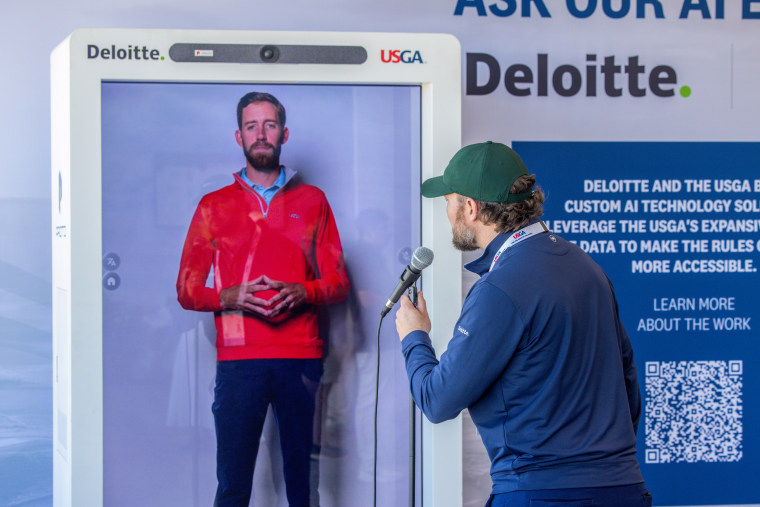
Golf enthusiasts flocked to eastern Long Island this weekend to witness the world’s top golfers compete against challenging Atlantic winds and the intricate fairways at the 126th U.S. Open held at Shinnecock Hills Golf Club. While golf’s long-standing traditions remain largely unchanged since the tournament’s inception in the late 1800s, the advent of AI technologies has introduced modern tools designed to enhance both players’ understanding of the game’s rules and fans’ enjoyment of major tournaments.
Introducing Rules AI
To assist players in navigating golf’s complex rules, the U.S. Golf Association (USGA), which oversees the U.S. Open, has rolled out a new chatbot-like tool called Rules AI. “Rules AI is about meeting golfers where they are and giving them access to answers that are as good or better than our own experts,” explained Craig Winter, the USGA’s senior director for the rules of golf, in an email to NBC News. The organization respects the sport’s tradition but believes in improving the overall playing experience.
The USGA has set 24 foundational rules covering everything from equipment to penalties. These rules can be as challenging to interpret as executing a flawless shot toward the flagstick. For instance, what should a player do if their ball stops on a paved road, rendering it unplayable? Or, what if a ball bounces off an alligator’s head into a pond?
How Rules AI Works
In a pilot phase debuting in late May, Rules AI allowed players at selected golf clubs to explore the technology through one of the USGA’s mobile apps. Users could input queries such as whether they can move a ball due to construction or how many clubs they can carry, receiving written responses shortly after. At the U.S. Open, interactive screens showcased the AI-generated rules official, managed by Deloitte employees who assisted in developing the system.
The AI avatar delivered rulings with specific references to the USGA rulebook. Joe Couhig, supporting a friend in the tournament, expressed his enthusiasm about the tool. “That tool could help take into account the entire situation for your specific shot, because a lot of the USGA rules are just written in a very general way,” he said.
The Role of Data in Rules AI
USGA has long offered phone and email services for resolving complex rule queries. Rules AI was crafted by analyzing over 25,000 real-life questions from these interactions, providing a blueprint of expert decisions. Anthony Santora, the USGA’s managing director for IT and leader of the Rules AI development team, highlighted the importance of this wealth of data. “With generative AI, the data you use is what sets you apart,” he observed, emphasizing that their system is informed strictly by internal data.
Michael Santora noted that one day the USGA hopes to make Rules AI a comprehensive source for any golf-related question, aiming for a national rollout by spring 2027. Currently, many fans remain unaware of the AI tool’s capabilities.
AI in Modern Golf
Aside from Rules AI, USGA has integrated automation in various areas. It uses technology to automatically track shot arcs with radar, provide real-time highlight clips, and offer text descriptions of player movements. Dave Giancola, USGA’s senior director of global media, pointed out that AI adds flexibility to data collection and presentation.
Adding to AI innovations, USGA launched RangeCast at the U.S. Women’s Open, enabling fans to analyze players’ warmup shots. ShotCast, released the previous year, provides shot-by-shot visualizations and AI-generated text summaries. Fan Ned Horton found these tools invaluable for understanding player decisions on the course.
USGA’s website and app now deliver broader AI-generated summaries, comparing a player’s performance with others and updating as the leaderboard changes. While some spectators are less enthusiastic about AI’s role, viewing golf as an escape from daily distractions, USGA’s Giancola envisions a future where AI enhances fan interaction with novelties like AI-enabled glasses for tracking shots. This aligns with the USGA’s mission to make golf more accessible to new audiences.
“As a fan of golf, technology, and the U.S. Open,” Giancola commented, “I’m eager to see what more we can achieve.” The potential for these championships is vast, he noted.
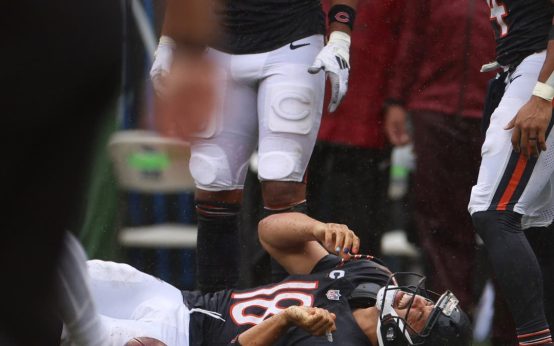 Caleb Williams Injury Update: Chicago Bears Quarterback Escapes Major Setback
 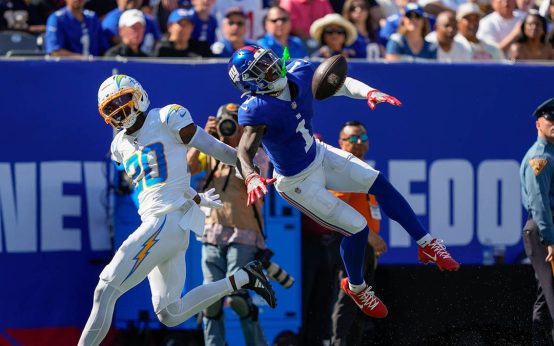 Bettors Reflect on Recent Plays and Monday Night Football
  Secure Your Internet Connection with Consistent VPN Usage While Traveling
  The Impact of Extended Job Searches on Mental Health
  Concerns Over AI’s Impact on Higher Education Learning
  Chicago Blackhawks’ Rookie Roman Kantserov Tackles Shortened Training Camp