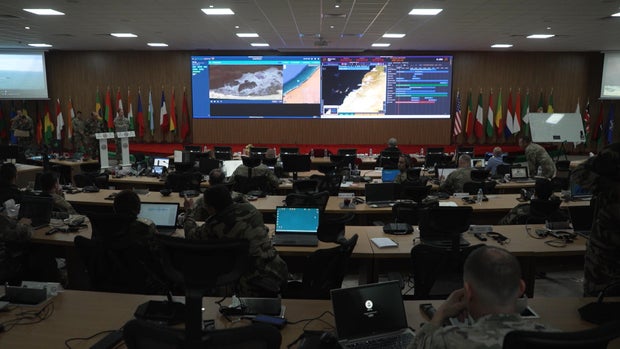
In southern Morocco, where the Sahara Desert meets the Atlantic coast, explosive sounds and gunfire recently broke the silence. American forces participated in the African Lion 2026 military exercise, the largest U.S.-led exercise in Africa. It involved 30 partner nations and focused on AI-driven systems.
Private defense contractors showcased products, seeking roles to modernize the U.S. military.
Shortening the “Kill Chain”
A key feature of the exercise was reducing the “kill chain” time, the sequence from target identification to trigger pull. U.S. Army Lt. Col. Ramon Leonguerrero mentioned using Palantir’s AI platform for rapid decisions. A process that used to take hours now happens in minutes.
In drills, humans still approved targets and commanded strikes. Autonomous systems capable of making such decisions already exist, though their use in real-world operations remains undisclosed.
AI and Project Maven
Project Maven played a significant role in the exercise. Developed by Palantir, Maven processes battlefield data through AI, identifying patterns and prioritizing information for commanders.
Maven interacts with human operators via Anthropic’s Claude large language model. Despite tensions between Anthropic and the Pentagon, Claude remains integral for querying and synthesizing data.
Ethical and Moral Considerations
U.S. military personnel expressed concern over autonomous systems making crucial decisions. A soldier cited the importance of human responsibility in decision-making.
General Dagvin R.M. Anderson emphasized the necessity to consider ethical issues related to AI. Despite reservations, he noted that avoiding AI would leave the U.S. at a strategic disadvantage.
AI adoption could prevent disadvantage against adversaries.
Robotic Advantage: Saving Lives
AI was also used to keep soldiers off the front lines by replacing them with robots. Overland AI’s ULTRA autonomous vehicle demonstrated its capabilities during the exercise, with a machine gun and explosives ready to be deployed.
The ULTRA is operated remotely, but future automation could enable independent firing decisions.
1st Lt. Vincent Gasparri highlighted how robots could save lives in dangerous operations. His team aims to increase efficiency and speed to outpace adversaries.
Gasparri’s goal is to protect soldiers by leveraging AI and robots.