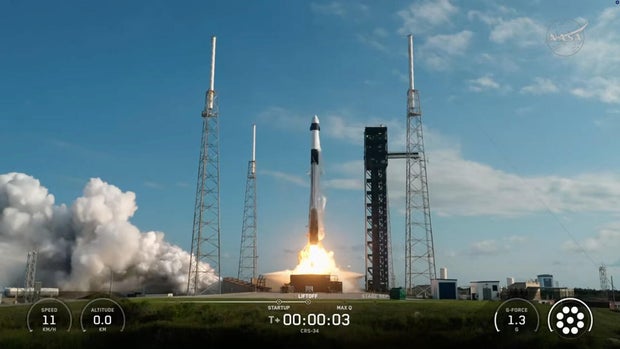
On May 15, 2026, SpaceX launched an uncrewed Dragon cargo ship filled with 6,500 pounds of supplies to the International Space Station (ISS). This shipment included nearly one ton of research equipment, samples, and materials for 50 science investigations.
The launch faced a three-day delay due to bad weather. The Dragon’s Falcon 9 booster ignited at 6:05 p.m. ET, departing from Cape Canaveral Space Force Station. It moved to the northeast, aligning with the ISS’s orbit.
Just two and a half minutes after liftoff, the rocket’s first stage, on its sixth flight, landed precisely on a pad near the launch site. Meanwhile, the second stage continued, deploying the Cargo Dragon into orbit nearly nine and a half minutes post-launch.
This marked SpaceX’s 638th Falcon 9 launch since 2010 and the 56th this year. The company achieved its 611th successful booster recovery with this mission. The first stage’s landing at Landing Zone 40 was flawless, adjacent to the launch pad.
“This will be the first Cargo Dragon spacecraft to head to the station for a sixth time, so a great milestone there,” stated Bill Spetch, ISS operations integration manager at the Johnson Space Center. “We’re sending over 6,000 pounds of hardware, supplies, science experiments and more to our Expedition 74 crew.”
The Cargo Dragon is scheduled for an automated docking with the ISS on Sunday, around 7 a.m. Crew 12 commander Jessica Meir, alongside her team, will then help unload the spacecraft.
The mission supports the Expedition 74 crew, which includes Soyuz MS-28/74S commander Sergey Kud-Sverchkov, cosmonaut Sergey Mikaev, and NASA astronaut Chris Williams. The cargo consists of 1,363 pounds of crew essentials, over 1,000 pounds of hardware, 282 pounds of spacewalk equipment, 186 pounds of computer gear, and 1,834 pounds of research apparatuses and samples.
“The ISS has enabled more than 4,000 different science experiments and technology demonstrations in its 25 years on orbit,” mentioned Liz Warren, deputy chief scientist for the space station program. “It showcases 5,000 researchers’ efforts from 110 countries globally.”
The ISS serves as a platform for scientific advancements and preparation for future lunar and Mars missions. In July, Soyuz MS-29 commander Pyotr Dubrov, cosmonaut Anna Kikina, and NASA astronaut Anil Menon will be launched from Baikonur Cosmodrome to replace the current Soyuz crew.
Furthermore, a Russian Progress cargo ship is expected in September, followed by NASA’s Crew 13 launch on September 12. As 2026 progresses, three additional cargo flights and crew rotations are planned for early 2027.
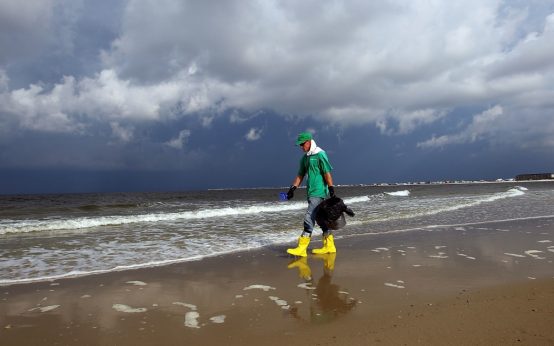 Marine Life Decline in Gulf of Mexico Post-Deepwater Horizon Spill
  Search for Amelia Earhart’s Missing Plane Nears Possible Discovery
 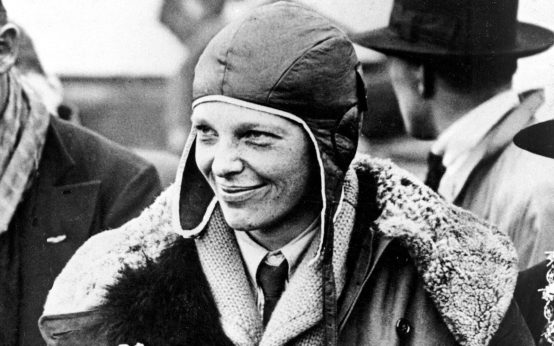 Investigating Amelia Earhart’s Possible Final Resting Place on Nikumaroro
  Tropical Storm Rachel and Coastal Hazards for Southern California
  Exploring Spider Webs, TV Pixels, and Storytelling in Science
  Henri Kagan and Kenso Soai Win 2026 Nobel Prize in Chemistry