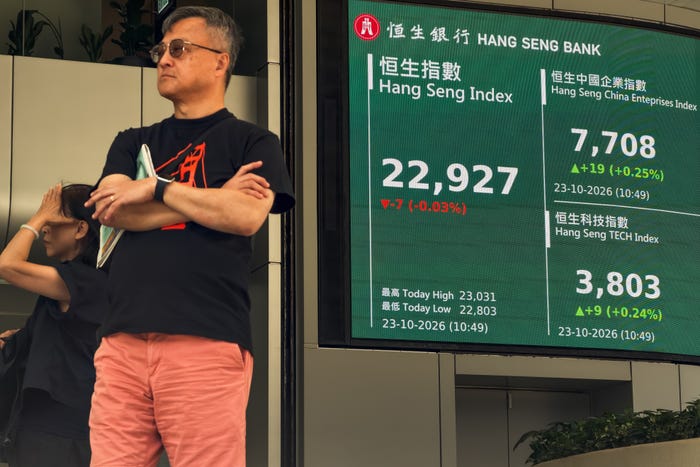
Hong Kong technology stocks experienced a downturn on Tuesday due to tightened US restrictions on China’s access to advanced AI chips. This move dealt a significant blow to the already struggling AI market in Asia. Chinese AI developers, including those behind the viral Ox Alpha model from Z.ai, were notably affected. Z.ai’s stock plummeted by 6%, while major tech companies Alibaba and Tencent saw declines of 6% and 3%, respectively.
Contrarily, China’s local chipmakers like SMIC and Hua Hong saw a boost in their shares, rising by 9% and 16%. Investors speculate that these companies could benefit as China accelerates efforts to develop its semiconductor industry in response to US restrictions. The situation underscores how the latest US measures are creating disparate outcomes within China’s AI industry, as shared by Charu Chanana, investment strategist at Saxo, in a note.
What benefits China’s domestic chipmakers may simultaneously hurt its AI developers.
Elsewhere in Asia, South Korean companies Samsung Electronics and SK Hynix faced declines of 3% and 2%, respectively, although they later recovered some losses. On the other hand, Japanese firms Kioxia and Advantest experienced significant drops of 7% and 6%.
The recent developments followed a rough session in the US stock market. The Philadelphia Semiconductor Index fell over 5% on Monday, as investors grew wary ahead of Nvidia’s anticipated earnings report.
Growing Risks
The US’s latest restrictions target a loophole where Chinese firms have accessed advanced chips by renting computing power from overseas data centers. New licensing requirements now cover shipments of advanced AI chips to nations like Singapore, Malaysia, and Brazil. Chanana noted the implications of these changes, emphasizing that the focus is now on who accesses computing power rather than direct purchases of advanced chips.
These restrictions might increase operational costs for Chinese AI developers and potentially reduce future demand for high-end processors required in AI data centers. Nvidia, recently plagued by leadership transitions, saw its shares drop by 4% amid these developments.
Despite the hardships, some look to Nvidia’s future demand as a more significant risk rather than immediate earnings impacts. The company is set to report its quarterly results shortly, the first under interim CEO Colette Kress. Nvidia’s outlook is crucial for Asia, particularly Taiwan’s TSMC, which manufactures its advanced processors, and South Korean memory suppliers used in AI servers.
The ongoing selloff arises amid broader concerns about the potential payback of large-scale investments in AI infrastructure. Within China, the US restrictions could cause an uneven impact. Domestic manufacturers like SMIC and Hua Hong might gain from increased demand and stronger policy support as Beijing aims to diminish reliance on foreign technology. Chanana commented on the evolving AI trade landscape, noting that the belief that all segments of the value chain benefit equally is diminishing.
 Amazon Enlists NYC Customers Against City Council Bill
 The Controversy Surrounding Jensen Huang and Nvidia
 GAO Finds Federal Agencies Lacking in Cybersecurity Planning
 Grand Theft Auto VI Sparks Relationship Challenges
 AI and Robotics Redefining Workforce Skills
 Cybersecurity Breach Exposes Bank Customer Data