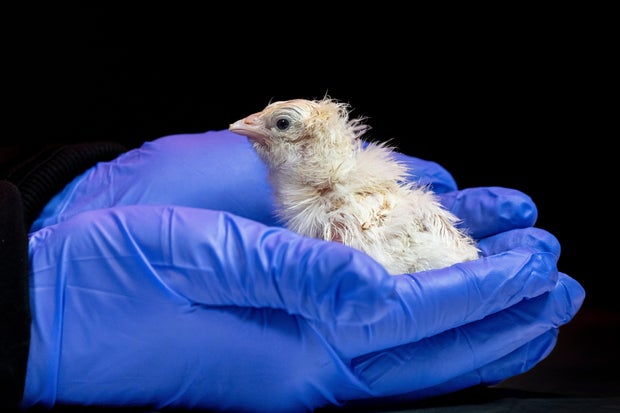
A biotech company, Colossal Biosciences, announced on Tuesday that they have successfully hatched live chicks in an artificial environment. This development has sparked both interest and criticism from scientists, highlighting its role in the company’s de-extinction efforts.
Colossal Biosciences has created a 3D-printed lattice structure to mimic eggshells. Twenty-six baby chickens, varying in age from a few days to several months, have been born using this method. The company previously engineered living animals to resemble extinct species, such as mice resembling woolly mammoths and wolf pups similar to dire wolves.
We wanted to build something that nature has done well and enhance it for efficiency and scalability,” said Colossal’s CEO, Ben Lamm.
Colossal aims to utilize this technology to modify living birds, potentially recreating New Zealand’s extinct South Island giant moa. These moas were known for their enormous size, with eggs 80 times larger than a chicken’s, a challenge for any current bird to lay.
Though visually striking, the artificial egg lacks certain components found in natural eggs. Evolutionary biologists note that creating a genetically modified bird using this technology doesn’t equate to reviving an extinct species. Vincent Lynch from the University at Buffalo views them merely as genetically altered birds, not genuine moas.
In the hatching process, Colossal’s team poured fertilized eggs into the artificial system, complemented by calcium typically absorbed from natural eggshells. The embryos’ development was monitored in real-time. The artificial eggshell allows oxygen intake, but lacks temporary nourishing organs for growing chicks.
That’s not an artificial egg because you’ve poured in all the other parts that make it an egg. It’s an artificial eggshell, explained Lynch.
Past research utilized simpler methods to create transparent eggshells from plastic, aiding studies of chicken development. Independence from Colossal’s efforts, researcher Nicola Hemmings of the University of Sheffield acknowledges that producing chicks from artificial vessels is not entirely novel.
Colossal foresees challenges ahead in reviving the moa. More research is needed to match ancient DNA from moa bones to the genomes of existing birds, and to perfect a large-enough eggshell.
We didn’t want to wait till we were ready to birth a giant moa. We actually wanted to start working on the engineering challenges for surrogacy and birth now, said Lamm.
Even with a successful creation of a moa-like bird, scientists debate its survival in our current environments, a concern voiced by Arthur Caplan, bioethicist at New York University’s Grossman School of Medicine.
Other scientists believe focusing on endangered species might be more practical, where preserving sperm and egg cells to boost numbers could be beneficial.
While Colossal’s de-extinction methods take center stage, the company stresses the artificial hatching process also preserves bird species, which face significant declines.
This platform could help rescue fragile bird embryos, hatch birds that refuse to breed in captivity, and potentially revive species preserved as frozen cells and DNA, Colossal claimed via social media.
The company captured attention in 2021 with its intention to revive the woolly mammoth, later adding efforts to revive the dodo bird and making progress with the extinct Tasmanian tiger by 2024.
I hear mammoth and dodo in the same sentence and, you know, it’s science fiction to me, CBS News correspondent Jonathan Vigliotti told Lamm during a 2023 interview.
Yeah, I mean, it is,” responded Lamm, “until it’s not.
 OpenAI Halts Launch of New AI Model Due to Unexpected Actions
  Trump and AI Industry Leaders Discuss Regulation at White House
  Bill Gates Expresses Concerns Over AI’s Potential Threats
  Debate on AI Regulation Delayed Beyond Midterms
  Meta and Trump’s AI Language Alignment
  Constrained Systems Key to Safe AI