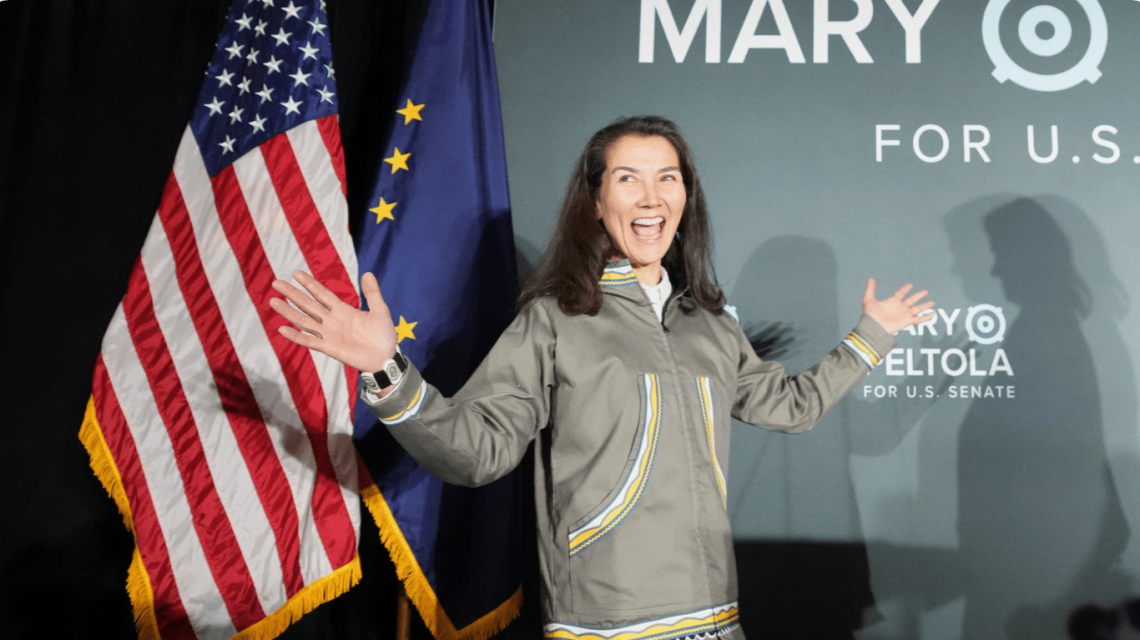
Alaska’s ballot counting process mirrors its vast geography: methodical and over great distances, one envelope at a time. In the race for Alaska’s U.S. Senate seat, Democrat Mary Peltola trails behind the majority with a shortfall of 157 votes, as noted in a Division of Elections report released Saturday. Peltola garnered 140,637 first-choice votes, making up 49.94% of the total. Her Republican competitor, Senator Dan Sullivan, received 129,424 votes, translating to 45.96%. Another Republican, Gerald L. Heikes, obtained 6,002 votes. Daniel J. Sullivan Jr., a retired teacher, accrued 4,652 votes while write-in votes accounted for 872 in total.
By early Sunday, 97% of the votes were counted, a statistic from The Associated Press. For a candidate to be elected outright, they need to surpass 50% of first-preference votes. If unmet, Alaska initiates a ranked-choice counting method on November 18. To achieve a majority strictly from first-choice votes, Peltola needs about 52% of the uncounted votes.
The Nuances of Majority Calculations
The 157-vote deficit fluctuates as each tallied ballot adjusts the benchmark for a majority. Peltola needs a significant share of the remaining ballots. What remains unreported, according to AP’s estimations, indicates thousands of Senate ballots are yet uncounted, affecting overall outcomes.
Sullivan’s Pathways
Senator Sullivan faces limited options. The deficit is larger than the apparent remaining votes. Hence, he cannot simply win with the uncounted votes. Rather, his chance lies in the ranked-choice vote should Peltola miss a first-round majority. Here, second-preference choices of eliminated candidates play a pivotal role.
By using open-source software RCTab 2.0.1 to process 282,698 ballots, Newsweek analyzed ranked preferences. Analyzing the inactive and overvote ballots showed Peltola securing 51.83% to Sullivan’s 48.16%. This independent analysis by Newsweek slightly differs from the state’s expected outcomes due to hand-counted and yet-to-be-tallied ballots.
Projections and Arguments
Earlier expectations differed. Sullivan’s campaign memos foresaw a narrow victory in ranked-choice rounds based on initial ballots. Conversely, FairVote’s preliminary analysis suggested Peltola would edge past in the final round.
The Role of ‘Dan Sullivan Jr.’
Complexity grew with claims of Sullivan Jr. siphoning votes from the incumbent Senator Sullivan amid allegations, denied by Peltola’s team, of intentional recruitment. The Justice Department attempted to challenge the election certification if this affected the results. However, the lawsuit faced dismissal over standing issues and election confidentiality concerns.
Conclusion
The race remains undecided. Alaska’s rank-choice count starts November 18 if no first-round majority emerges, with official results expected by November 25. Meanwhile, Donald Trump has provided commentary, dubbing Sullivan Jr. as “Fake Dan Sullivan.” As Democrats already control Congress, Peltola’s win would be notable, offering the first Democratic Senate seat in Alaska since 2014. Presently, the race’s outcome depends on forthcoming overseas ballots and ranked choice tabulation results.
 Reevaluating Union Certification Elections
 Meloni Reconsiders Exit Tax Amid Protests
 Democrats Projected to Gain House Control
 Trump’s Unexpected Support for El-Sayed’s Universal Health Care Proposal
 Key Global Developments: Space, Politics, and Policy
 Democrats Secure Significant House Majority