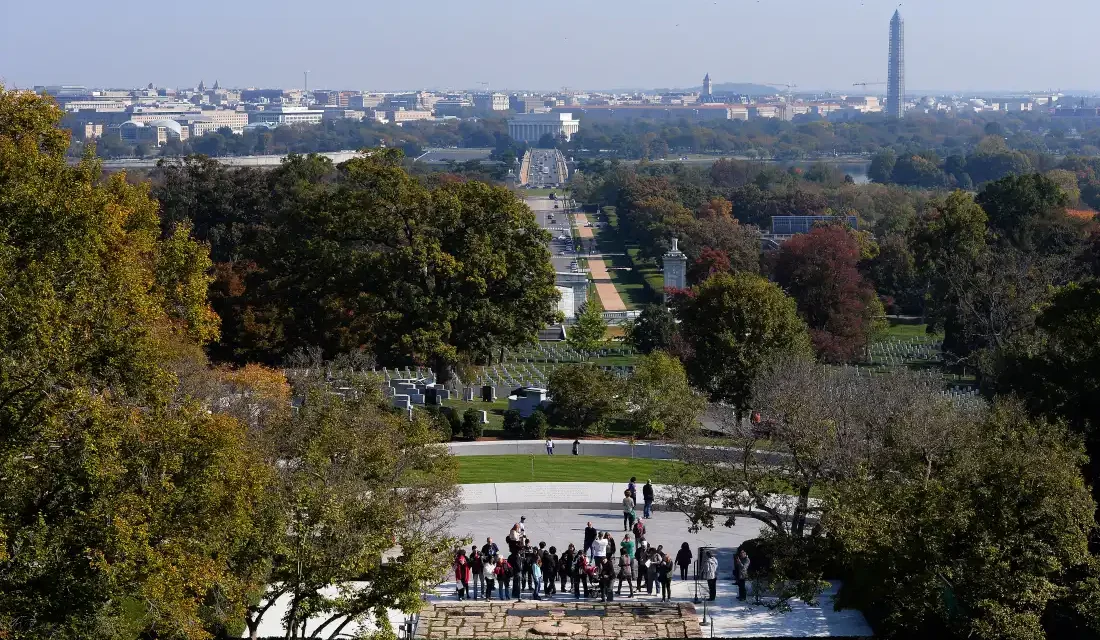
The gravesite of former President John F. Kennedy at Arlington National Cemetery aligns with the Lincoln Memorial. Kennedy’s relatives argue that President Trump’s proposed 250-foot arch would disrupt this view and cast shadows over the grave.
Nine members of the Kennedy family have filed a federal lawsuit to block the planned structure. They claim it would obstruct the gravesites of John F. Kennedy and other family members at Arlington National Cemetery, including disrupting the view of the John F. Kennedy Eternal Flame.
“A towering arch casting shadows across the graves of our father, mother, and uncles, as well as the graves of so many who have served our country, would also cast a shadow over our democratic principles,” Rory Kennedy and Maxwell Kennedy stated on behalf of the family.
The plaintiffs include children of Senator Robert F. Kennedy and Ethel Kennedy, as well as a son of Senator Edward M. Kennedy. Notably absent from the lawsuit is Health and Human Services Secretary Robert F. Kennedy Jr.
White House spokesperson Davis Ingle expressed disappointment over the lawsuit, stating that the project aims to honor those interred at Arlington Cemetery. The administration remains confident in their case for the monument.
Filed just before Veterans’ Day, the lawsuit adds a personal angle to the legal battle. The Kennedys argue that the construction of the arch represents “a permanent denigration of the Kennedy Gravesites.” They claim it would fundamentally alter the way they and others appreciate these memorial sites.
The current legal proceedings build upon earlier cases from Vietnam War veterans and architectural historians. These are now joined with opposition from the governments of D.C. and Virginia, as well as a lawsuit from the Arlington County Board.
Despite recent approval from the National Capital Planning Commission, further construction ceased when District Court Judge Tanya Chutkan issued a temporary block. The arch’s legality without congressional approval is a central point of contention.
The Trump administration argues the project is justified by historical authorizations for similar structures, but Judge Chutkan has raised concerns about these claims. D.C. and Virginia, Chutkan noted, likely have standing based on potential financial and logistical impacts.
“The Kennedys’ involvement strengthens the plaintiffs’ standing,” said Georgetown University law professor David Super, noting potential discomfort a judge may have in dismissing their concerns.
The proposed arch location would significantly impact JFK’s gravesite, which includes an eternal flame located near Arlington House. This site and the adjacent Tomb of the Unknown Soldier are among the cemetery’s most visited areas. Kennedy selected Arlington as his burial site for public accessibility and its view back toward the District.
The Kennedys emphasize that JFK’s gravesite was intentionally placed for optimal visibility, linking it visually to both Arlington House and the Lincoln Memorial. The family’s legal motion highlights a forensic analysis indicating that the arch would shadow JFK’s memorial on numerous days each year, notably obscuring the eternal flame.
The Trump administration acknowledges the historical impact but insists that relocation would void the monument’s purpose. The administration plans for the arch to feature its own eternal flame, as recommended by the Federal Aviation Administration.
Critics argue the arch would disrespect those buried at Arlington, undermining the cemetery’s solemnity. They also stress that construction would disrupt daily funeral services held at the site.
On legal grounds, the administration has rebranded the arch as a military structure, though this argument lacks detailed national security plans in the approved proposal. Its suitability is contested by retired military officials citing substantial safety risks.
Retired Brigadier General Steven Anderson highlighted concerns about using the arch as a storage space, nearby drone launches, and proximity to road networks, labeling it a “high-payoff target” for enemies.
While the administration remains committed to the monument, resistance includes public protests and a strong legal push for a permanent ban. Democratic leaders in Congress vow further scrutiny of the project’s progression, although Trump’s veto power presents a legislative hurdle.
The future of the controversial arch likely rests with a broader legal challenge reaching the Supreme Court.
 Democrats Secure Largest House Majority Since 1992
 Carney Jokes About Trump During Press Dinner
 The Political Symbolism of Facial Hair: A Look at Mayor Mamdani’s Mustache
 Analyzing Gender Disparity in Chinese Politics
 Mark Ruffalo Faces Backlash After Criticizing Sen. Chuck Schumer
 El-Sayed Questions Israel’s Identity as Democratic or Jewish State