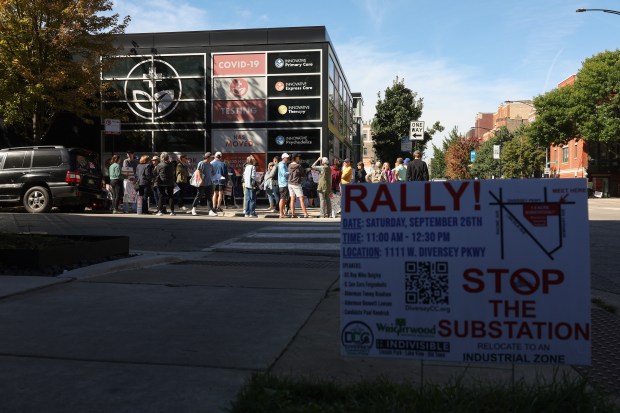
The residents along Diversey Parkway recognize the urgent need for improvements to their electrical grid. They admit the necessity for a new substation to supply power to homes and businesses but insist it should be built elsewhere. Mary Driscoll, a resident of Lakeview for over 50 years, speaks out against the construction at 1111 W. Diversey Parkway. She distinguishes between opposing an unwanted utility and exclusionary politics, emphasizing community solidarity.
Thousands of locals, including Driscoll, oppose ComEd’s plan for the substation. ComEd claims the location suits the equipment needed to prevent power outages, while opponents suggest using the land for housing. The debate has turned into a narrative battle, with residents accusing ComEd of dishonesty and the utility arguing against misunderstandings.
The Diversey Community Coalition (DCC) has mobilized over a thousand residents against the substation, framing their stance as THIMBYism—’Transit-oriented Housing In My Backyard.’ Organizers warned attendees of the potential noise and fire risks, emphasizing hope for housing development instead. Emilia Rosenberg, aged 10, expressed her desire for a safe neighborhood, while her brother Henry supported housing to save lives.
The coalition flooded the Illinois Commerce Commission with comments, slowing ComEd’s plans. The DCC envisions the site accommodating up to 200 apartments, providing homes for more than 450 people, including affordable units. They estimate this development could generate an additional $5 million in local spending annually. However, these projections emerged without consulting developers or real estate experts, relying on various inputs instead.
Chicago zoning expert Edward Kus reviewed the proposal, finding it unrealistic under current zoning regulations. He estimates the site could support fewer than half of the proposed apartments. ComEd owns the land, purchased in 2021 for $11.5 million, and zoning allows them to build a substation regardless of the property’s designation. If the ICC approves the project’s size and cost, ComEd may proceed; any housing development depends on ComEd selling the land, a scenario they have dismissed.
ComEd, through external affairs VP Keisha Parker, stated a preference for feedback and expressed no interest in relocating the site due to existing underground infrastructure, which saves on cost and time. Despite the coalition’s efforts, ComEd remains firm in its decision.
Signs with ‘STOP THE SUBSTATION’ and ‘WE WANT HOUSING’ demonstrate an evolving campaign. The group warned that replacing a COVID-19 testing site with a substation could lead to school lockdowns and evacuations. Despite studies, including from the World Health Organization, finding no health risks associated with substations, Driscoll advocates for caution, noting nearby schools.
Residents recall substation explosions in 2006 and fear the proposed facility may invite similar disasters. ComEd disputes this, asserting advancements in technology reduce risks. The utility claims substations are integral to neighborhoods, often blending in discreetly. They stress the infrastructure already present at the site minimizes disruption compared to new installations elsewhere.
The coalition sought alternative locations, identifying 14 potential sites after extensive research, focusing on manufacturing zones away from schools and transit. Despite being vetted and supported by local officials, ComEd deemed all options unsuitable, citing costs that would burden electricity customers across northern Illinois. The DCC accuses ComEd of superficial reviews, urging a reevaluation of the sites, a request unheeded by ComEd.
The market for housing in Lincoln Park is intense, with renters often paying above asking prices to secure a property. Andy Ogorzaly, a real estate professional, points to a population decline from 100,000 in 1950 to 67,000 now, attributing it to large single-family homes replacing multiunit buildings, driven by local policies favoring low-density developments.
The Illinois Commerce Commission’s decision on December 15 could allow ComEd to proceed with the substation. A recent recommendation questioning the project size gives the DCC hope. Meanwhile, ComEd stands firm, ready to justify the project size while considering the substation’s appearance. They maintain the neighborhood needs infrastructure to support future growth.
 Cumberland Island Land Swap Proposal Sparks Controversy
 Rethinking Flood Risk in Residential Areas
 Increasing Wildfire Risks and Strategies for Protection
 Community Activist Reshapes Local Politics in Prince George’s County
 John Denver’s Legacy: A Conservation Triumph in Colorado
 AI Technology Aims to Boost Honey Production Amid Bee Colony Challenges