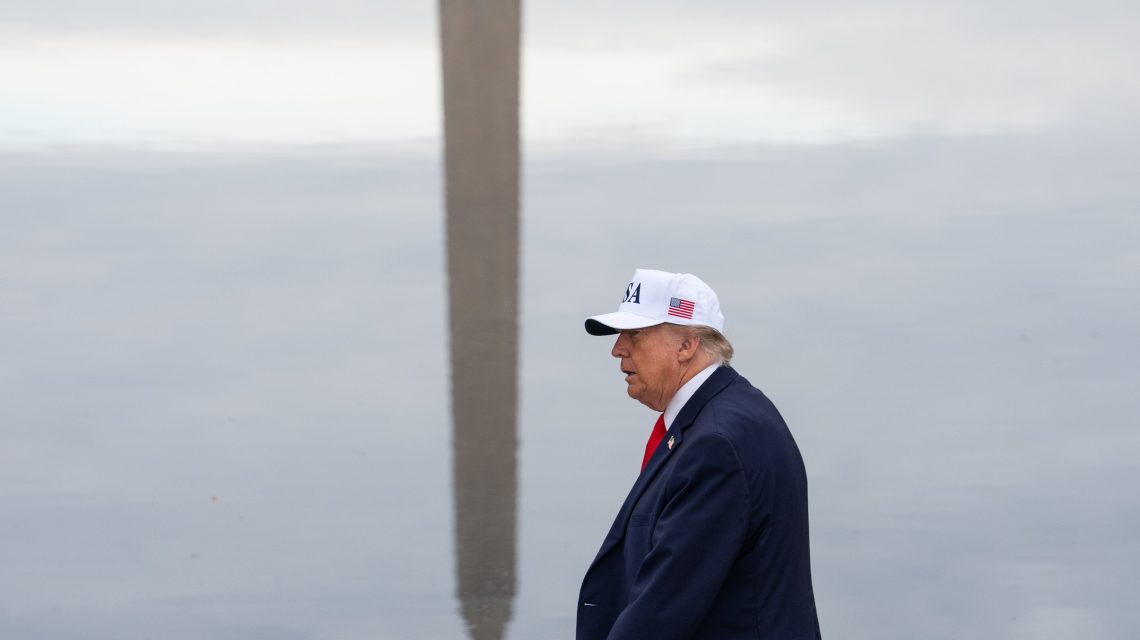
Following a recent election that strongly opposed his policies, President Donald Trump made an appearance to discuss a topic both familiar and unexpected: his efforts to reshape parts of Washington, D.C., the backdrop to his presidency. Despite his interest in project management, the Democratic takeover of Congress means Trump’s plans to transform D.C. will face more hurdles than during the first two years of his second term.
Trump’s projects involve renaming and renovating the Kennedy Center, redesigning a public golf course, and plans for a memorial arch 100 feet taller than the Statue of Liberty. These initiatives are contentious among Democrats, who had limited power until now.
The potential clash between Democratic oversight and Trump’s focus on these projects became clear in his recent messages, both before and after the election. His comments on Monday focused on the reflecting pool in front of the Lincoln Memorial. Then, on Wednesday, he toured the under-construction White House ballroom, discussing its columns, steel beams, and Corinthian designs.
Democratic oversight is likely to increase. Rep. Jared Huffman of California, a top Democrat on the Natural Resources Committee, opposes what he calls Trump’s “vanity projects,” which he argues transform public spaces into tributes to Trump. Huffman has scrutinized these projects over the past year, preparing for Democratic control to demand accountability and protect public interest.
“We’ve pushed back against vanity projects that seek to transform treasured public spaces into gaudy tributes to Trump,” Huffman remarked in a letter to fellow Democrats, seeking their support to be chairman.
With Democrats controlling the appropriations process, figures like Virginia Democratic Rep. Don Beyer stand ready to oppose these efforts. Beyer has already voiced opposition to the memorial arch planned in Memorial Circle, across from the Lincoln Memorial.
The change in control impacts not only project approval but also who names the general counsel of the House. The House Speaker, expected to be Rep. Hakeem Jeffries, will play a role in this political realignment.
While Democrats previously struggled as a minority in Congress, the new majority positions them to enforce accountability and challenge Trump’s initiatives through legislative and legal channels.
The approval of the 250-foot arch by the National Capital Planning Commission, despite strong objections, showcased the tensions. The commission’s marathon session featured more than 120 witnesses, many of whom opposed the arch’s proximity to Arlington National Cemetery.
U.S. District Judge Tanya Chutkan temporarily blocked Trump’s administration from starting construction after a federal judge’s late-night decision. Legal challenges are ongoing, involving veterans and an architectural historian who demand a halt to the projects until the lawsuit concludes.
During a White House ballroom tour on Wednesday, Trump discussed several ongoing projects, including the East Potomac Golf Links and the National Garden of American Heroes. These projects are embroiled in legal battles.
The golf course project, specifically, is under scrutiny as U.S. District Judge Ana Reyes plans a “formal inquiry” into whether Trump’s attorneys breached ethical guidelines during these project disputes.
Skye Perryman, president and CEO of Democracy Forward, represents plaintiffs in multiple lawsuits against Trump’s administration. She emphasized that the election results provide new avenues for challenging the administration’s actions.
“We hope and we anticipate Congress will fulfill its constitutional duty of checking executive branch excesses,” Perryman stated, noting that hearings and investigations into project funding are anticipated.
Concerns about project costs remain, with some figures emerging during testimonies. For example, the golf course’s seawall construction is estimated to exceed $300 million. Congress has appropriated $257 million for the Kennedy Center renovation.
The White House has yet to comment on these developments. Further changes to D.C. governance may arise as new Democratic governors of Texas, Georgia, Iowa, and Nevada come into power. These states provide significant National Guard troops, and their involvement in Trump’s mobilization orders has been a contentious issue.
 Mississippi State Auditor Shad White Announces Gubernatorial Bid
 Tragic Car Crash in Southern California Claims Teen Life
 Trump Dismisses Third Impeachment Prospects
 Custody Dispute Involving Rep. Max Miller Delayed
 Attorney General Addresses Post-Midterm Democratic Threats
 Senator Elizabeth Warren and the Future of Crypto Regulation