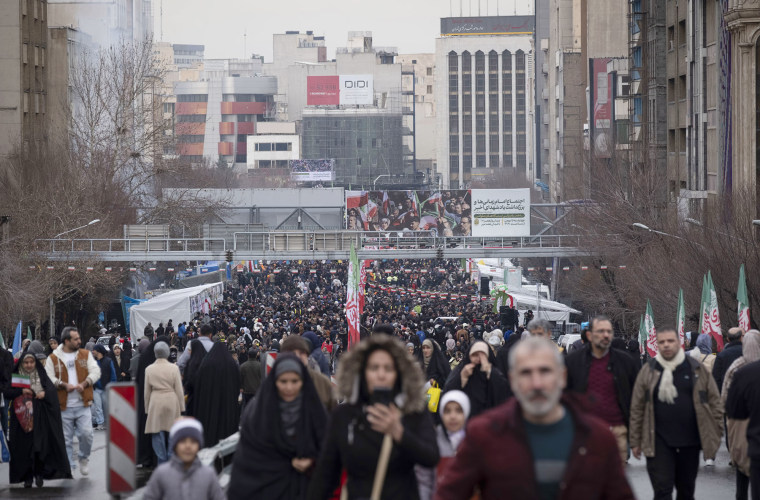
This week in downtown Tehran, a substantial security detail guarded a gathering in a square, with surrounding streets being closed off to the public. The scene contrasted sharply with events from a month ago when anti-government protests erupted countrywide. Participants this time were seen holding portraits of Iran’s supreme leader, Ayatollah Ali Khamenei, according to footage captured on Wednesday. The atmosphere involved Iranian flag-waving, children with face paintings, and music playing—activities that traditional hard-line clerics had, at one point, outlawed.
The assembly at Valiasr Square was officially intended to honor the birth of Imam Mahdi, an important Islamic figure prophesized to bring peace with the support of Prophet Isa, known as Jesus in Islam. Despite the event’s religious veneer, political sentiments were evident. Amidst traditional songs and chants, the attendees also expressed government support and voiced slogans like “Death to America.”
Nearby kiosks displayed flags of Hezbollah, the militant group supported by Tehran, while a photo op featured a cardboard cutout of its former leader Hasan Nasrallah, assassinated by Israel in September 2024.
This Mid-Shab’an Eid celebration in Tehran, traditionally supported by government officials and regime advocates since the theocratic regime’s founding in 1979, seemed to attract fewer attendees this year. This decrease could be attributed to a recent wave of protests and violent suppression. According to the U.S.-based Human Rights Activists News Agency, around 7,000 people were killed during these protests, with Tehran being one of the affected areas. The agency claims it verifies each death with contacts across Iran and believes actual numbers may be greater. Additionally, over 50,000 people have been reported arrested.
Anoush Ehteshami, a professor of international relations at Durham University in the U.K. and an expert on the Middle East, commented that the protests’ scale and vigor were “unprecedented.” In an interview with NBC News, he noted widespread unrest and dissatisfaction among large segments of the population. Despite the current calm, discontent stems from Iran’s international isolation and the severe impact of U.S.-imposed sanctions related to its nuclear activities and human rights issues.
The Iranian economy faces massive challenges as its currency has sharply devalued, leaving citizens grappling with skyrocketing prices and inflation.
While a fraction continues to benefit from the regime—mostly government employees, security personnel, and their families—Ehteshami highlighted that the economy is in the hands of a state-aligned oligarchy. These individuals, who profit from the sanctions, control significant trade segments and often prefer the status quo.
Trita Parsi, the executive vice president of the Quincy Institute for Responsible Statecraft, expressed skepticism about a return to pre-protest normalcy in Iran. The significant loss of life has irrevocably changed public sentiment. Parsi mentioned unprecedented requests from some Iranians for foreign military aid, spurred by threats from President Donald Trump to assist protesters with military force. While the U.S. military has mobilized defense systems and naval forces strategically positioned near Tehran, discussions between American and Iranian officials were initiated on Friday to avert further escalation.
Despite attacks on Iranian nuclear sites by the U.S. and Israel generating a strong wave of nationalism, Parsi warned that future military actions could galvanize further national unity. Yet, life in Tehran attempts to maintain normalcy. Unlike prior spontaneous gatherings, Wednesday’s celebration for Imam Mahdi was a governmental effort.
Henry Austin from NBC News Digital in London contributed to this report.
 CNN Defends Use of Anonymous Sources in Iran War Reporting
  Colombian President Prioritizes Energy Security in New Administration
  Israel Enhances Naval Strength with Advanced Submarine
  Generational Shift in Voter Dynamics and Its Impact on the Democratic Party
  Elon Musk’s Government Efficiency Initiative Overstates Savings
  Fetterman Criticizes El-Sayed’s Campaign Tactics Ahead of Michigan Senate Race