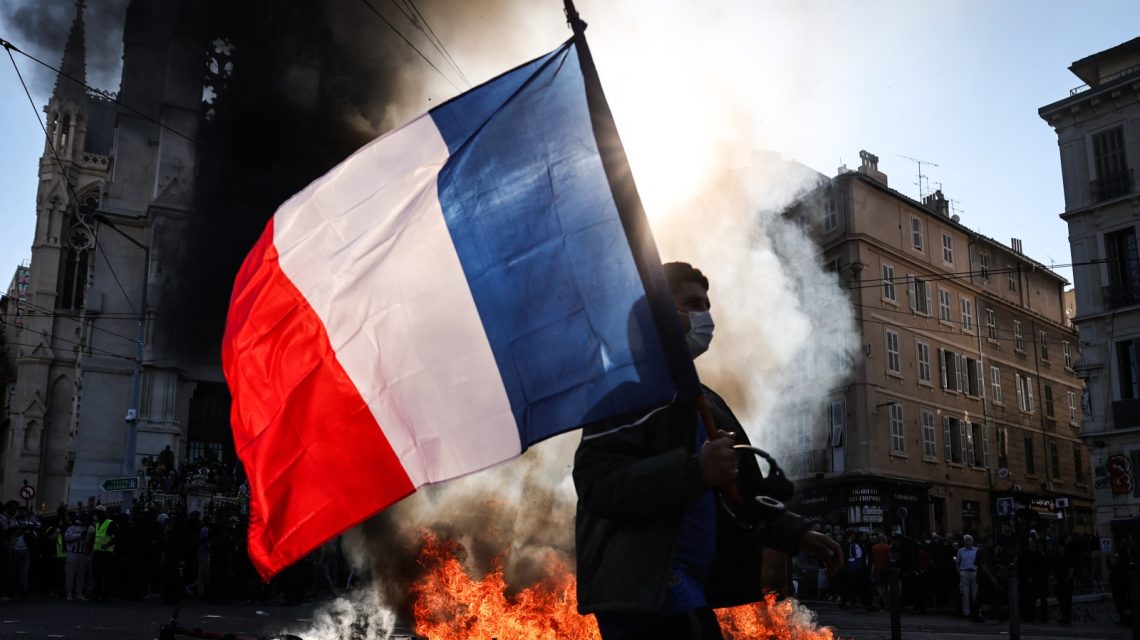
On October 17, over half a million French citizens peacefully protested against the rising cost of living and deteriorating school conditions. By nightfall, Limoges’ town hall, withstanding two world wars, was reduced to ashes. Authorities arrested nearly 2,400 individuals. Around 1,000 policemen and firefighters sustained injuries, and about 3,000 businesses suffered looting or damage. Burned out cars filled the streets. What commenced as public dissent has transformed into a crisis threatening public order, serving as a cautionary tale for the Western world.
France, alongside Europe, has witnessed protests in the past. But as these demonstrations extend beyond French borders, a disturbing question arises. What occurs when radical factions exploit legitimate grievances to destabilize institutions that form the pillars of a free society? This reflects a civilization questioning its ability to defend itself.
French leadership is responding to the situation with urgency. Prime Minister Sébastien Lecornu informed parliament that far-left groups orchestrated an ‘insurrectionary plan.’ Intelligence sources revealed attempts to incite disorder until next year’s presidential election. President Emmanuel Macron accused far-left activists of assaulting law enforcement and vandalizing public buildings. His interior minister admitted that authorities ‘lost control’ in major cities.
qPeaceful protest is a democratic entitlement. Yet, when radical and Islamist groups, along with external actors, exploit public concerns to assault law enforcement, damage businesses, and undermine institutions, the implications surpass reasonable dissent. This morphs into intimidation.
Questions arise about the financial backing of these disturbances. Recent studies on the 54 organizations tied to the French protests revealed only 16 were student or youth groups. The remainder included political entities, communist and Islamist organizations, pro-revolutionary advocates, and other transnational and domestic bodies. Establishing any links between these entities and acts of violence through evidence is crucial. Yet, transparency is essential for citizens to recognize when organized networks target law enforcement and Western institutions.
Modern activism often layers intermediaries and nonprofits to mask funding sources. Tech mogul Neville Roy Singham’s financial connections have come under scrutiny amidst allegations of ties to the Chinese Communist Party. Singham finances the nonprofit Tricontinental, whose leader, Vijay Prashad, expressed support for the protests. BreakThrough News, affiliated with Singham, amplified these events. While these links don’t conclusively prove involvement, they warrant investigation given their global reach.
The rise of these heavily funded radical organizations holds domestic implications. Numerous global progressive bodies have backed harassment of Immigration and Customs Enforcement (ICE) agents and the businesses serving them, supporting the Sunrise Movement. Sunrise has openly admitted using financial tactics against hotels accommodating ICE agents. Ordinary hotel employees, business owners, and citizens seeking livelihood bear the brunt of this approach.
Despite different agendas, Marxist revolutionaries, Islamists, and regimes adverse to the West share a common interest in weakening Western institutions, exacerbating social divisions. Where cooperation occurs, it deserves thorough investigation and prosecution.
The Trump administration addressed this as a civilizational challenge. Speaking in Athens on October 7, Secretary of State Marco Rubio referenced ‘thumos,’ a Greek idea signifying passion, strength, courage, and pride. Rubio cautioned about losing the drive to fight, strive, and survive. At the Munich Security Conference in February, he warned against ‘civilizational erasure.’ Vice President JD Vance echoed this sentiment, and the State Department emphasized the necessity of enforcing laws and securing borders.
In November 2025, the State Department labeled four European far-left factions as foreign terrorist organizations. Events in America serve as a precursor. Summer 2020 saw organized riots engulfing cities. Police precincts burned, small businesses were destroyed, with lasting damage to communities. Many businesses belonged to the very individuals the protests claimed to support. This illustrates how swiftly public order can unravel if violence remains unchecked.
Americans have a clear decision: to maintain a thriving civil society or let intimidation and extremism erode it. Achieving this requires transparent political financing, law enforcement, safeguarding civil and peaceful protests, and ensuring accountability for violence.
Socialism and radical extremism perceive individuals as mere means for their movements. A shopkeeper’s trade or hotel worker’s earnings is an acceptable sacrifice for power. ‘America First’ stands on a different premise: the citizen comes first, not the cause. ‘E Pluribus Unum’ transcends a national motto. It symbolizes a shared resolve for a nation where free individuals live, work, raise families, worship, prosper, and dissent without fear of mob dominance.
The French riots signal a warning. A civilization won’t collapse instantly. It weakens when leaders dismiss disorder, institutions recede, and citizens lose the resolve to protect what generations built. A critical choice lies ahead: a fragmented civil society subdued by intimidation or the pursuit of greatness through civilizational thumos. I opt for the latter.
Chad Wolf chairs Homeland Security and Immigration Policy, leading the Western Hemisphere Initiative at AFPI. He previously served as acting secretary of the U.S. Department of Homeland Security during President Donald Trump’s administration. Views in this article are solely his own.
 Blueprint for GOP Renewal: Lessons from Ballot Measures
 Minnesota and Medical Aid in Dying: A Call for Reconsideration
 The Complexities of Post-Divorce Interactions
 Restoring Democracy Through Legal Means
 Michael Goodwin’s Commentary on Political and Social Issues
 Reflections on Disability Rights and Representation