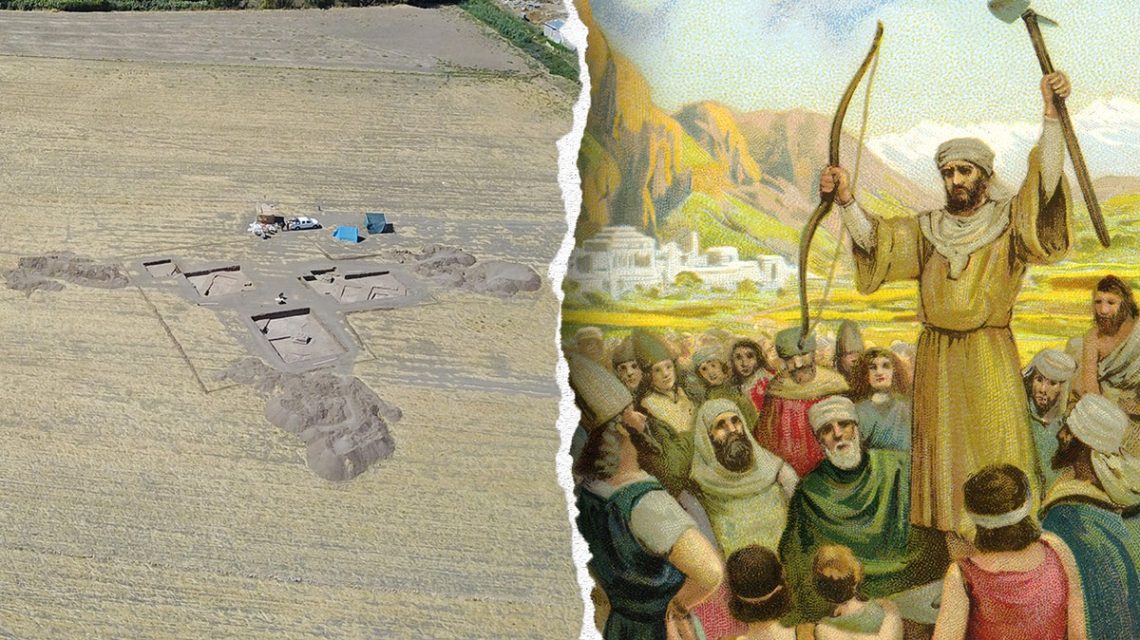
Recent archaeological findings in Iraq have uncovered evidence suggesting that Christians once lived alongside adherents of a presently lesser-known religion. This fascinating discovery was brought to the public’s attention by Goethe University Frankfurt in Germany in December.
Excavations began in late summer of 2025 at the Gird-î Kazhaw site located in Iraq’s Kurdistan region. The focal point was a building complex dating back to approximately 500 A.D.
ARCHAEOLOGISTS UNCOVER EERIE ANGLO-SAXON ‘SAND BODIES’ AT NUCLEAR POWER STATION SITE
Initially, archaeologists were puzzled about the original purpose of the complex. However, their discovery of five square pillars hinted that it might have functioned as a church, as stated in a university press release. Initial geophysical investigations suggested the ‘church’ might have been part of a more extensive monastic complex as they detected additional walls underground.
A significant aspect of the find includes the uncovering of more stone pillars, which suggest a potential three-nave structure, indicative of a Christian meeting place. Among the artifacts, pottery adorned with a Maltese cross was also discovered.
ARCHAEOLOGISTS FIND ARTIFACTS OLDER THAN STONEHENGE BENEATH BRITAIN’S HOUSES OF PARLIAMENT: ‘INCREDIBLY RARE’
The site’s close proximity to a nearby Sasanian-era fortification is noteworthy, as it might imply that Christians and Zoroastrians coexisted in the region. The Sasanian Empire, a significant Persian empire, ruled from 224 A.D. to 651 A.D. and was predominantly Zoroastrian. The empire’s fall in the 7th century led to the region’s Islamization.
Alexander Tamm, a professor at Friedrich-Alexander University of Erlangen–Nuremberg who co-led the excavation, mentioned that evidence of Zoroastrian influence at the site was mostly indirect. He noted, “There was also a small fortress in use simultaneously, which likely housed a Zoroastrian military unit.”
Despite theological differences, historical accounts indicate that religious diversity was common, with Zoroastrianism featuring multiple deities, in contrast to Christianity’s monotheism. Tamm pointed out that such differences extend to burial customs, with Zoroastrians avoiding direct earth burials to preserve the purity of the soil, unlike the ground burials performed by Christians.
Tamm remarked on the surprising scale of the findings, especially as prior expectations were more modest, anticipating possibly uncovering a small village. He highlighted the ongoing work, “There is still a great deal left to excavate,” suggesting that further discoveries could provide additional insights into early Christian history in Iraq and Iran.
Despite their religious differences, the excavation’s diverse team, including Islamic workers from the Sulaymaniyah Antiquities Authority, were unified by their shared dedication to archaeology and the expansion of knowledge.
 Colin Kaepernick’s Press Tour Raises Unasked Questions
  Controversial Claims in Charles Spencer’s Book about Princess Diana’s Divorce
  Google Fined for Breaching EU Privacy Rules
  South China Sea Tensions Rise after Collision between Chinese and Philippine Ships
  North Korea’s Hypersonic Weapon Test Amid Global Tensions
  Austin Tice: A Search for Answers