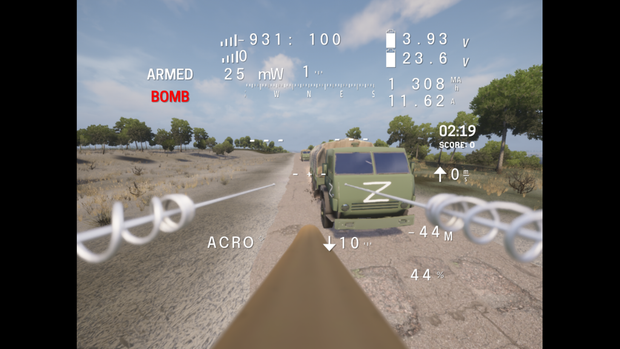
London — Video gamers now have the opportunity to experience a scaled-down version of a first-person drone training simulator initially developed by the Ukrainian army. This game has successfully transitioned from being a battlefield training tool to a source of home entertainment. Known as the “Ukrainian Fight Drone Simulator” (UFDS), the game’s release aligns with Ukraine’s ongoing efforts to counter Russia’s four-year-long, extensive invasion.
The game is available for purchase online for roughly $30. It offers incredibly realistic physics and piloting controls, mirroring the technology used to train Ukrainian drone pilots to locate and destroy Russian military assets like tanks, missile launchers, and troops. Importantly, the full version of the simulator remains accessible at no cost for Ukrainian Armed Forces personnel.
Vladyslav Plaksin, the CEO of the Drone Fight Club Academy—a training facility for Ukrainian military drone pilots—played a pivotal role in the development of UFDS. Since its inception early in the conflict, the academy has trained over 5,000 pilots. Additionally, last year they collaborated with the U.S. Air Force for a training session at Ramstein Air Base in Germany.
Plaksin mentioned to CBS News that one aim of transforming the military program into a video game is to empower young Ukrainians, offering them skills to fly drones without the necessity of being in the trenches armed with rifles.
A screenshot from the game illustrates the first-person view of a drone operator, seconds before a simulated attack on a Russian vehicle. Such imagery has fueled interest in drone technology among young Ukrainians, who, influenced by heroic tales of military drone pilots, are eager to participate in this modern warfare domain.
The creators of the game describe it as a “public adaptation of a leading ultra-realistic FPV [first person view] drone trainer,” built on frontline experiences from Ukraine. Players are offered the chance to “learn to fly like a front-line pilot, take on real-world mission scenarios, and feel the rush of modern FPV warfare.” The game includes various drones and combat missions against Russian targets, designed to be realistic enough to help players grasp the basics of drone warfare.
While many games simulate FPV warfare, featuring activities like maneuvering tanks or flying fighter jets, UFDS is distinctive as it is adapted directly from military-grade software.
Ethical Considerations
Transitioning a military training tool into a commercial video game raises ethical concerns. Similar games have long been tools within military training worldwide, although typically developed with entertainment in mind. UFDS reverses this trend, taking a real-world application and bringing it into homes.
Plaksin acknowledges these ethical dilemmas, calling it a “very sensitive question,” but points out that many simulators exist with similar concepts. “There are many other simulators which do the same, and we are not opening something new,” he remarked.
UFDS isn’t pioneering the use of games as pseudo recruitment tools either. The “America’s Army” game series, launched by the U.S. Army in 2002, is a recognized example of video games boosting recruitment efforts by militaries.
Potential Adversarial Use
Addressing concerns that rival militaries, such as Russia’s, might exploit the game for training, Plaksin emphasizes the significance of safety measures to prevent sharing sensitive information. The civilian version of UFDS greatly differs from the one employed at the Drone Fight Club Academy.
“The major differences are in the tactics,” Plaksin explains, noting that while players get substantial understanding, the nuanced tactics are absent from the game.
Significant gameplay adjustments were implemented to maintain user interest; tedious aspects of actual drone warfare were simplified or omitted. For instance, unlike real missions necessitating long flights towards targets, the game employs an arcade-style approach while maintaining realistic controls.
Currently, UFDS remains a niche with a small, dedicated player base—around 50 daily participants. Such simulation games tend to attract focused audiences rather than the broader gaming community.
In efforts to enhance the game’s popularity, Plaksin is organizing competitions aimed at “increasing the number of players” and fostering competitive environments among gaming enthusiasts.
 Scrutiny Over Alberta Separatists’ Alleged Offer to the U.S.
  Alleged Cartel Leader Arrested in Mexico
  Trump Orders Nidal Hasan’s Execution by Firing Squad
  Russia Criticizes Potential U.S. Military Base and Nuclear Plan in Lithuania
  Trump’s Political Sway in Latin America’s Elections
  Flávio Bolsonaro’s Strategic Decision in Presidential Campaign