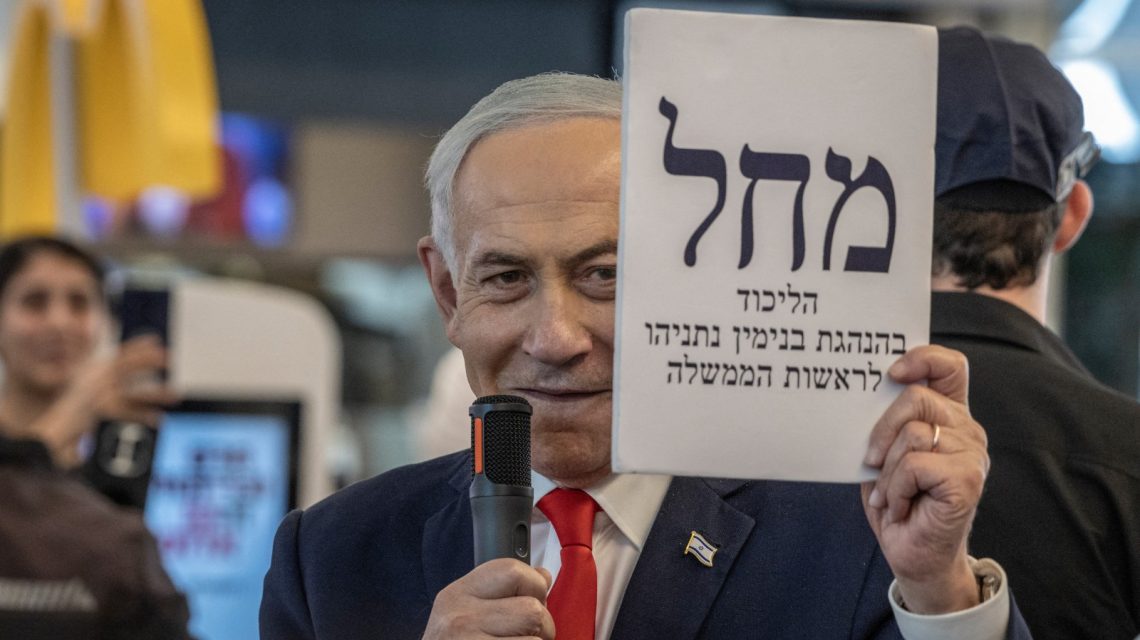
Israel’s Prime Minister, Benjamin Netanyahu, has unveiled a map detailing his perspective on alliances in the Middle East. This move has sparked discussions on how isolated Israel has become under his leadership. With Israeli elections scheduled for October 27, Netanyahu showcased this map during his first in-person security briefing since Hamas attacked on October 7, 2023.
The map, not originally crafted by Netanyahu, was first developed by the Friedrich-Ebert-Stiftung, a think tank tied to Germany’s center-left SPD party. Released in May, it serves as an analytical assessment of regional alignments from Libya to India. Andreas Krieg, associate professor at King’s College London, shared with Newsweek that Netanyahu’s map reveals more than intended. While Netanyahu aims to portray himself as a creator of a new regional security structure, the map indicates Israel’s increasing isolation from major regional powers.
Yoram Meital, professor emeritus of Middle East Studies at Ben-Gurion University, stated that Netanyahu seeks to position Israel as a significant regional power with strategic partnerships. However, Meital argues that Netanyahu’s narrative is selective and somewhat misleading.
What Did Netanyahu’s Map Show?
Some Israeli media outlets boycotted the briefing in protest of Netanyahu’s limited engagement with the press. However, top aides and security officials attended. The Times of Israel reported that during the event, Netanyahu presented the map titled “geopolitical alliances in the Middle East,” which used colors to denote different regional alliances.
The “Israel-UAE Hexagon alliance” appeared in blue, while lighter blue indicated countries considered friendly by the alliance, such as Greece, Ethiopia, and Somaliland. Iran and its allies, the Axis of Resistance, were marked in purple, covering areas like Yemen, where civil conflicts persist. Lavender represented Iran-friendly countries, including Russia and parts of Iraq. The “Sunni Diamond Alliance,” consisting of Turkey, Saudi Arabia, Egypt, and Pakistan, was shown in dark green, with lighter green for friendly countries like Sudan, Syria, and Jordan.
Netanyahu defended military actions against Iran, viewing preemptive measures as necessary following October 7 attacks. However, Krieg noted that the map highlights the regional resistance Israel’s strategy is generating. Increased military ambition prompts other states to balance against Israel.
Krieg added that while Netanyahu can modify the Middle East map, he cannot alter the strategic interests of the countries. The presented map of emerging relationships does not equate to tangible alliance systems.
What Are Netanyahu’s Regional Priorities?
A shift under Netanyahu is Israel’s alignment with UAE’s “axis of secessionists.” Israel aims to integrate Abu Dhabi’s networks of separatist movements into its regional security framework. These efforts revitalize Israel’s old periphery doctrine, focusing more on substate actors than sovereign entities.
Netanyahu aims to influence the regional order by exploiting fragmentation in neighboring states. This approach allows Israel to project influence without needing political consent from other regional capitals. Yet, this strategy faces challenges, especially from Saudi Arabia, which sees it as undermining regional stability.
Previously, Netanyahu depicted Saudi normalization as a diplomatic victory. Now, his strategy places Saudi Arabia at the heart of a competing alignment. During the briefing, Netanyahu vowed to dismantle the Iranian regime, minimized West Bank settler violence, and emphasized the election’s significance for achieving Israel’s military goals.
Meital criticized Netanyahu for not acknowledging security lapses from October 7, 2023, and the consequences of the Gaza war, including civilian casualties and destruction. After the briefing, Gadi Eisenkot, leader of the Yashar party, accused Netanyahu on X of not meeting the central objectives of the war. Eisenkot pointed to the presence of armed Hamas operatives in Gaza, Hezbollah’s military buildup, and the deteriorating West Bank security.
Meital noted that Israeli opposition contests Netanyahu’s security narrative, distinguishing between short-term military wins and long-lasting national security. This criticism highlights the October 7 failures, human and economic tolls of wars, and Israel’s declining international reputation.
 Congressman Gallagher Urges FBI to Combat Illegal Marijuana Operations in Northern California
 President Trump’s Economic Policies and Voter Perceptions
 Putin’s Summer of ’69: A Different Worldview
 Elections 2026: Major Developments and Ongoing Coverage
 Texans Cope with Rising Beef Prices Amid Election Season
 Ukraine’s Innovative Drone Medical Evacuation Amid Ongoing Conflict