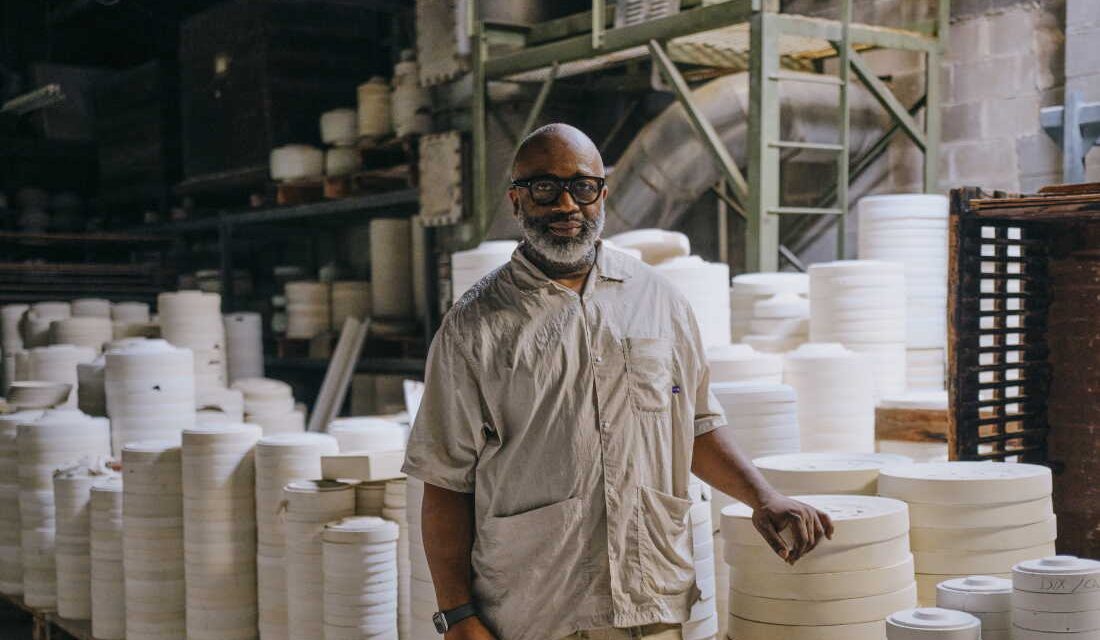
Theaster Gates poses for a portrait at the Pickard China factory in Antioch, Ill. The 53-year-old Chicago-based artist recently acquired the business for an undisclosed sum.
The Pickard China factory in Antioch, Illinois, located about 50 miles northwest of Chicago, is a sprawling space filled with large, noisy machines splattered with clay. The scent of turpentine fills the decorating room, where gilders mix the chemical into pigments used to hand-paint plates, cups, and other luxurious porcelain homewares. Employees like Rachael Keeling, who applies a narrow green band to a spinning porcelain plate destined for a golf club awards ceremony, seem unfazed by the strong odor. Keeling is among a small group of British craftspeople employed at Pickard, having moved to the U.S. to work for the company 25 years ago.
Keeling mentions her concerns about the future of fine china production. She originally came from the Wedgwood factory in Stoke-on-Trent, which began automating and relocating overseas. “I came here and it’s like, ‘Oh, is it going to happen again?’
A Long Decline
In the past, several companies manufactured high-end china in the U.S., but Pickard is the last one remaining. Its clientele includes the White House, U.S. embassies, upscale hotels, private jets, golf clubs, and high-end retailers such as Williams-Sonoma. Michelle Obama’s interior designer, Michael Smith, praised the blue-green rimmed dinnerware set Pickard commissioned during the Obama administration.
Despite its prestigious customers, Pickard and the broader fine china industry have faced a long decline. The factory is in urgent need of repairs and upgrades, as its output is merely a quarter of what it was during the company’s peak in the 1970s. Historian Philip Scranton of Rutgers University noted the cultural shift that led to decreased demand for this commodity, with escalating manufacturing costs contributing to the downfall of American china factories.
Pickard’s survival has been attributed to “stubbornness and legacy.” Founded in 1893 by pottery salesman Wilder Pickard, it remained under family operation until Theaster Gates became involved.
An Unexpected Partnership
Theaster Gates, a renowned contemporary artist, connected with Pickard through Illinois First Lady MK Pritzker. Gates count the Obamas and other influential figures as friends. During a visit to the factory, Gates and Andy Pickard Morgan, the fourth-generation leader since 2006, informed the staff of Gates’s acquisition of the business. Pickard Morgan, who approached retirement without any family member wanting to oversee the business, saw an opportunity in Gates’s artistic vision.
The partnership may seem unusual: a modern artist and a traditional porcelain business. Yet, Gates sees artistry in expansive terms, focusing on the boundaries of art. His past endeavors include restoring defunct buildings, archives, and businesses, primarily on Chicago’s South Side.
Ken Mehta, former owner of a neighborhood hardware store, spoke about Gates’s heart for restoration. Gates transformed Mehta’s store into an art installation and event space after purchasing it in 2014.
Gates also acquired a condemned bank building for $1 from the City of Chicago, turning it into the Stony Island Arts Bank, which stores Black history and culture books. Linda Johnson Rice, chairman of Johnson Publishing Company, appreciates Gates’s respect for legacy, but acknowledges the difference between revitalizing dormant assets and running an ongoing business.
Embracing Challenges
The new president of Pickard China, Gates has challenges ahead. The factory needs significant repairs, including a new roof and HVAC system. Gates aims to assemble a team for daily operations while he guides creative strategy, with Morgan remaining in an executive role.
Gates remains optimistic about the task, seeing it as poetic. By adding to the legacy, it opens new avenues for his artistic practice, including porcelain work. After all, he now owns a china factory.
Jennifer Vanasco edited the audio and digital versions of this story, with contributions from Clare Lombard. Chloee Weiner mixed the audio. Danielle Scruggs is the photo editor.