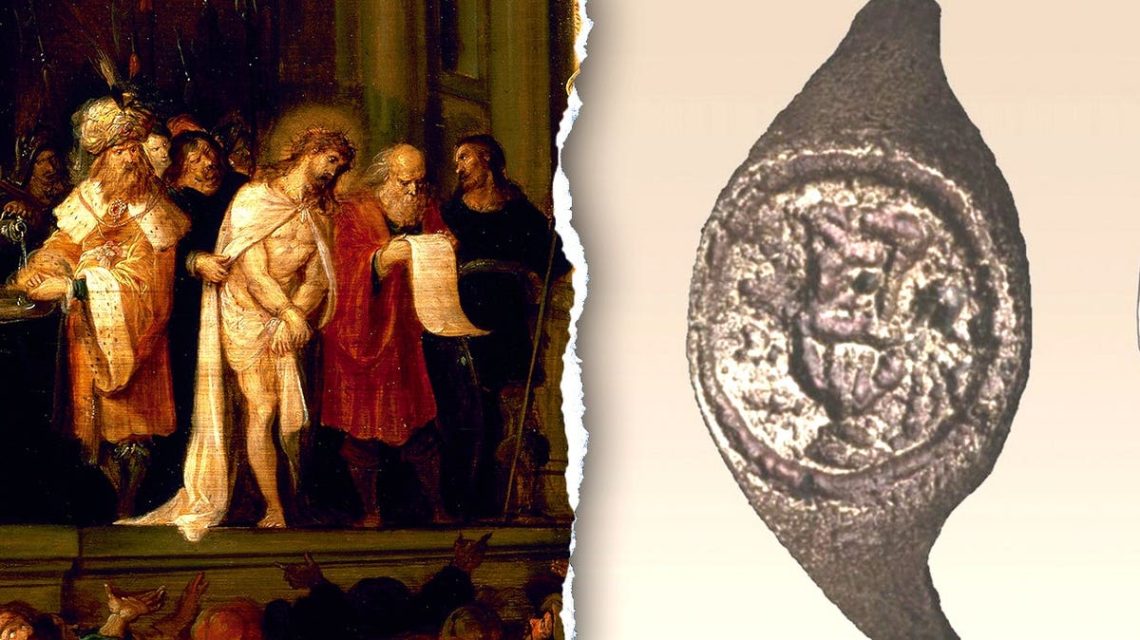
A recent study provides fresh understanding of an ancient ring inscribed with a name associated with Pontius Pilate. Found in the 1960s at Herodium, a fortress in the Judean desert, this ring has been re-examined to reveal possible connections to the Roman governor known for sentencing Jesus Christ to death almost 2,000 years ago.
Historical Context and Analysis
After being stored for over five decades, new findings about the ring were published in 2018 by researchers from the University of California, Los Angeles (UCLA). A subsequent study questioned its link to Pilate. Catherine Bonesho, a UCLA professor of ancient Judaism, explored this debate in a study released in Palestine Exploration Quarterly.
Bonesho identified the ring’s inscription as a transliteration of the Latin word ‘PILATO’ into Greek letters, suggesting it means “for Pilate” or “to Pilate.” Her interpretation differs from previous views that suggested it was a miswritten or shortened Greek version implying “belonging to Pilate.”
The ring’s connection to Pilate provides insights into the Roman administration in Judea and the distribution of authority in its political framework.
A Closer Look at the Ring
According to Bonesho, the ring likely belonged to a subordinate staff member rather than Pilate himself. Despite its poor quality, the Greek transliteration, and the likelihood that users of such seal rings were enslaved or formerly enslaved, the ring adds valuable information about administrative practices of the era.
The ring could illustrate how lower-ranking individuals used items linked to Pilate’s authority for business and legal operations. These actions appeared to carry the governor’s backing and that of the Roman bureaucracy.
Implications for Historical Understanding
Historian Candida Moss supports the idea that this ring, although not a symbol of wealth, played a key role in administrative procedures in Roman Judea. It might clarify why an inexpensive ring is associated with a significant figure like Pilate.
Moss suggests that the use of the ring indicates how someone working under Pilate wielded his power, such as making business or legal decisions with Pilate’s seal.
The Biblical Connection
Aside from archaeology, this interpretation may enhance the understanding of biblical narratives. Moss notes that this artifact might illuminate the Gospel of John’s detail about Jesus’ crucifixion inscription as “King of the Jews,” which Pilate reportedly ordered.
The ring could clarify why the Bible attributes the writing of this inscription to Pilate, even though subordinates likely did the work.
 Lonnie G. Bunch III Reflects on His Legacy at the Smithsonian
  Animal Self-Medication Insights
  Carlo Rovelli’s Perspective on Physics and Ultimate Reality
  Department of Defense Legal Waiver Promotes UAP Disclosure
  Discovery of WWII POW Documents in New York
  Lost City Linked to Jesus Discovered Near the Sea of Galilee