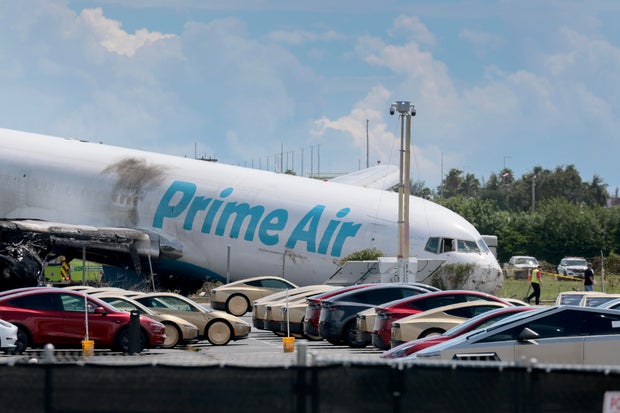
Investigators from the National Transportation Safety Board (NTSB) are preparing to interview the pilots of the Amazon cargo plane that crashed at Miami International Airport, resulting in five fatalities. The incident occurred after the aircraft overshot the runway. The two pilots, who have been discharged from the hospital, are scheduled for interviews on Wednesday morning. This is part of the NTSB’s ongoing investigation, NTSB Chair Jennifer Homendy stated during a news conference on Tuesday night.
The captain is a 55-year-old named Captain Joseph Carroll, with 7,145 flight hours as of March 31. The first officer is Jaime Felipe Silva Molina, aged 37, having 2,655 flight hours as of August 31, officials revealed. Both the cockpit voice recorder and flight data recorder were retrieved from the crash site. Homendy confirmed these details previously.
“The cockpit voice recorder contained more than two hours of good quality audio,” Homendy explained, noting that the flight data recorder recorded around 55 hours of data. Public disclosure of the cockpit voice recorder’s contents is pending the pilot interviews on Wednesday.
Efforts are ongoing to uncover the causes behind the Amazon cargo plane crash at Miami International Airport on September 7, 2026. “We need to talk to the crew to understand how they’re manipulating the controls to better comprehend the situation,” NTSB’s lead investigator Chihoon Shin indicated. “Crew accounts and interviews are vital to filling gaps in our understanding,” Shin added.
Plans are also in place to talk with air traffic controllers, dispatchers, and others present during the crash. The NTSB team dedicated their first full day on-site to collecting evidence, such as drone footage and tire marks, Homendy remarked. The aircraft’s weight was nearly 252,000 pounds at takeoff, including 32,000 pounds of cargo, mainly contact lenses. No hazardous materials were discovered.
According to Shin, recorded data from the NTSB showed no deployment of speed brakes or thrust reversers, mechanisms aimed at slowing down or descending an aircraft quickly. Shin cautioned against speculation on why such measures weren’t activated. “We’ll conduct a thorough aircraft performance study,” Shin mentioned.
Homendy emphasized the investigation will focus on the flight’s history, crew experience and training, and events preceding the impact. The Boeing 767-33 crashed after overrunning the runway during landing, leading to collisions with several vehicles and consequent fire. This resulted in the aircraft resting around 1,300 feet from the runway’s edge, with aerial footage showing a debris field inclusive of vehicles belonging to the victims.
Two out of Miami International’s four runways were closed. Officials allowed partial reopening of one runway for departures. Photos of the flight data and cockpit voice recorders from 21 Air LLC Flight 7598 were issued by the NTSB on Tuesday.
Aviation attorney Pablo Rojas analyzed crash footage, noting the plane’s excessive speed upon approach. “The video indicates the ground covered during approach and touchdown was substantial,” Rojas stated. Mechanical issues are also under scrutiny, with observations potentially indicating inconsistent ground contact of the landing gear.
Rojas suggested questioning why the pilots did not execute a go-around, a standard procedure of retrying the landing. NTSB officials confirmed they couldn’t determine if a go-around had been attempted in a Tuesday briefing.
 ICE Agent Shoots Civilian in Austin: Investigation Underway
  Sunday Sports Recap and Weekend Adventures
  Fatal Car Crash in Irvine Claims Two Lives, Including Car Show Co-Founder
 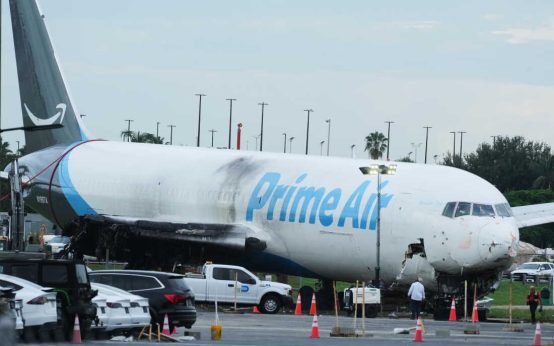 Amazon Suspends Partnership with 21 Air Following Miami Cargo Plane Accident
 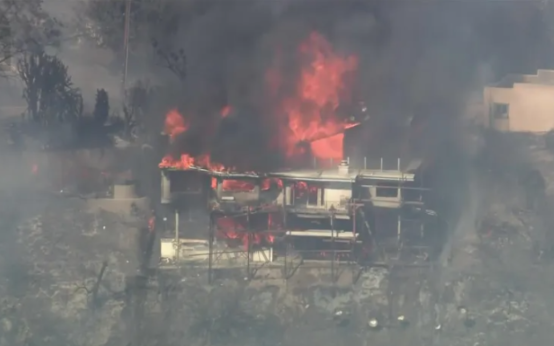 Brush Fire Prompts Evacuations in La Habra Heights
  Lawmakers Challenge NFL Streaming Costs and Scheduling