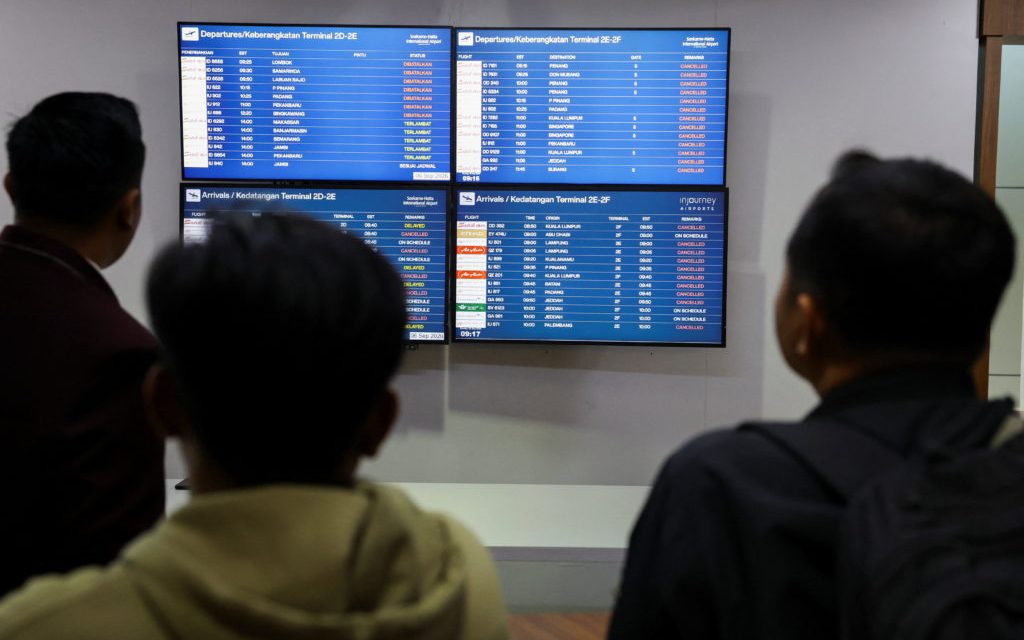
In Indonesia, a significant volcanic eruption occurred at dawn on Sunday, leading to widespread travel disruptions as flights were suspended at major airports. Anak Krakatau, a volcanic island located in the Sunda Strait between Java and Sumatra, had been showing signs of activity since Friday. It erupted twice early Sunday, once for 30 seconds at 3:53 a.m. and again three hours later for 16 seconds, as detailed by Indonesia’s Geological Agency.
Closed-circuit camera footage captured the dramatic lava flares emitted by the volcano. Fortunately, no casualties were reported, and authorities did not issue any evacuation orders. However, residents and visitors were advised to keep a safe distance of at least 3 kilometers (2 miles) from the active crater due to safety concerns.
Volcanic ash affected areas in Jakarta and Lampung province on Sumatra’s southern tip. Due to these conditions, AirNav Indonesia closed airspace around Soekarno-Hatta and Halim Perdanakusuma airports in Jakarta, as well as at six other airports, including Radin Inten II Airport in Lampung. These closures impacted 170,000 passengers, resulting in 1,558 canceled flights by Sunday evening, including 963 cancellations at Jakarta’s Soekarno-Hatta airport alone.
Eight airports remained closed until midnight, causing significant inconvenience to travelers. Diego Urdiales, a tourist from Spain, expressed frustration due to the lack of updates from airlines, while Indonesian passenger Michele Gouw highlighted the inevitability of nature’s forces.
The Directorate General of Civil Aviation emphasized the importance of safety and coordinated with airlines, airport operators, and air navigation services. Ministry of Transportation director general of civil aviation, Lukman F. Laisa, stressed that disruptions may persist due to factors like aircraft rotations and fleet availability. Services at Bali’s I Gusti Ngurah Rai International Airport and Medan were also affected.
Data from Indonesia’s volcanology agency and the Darwin Volcanic Ash Advisory Centre showed two ash clouds using satellite imagery. One cloud reached 20,000 feet (6,100 meters) and moved northeast over areas like Jakarta and waters nearby. A second cloud ascended to 50,000 feet (15,200 meters) and spread across various parts, including Banten and Lampung provinces.
Lana Saria, heading Indonesia’s Geological Agency, indicated that activity at Anak Krakatau has increased since July, with the Sunday eruption being the most substantial during that time. Although multiple eruptions suggest a continuous supply of magma and volcanic gases, it is challenging to predict further eruptions. The main risks include volcanic ash, high gas concentrations, and hot rock emissions.
The eruption’s impact extended to education, with the government authorizing schools in ash-affected areas to transition to online learning temporarily. This measure is meant to minimize student exposure to ash and allow flexibility in classroom engagement.
Anak Krakatau, meaning “child of Krakatau,” emerges as the successor of Krakatau, known for its massive 1883 eruption that affected climate globally. A 2018 eruption caused a deadly tsunami, altering Anak Krakatau’s size significantly.
Contributors to this report include Edna Tarigan, Dita Alangkara, and Fadlan Syam. Support for trusted journalism and civil dialogue remains crucial for maintaining a healthy democracy.
 U.S. Forces in Japan Face Curfew Following Marine’s Arrest
  Grief and Resilience: Remembering Hersh Goldberg-Polin and the Aftermath of the October 7 Attacks
  Zion Teasley Pleads Guilty to Murder of Lauren Heike
  Concerns Rise Over Working Conditions at Fuyao Glass America Inc.
  Investigation into Lineage Warehouse Fire in Boyle Heights
  Cornell University’s Faculty Considers No-Confidence Vote Amid Allegations