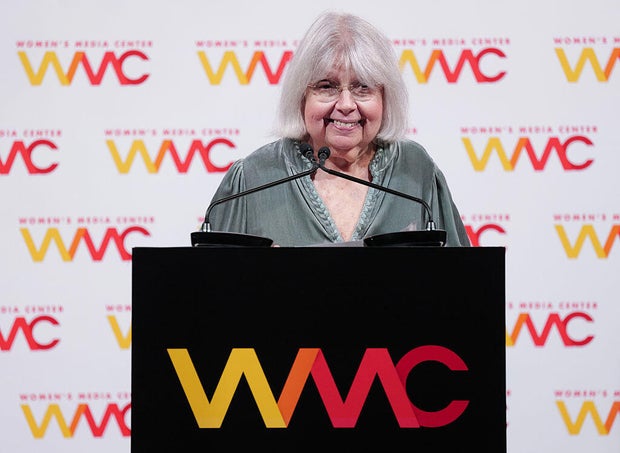
Robin Morgan, a child star turned influential feminist and poet, passed away at 85. Known for her radical activism, she continued writing new books and poems until her death in New York. Her passing occurred just days after the death of Gloria Steinem, a close friend and fellow activist, according to her son, Blake Morgan.
Throughout the 1960s and ’70s, Morgan was a prominent figure in second-wave feminism, challenging societal norms. Dubbed an ‘Ideal American Girl’ during her childhood, she became a trailblazer for justice, with a notable list of achievements, a prison record, and an FBI file.
Her involvement in defining moments of feminist history included organizing the first protest against the Miss America pageant in 1968. She, alongside other activists, aimed to reject the pageant’s values and symbolically discarded items like bras in a ‘Freedom Trash Can.’
In 1970, she edited the influential essay anthology ‘Sisterhood is Powerful,’ becoming a cornerstone of modern feminism. Despite her accomplishments, Morgan viewed herself primarily as a poet and artist, seamlessly blending her creative work with activism.
“She was able to distill big ideas succinctly,” her son Blake Morgan noted, referencing her quote ‘hate generalizes, love specifies.’
Morgan is credited with coining ‘herstory,’ reinforcing women’s narratives within history. Her poem ‘Monster,’ expressing revolutionary desires, was widely quoted at feminist gatherings. Additionally, her poem ‘Arraignment’ reflected the movement’s support for Sylvia Plath and criticism of her husband Ted Hughes, which inspired Sonic Youth’s song titled ‘J’Accuse Ted Hughes.’
Referred to as an ‘anarchist housewife,’ Morgan challenged authority on both political spectrums. In 1970, her activism led to an arrest during a protest at Grove Press, advocating for employees’ rights to unionize.
Her essay ‘Goodbye to All That’ critiqued various libertines and activists, showcasing her dissatisfaction with existing societal norms.
In her personal life, Morgan had relationships with both men and women, and was married to Kenneth Pitchford, a gay poet, for over 20 years. Together, they had a son, Blake Morgan. Their unique relationship was described by her as a ‘two-member commune,’ defying conventional marriage labels.
Her memoir ‘Saturday’s Child’ shared insights into her life, expressing surprise and joy at her journey, alongside maintaining humor. She once quipped, ‘Put that in your apple pie and smoke it.’
In total, Morgan published over 20 books, with works including ‘The Word of a Woman: Feminist Dispatches,’ poetry collections like ‘Monster,’ ‘Dark Matter,’ and followed up with ‘Sisterhood is Global’ and ‘Sisterhood is Forever.’
As editor-in-chief of Ms. Magazine, her role was perceived by Steinem as a versatile contributor to the protest movement. Morgan co-founded feminist groups like New York Radical Women and W.I.T.C.H., enhancing her impact on feminism.
Discontent with the Youth International Party’s treatment of women, she distanced herself from the ‘Yippies.’ In 1984, she established the Sisterhood Is Global Institute—an early feminist think tank—and co-founded the Women’s Media Center in 2005 with Steinem and Jane Fonda, advocating for women’s media presence.
Later in life, she hosted a syndicated radio show and actively engaged in public discourse, despite a Parkinson’s disease diagnosis made 16 years prior.
Born in 1941 in Lake Worth, Florida, she had a challenging upbringing. Her mother falsely claimed her father was dead and altered Morgan’s birth year to enhance her public appeal. By three, she engaged in modeling and had her own radio show by age five, eventually appearing on TV shows like ‘Mama.’
Despite public perception as courteous and ideal, she wrote a poignant childhood poem revealing deep emotions. During a ‘Juvenile Jury’ broadcast, she challenged the notion of punishing children, which led to visible tension with the producer.
Her early adult years included studies at Columbia University, poetry workshops, and active political engagement. She marched for civil rights and against the Vietnam War, encountering prominent poets such as W.H. Auden.
In 1962, Kenneth Pitchford, who would become her husband, described her as possessing endless possibilities during their first meeting. Their partnership reflected her resilience and adaptability in navigating societal expectations and challenges.
 Exploring the Lucas Museum of Narrative Art
  Melanie Griffith Reflects on Wellness Retreat and Career Legacy
  Jennifer Aniston’s Relationship Insights from Relationship Experts
  Kim Kardashian Shares Esophagitis Diagnosis Amid Personal Concerns
  Duncan Sheik, Singer-Songwriter and Broadway Composer, Dies at 56
  Engelbert Humperdinck Reflects on Life-Saving Shoelace During Army Service