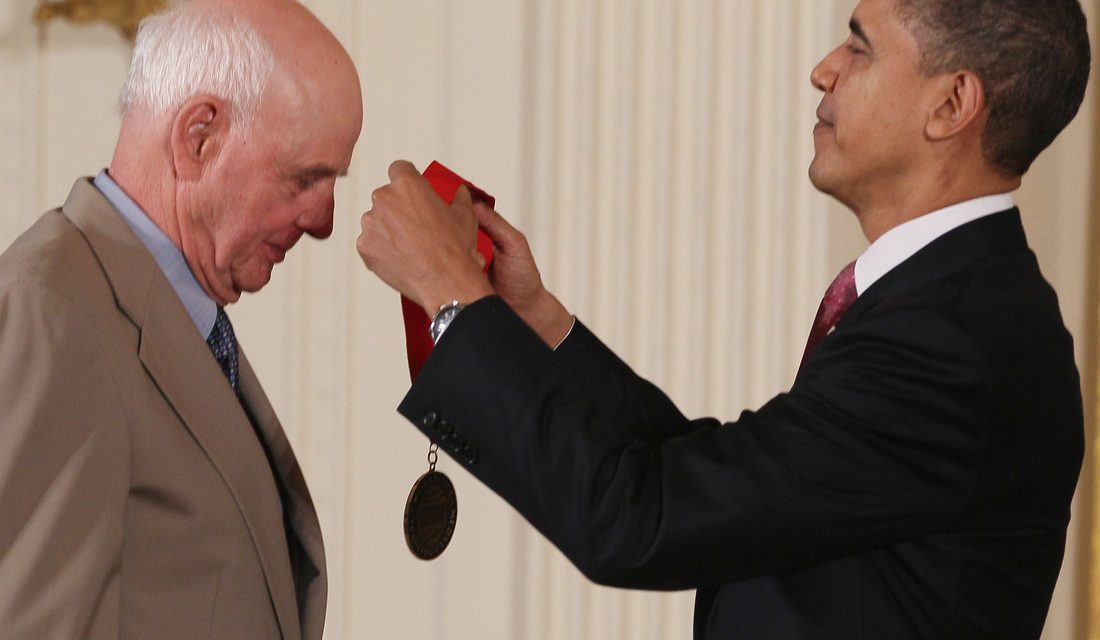
President Barack Obama presented the 2010 National Humanities Medal to Wendell E. Berry during a White House ceremony in 2011. The novelist and poet spent his life farming and writing in Henry County, Kentucky, land farmed by his family for seven generations. Berry passed away at 92 in Port Royal, Kentucky.
Berry’s academic career began after studying at the University of Kentucky and Stanford. He secured a position as an English professor at New York University by age 28. However, city life was not for him. In his 1968 essay A Native Hill, Berry described leaving behind the New York literary scene, returning to Kentucky. He wrote about the choice to reconnect with his home, stating, “I had made a significant change in my relation to the place.” Berry chose to remain in Kentucky for the rest of his life, which he achieved.
His work was highly inspired by the land he farmed in Henry County. Berry was a critic of industrialized farming and had reservations about technology. He opted for hand-writing his work, which he later typed on a typewriter bought in 1956.
Berry’s literary approach involved slowing down to notice the environment, such as in the 2001 poem June Wind: Light and wind are running over the headed grass as though the hill had melted and now flowed.
His poems often incorporated sharp prose to comment on political issues, such as Against the War in Vietnam, published in 1968.
President Obama awarded Berry the National Humanities Medal in 2012, and he was the first living author inducted into the Kentucky Writers Hall of Fame in 2015.
During a 1998 NPR interview, Berry was cautious about advising youth, stating, “I think advising the young about a life course is probably not a responsible thing to do.” Nonetheless, he suggested that young people should find a place to settle, “learn the history of it, and the names of the plants and animals and the neighbors.” Berry’s writings serve as timeless lessons on appreciating and respecting one’s environment.
 Converse Apologizes and Withdraws Controversial Ad Amid Criticism
  Lucas Museum of Narrative Art Unveils in Los Angeles
  Lonnie G. Bunch III Reflects on His Legacy at the Smithsonian
  A Decade of Impact at the National Museum of African American History and Culture
  Urgent Archaeological Efforts in Quinhagak Stay Ahead of Erosion
  Kennedy Center Faces Potential Bankruptcy and Closure Amid Controversies