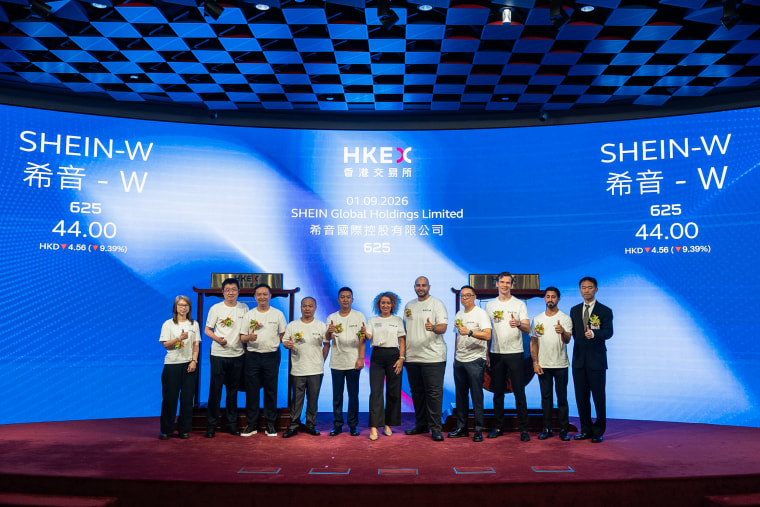
On Tuesday, Shein faced a turbulent entry into the Hong Kong stock market, marking an 8% drop in share value. Investors voiced concerns over the factors hindering its growth. Established for providing affordable fashion items like $5 tops and $10 dresses, Shein has been impacted by U.S. and European tariff changes, disrupting its business model. The company’s planned listings in New York and London were blocked due to scrutiny and Chinese restrictions.
In morning trading, shares were exchanged at approximately 44.6 Hong Kong dollars ($5.68), setting Shein’s valuation at around $24 billion, significantly diminished from its 2022 peak valuation of nearly $100 billion. The Hang Seng Index showed a 0.6% decrease. Shein’s Chief Financial Officer Leigh Gui emphasized the brand’s commitment to innovation and supply chain partnerships at the ceremonial opening of their listing.
CEO Sky Xu, a figure known for avoiding public attention, refrained from speaking at the event but interacted with employees for photos. Xu did not respond to inquiries from Reuters.
“I think the weak debut shows that even after the huge valuation reset, investors still don’t see Shein as obviously cheap,” stated Charu Chanana, Chief Investment Strategist at Saxo Bank.
Chanana compared Shein’s valuation to that of PDD, Temu’s owner. She noted Shein was priced at 15 times expected earnings, unlike PDD, raising concerns about the potential premium investors face amid regulatory and trade uncertainties.
During the IPO, demand for Shein’s stock was relatively low compared to the booming interest seen in AI and robotics sectors. The retail segment was subscribed 5.63 times, while the international segment saw 2.59 times the subscriptions. Historical deals have seen extensive oversubscription, particularly by Hong Kong’s vigilant retail investors.
Shein sold approximately 6.6% of its enlarged share capital through the IPO. Cornerstone investors secured about one-fifth of the offering, subject to a six-month lock-up period, leaving around 5% of shares for free circulation.
The U.S. exit from de minimis duty exemptions for e-commerce shipments under $800 last year affected Shein. The EU followed with similar import tariffs, further complicating Shein’s operations. This led to a 39% decline in net income last year, and a loss in the first quarter of this year.
Shein forecasts a first-half operating profit margin decrease from the first quarter due to elevated customs duties, tariffs, fees, and logistical expenses in Europe and the Middle East.
Equity Research Director Lorraine Tan suggests new market arenas may compensate for slowed growth in the U.S. and Europe, yet warns that delivery cost challenges could limit expansion benefits.
Shein has diversified beyond its core fast-fashion offerings by expanding its marketplace and acquiring the U.S. brand Everlane in May. Their strategy involves providing marketplace and supply chain services to additional brands, similar to their acquisitions of French brand Pimkie and British brand Missguided.
The IPO serves as a mechanism to appease early investors who originally supported Shein at higher valuations. Shein plans to make cash payments equating to $3.5 billion and adjust shares for some preferred shareholders.
“This IPO is not merely a fundraising event — more notably, it is a capital-structure event,” commented Jianggan Li, CEO of consultancy Momentum Works.
 Data Centers in Virginia face Growing Opposition
  Texas Leads Air Taxi Innovation with Project Nexus
  Experts Warn Against Alarmism in AI Governance
  AI and the Changing Nature of Google Searches
  Data Centers Stir Controversy in Texas Amid Growth Boom
  The Technology Rivalry: Trump’s Meeting with Xi and the AI Ecosystem Clash