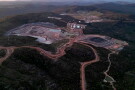
Brazil is gaining attention as a key player in the global quest for rare earths, thus offering an alternative to China’s stronghold. These elements are crucial for numerous technologies, from mobile devices to green energy. This shift is pertinent for countries like the United States and Australia, as revealed by an analysis of mining permits by The Associated Press and Reporter Brasil.
Economic and Environmental Implications
Brazil’s rich rare earth reserves rank second only to China. This could substantially boost its economy. Foreign investors are eager to tap into this potential, with foreign interests accounting for nearly 42% of over 2,700 exploration applications. Most of these investments come from Australia, the U.S., and Canada.
As demand for rare earths climbs, especially after China’s export restrictions last year, U.S. companies are bolstering their roles in Brazil’s mining landscape. America’s involvement includes acquiring Brazil’s sole rare earth producer, Serra Verde. The process of exploration and mining, however, poses environmental risks, particularly in areas near the Amazon rainforest.
Environmental Concerns
Mining activities intersect with ecological priorities, risking environmental damage and impacting Indigenous populations. Nearly 25% of mining applications affect regions that overlap with protected territories. Mining can release toxic chemicals and radioactive waste, threatening local ecosystems.
Efforts are underway to streamline permitting processes, spurred by rising demand. Yet, mining activities still require careful regulation to mitigate environmental harm, with consultations with local communities being essential when Indigenous territories are involved.
International Interests
Mining applications from Australia lead the charts, followed by those from the U.S. and Canada. Australia, with the involvement of companies like Borborema Recursos Minerais, has filed substantial applications within Brazil. U.S. companies, notably Alpha Minerals Brazil, are also making significant strides.
The U.S. is investing heavily, exemplified by the recent acquisition of Serra Verde for $2.8 billion, supported by a $565 million financing package. Additionally, the U.S. Department of Commerce plans to inject up to $1.6 billion into boosting U.S. rare earth interests.
China’s Position
Despite China’s rare earth interests, no Chinese companies have applied for mining in Brazil by mid-2023. Still, China remains a potent player, as shown by their acquisition of Mineração Taboca, Brazil’s largest tin producer, and interest in the Amazon’s rare earth potential.
In response to China’s dominance in processing and refining, Brazilian proposals are emerging, encouraging foreign investments with mandates for technology and processing capacity transfers to Brazil.
“We recognize the need for a diverse critical minerals market,” commented Sophie Davies, Australia’s ambassador to Brazil, emphasizing the importance of diversification in mineral production and trade.
Brazilian President Luiz Inácio Lula da Silva recently highlighted measures to ensure that processing and transformation of these minerals occur domestically, reinforcing national interests.
 Organic Farming with Bokashi in Zambia
  California’s Demographic Shifts: A Closer Look
  Israel Marks Tragic Anniversary Amid Political Turmoil
  Israel Commemorates Third Anniversary of Hamas-Led Attacks
  Immigration Policies and Their Impact on Afghan Refugees in the U.S.
  The Impact of October 7 and Its Aftermath