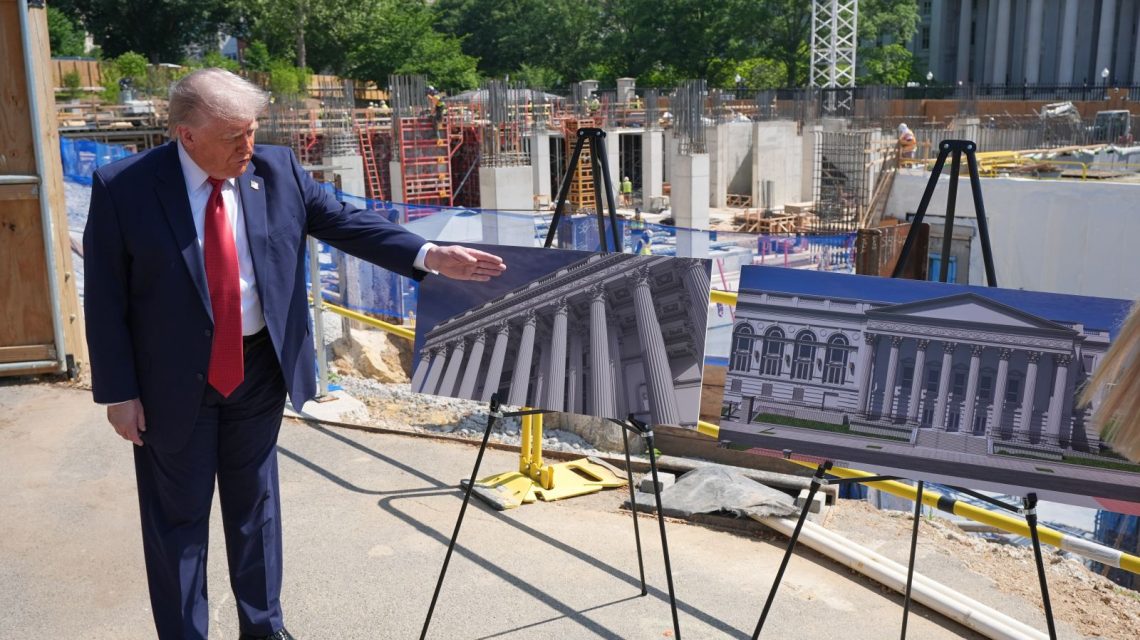
President Donald Trump has accused a historic preservation group of disclosing “top military secrets” related to his White House ballroom project. He labeled its members as “treasonists” while his administration took the issue to the Supreme Court. Through a post on Truth Social, Trump referred to the National Trust for Historic Preservation as the group responsible for the lawsuit against the Military Complex.
Trump did not provide evidence of any classified information disclosure by the nonprofit. He claimed senior military and Secret Service officials had shown the group detailed plans, yet they continued with their lawsuit despite warnings about the “Top Secret nature” of the project.
White House Project Details
The President stated that the new East Wing complex would feature a rooftop “DronePort.” He argued the ballroom and security infrastructure were crucial for protecting presidents, their families, and senior officials. The public Supreme Court filing described various security features, including bomb shelters, sniper positions, missile-resistant construction, and facilities extending five stories underground.
National Trust for Historic Preservation’s Position
The National Trust for Historic Preservation has not directly addressed Trump’s latest accusations but has previously disputed similar allegations. In April, after the Justice Department claimed the organization was shown plans for a “Top Secret” facility, the Trust informed a U.S. District Judge that it did not have access to specific details.
Attorney Gregory Craig, representing the Trust, called the administration’s assertion about the lawsuit’s risk to Trump’s life “incorrect and irresponsible” in an April letter to the Justice Department.
‘Integrated Military Complex’ Legal Dispute
The Trust sued the administration in December, stating the construction lacked congressional authorization and necessary legal reviews. A federal appeals court upheld a preliminary injunction blocking the ballroom’s aboveground construction, while allowing underground facility work to continue.
On Thursday, the administration asked the Supreme Court to halt the injunction while pursuing an appeal. They described the complex as an “integrated military complex” essential to national security. The administration sought a decision before the injunction’s effect on August 21.
The Trust responded, arguing the courts had considered national security facts and urged the justices to deny the stay request.
Supreme Court’s Role
The administration’s emergency application requests the Supreme Court to suspend the lower court’s injunction rather than issue a final ruling on the ballroom’s legality. Solicitor General D. John Sauer also requested an immediate administrative stay before August 21.
The administration contends that it is likely to succeed on the merits and claims irreparable harm if construction stops. They argue Congress has authorized improvements on the White House property, and the project is 65 percent complete. Halting work would cause safety and operational issues, they warn.
Judicial Opinions and Reactions
The D.C. Circuit Court rejected the administration’s view of presidential power. Judges ruled that substantial White House changes require Congress’s approval. They highlighted no historical example of a president using private money for significant demolition and replacement within the White House.
Judge Neomi Rao dissented, arguing the Trust lacked standing and existing laws supported the President’s authority. The administration’s appeal to the Supreme Court relies heavily on her reasoning.
Chief Justice John Roberts provided the Trust until Tuesday to respond to the emergency application. The organization asked the court to deny the request, accusing the administration of expedited construction efforts.
Trump’s Extended Claims
In his Truth Social post, Trump said: “These are the TREASONISTS that brought the suit against the Military Complex. They revealed Top Military Secrets!” He criticized the National Trust for Historic Preservation’s name, claiming it was misleading and suggested a governmental identity.
Trump further argued the group frequently impedes projects and emphasized the suit’s impact on national security and presidential safety. He attributed the organization’s persistence to “Trump Derangement Syndrome,” citing the Democratic Senator John Fetterman.
Trump attacked specific individuals involved, including Carol Quillen, alleging her lack of experience and harmful past decisions. He challenged the involvement of a supposed activist, asserting she lacked the necessary clearance or expertise in national security matters. Trump’s post concluded with criticizing the legal system’s effectiveness.
 Latino Men Shift Away From Trump Ahead of Midterms, Poll Reveals
  Growing Threat of AI-Driven Scams and Deepfakes
  Jonathan Turley Criticizes Protests Targeting Supreme Court Justices
  Amir Odom: Perspectives on LGBTQ Movement and Political Identity
  Exploring Orange County’s Anti-Mexican Political History
  SNL’s Cold Open Highlights GOP Struggles