The Danube Drought Impact
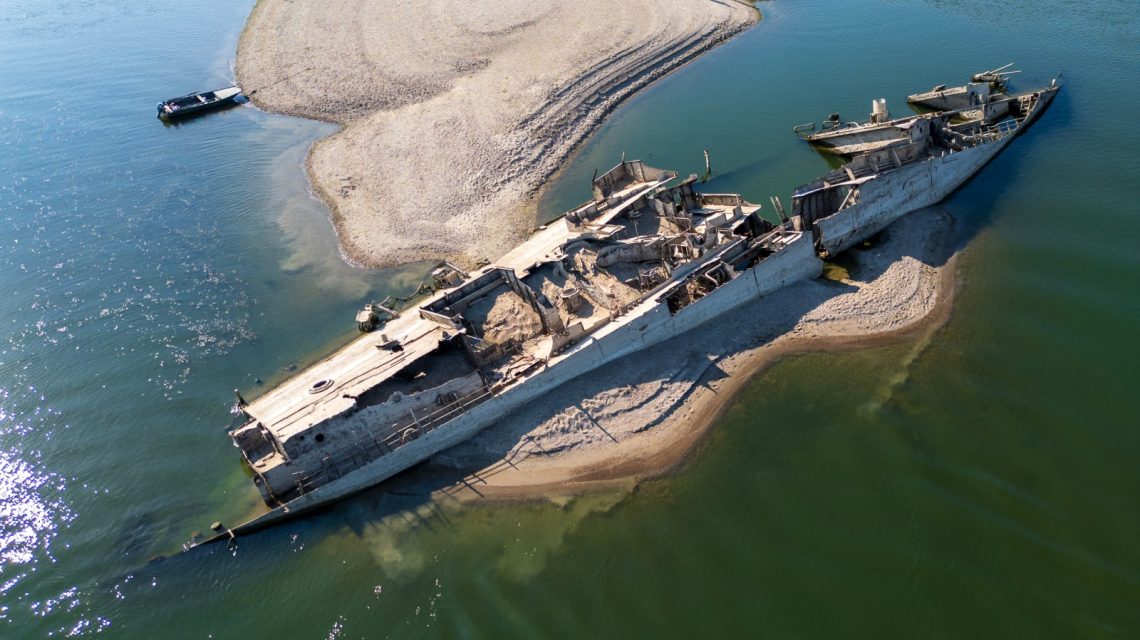
The Danube River, near the Serbian port of Prahovo, reveals a significant history from World War II. Due to drought, the river’s decline has exposed the rusting hulls of German warships scuttled in September 1944 as German forces retreated from the Soviet advance. Eight decades later, this river has gained renewed importance amid the European conflict.
Ukraine relies on the Danube for exporting grain westward when Russian attacks render the Black Sea ports unsafe. However, the Danube’s reduced flow in Romania has disrupted shipping and power generation.
Russia’s Intensified Campaign
Russia is actively targeting Odesa’s ports, vital for Ukraine’s Black Sea exports. Within July, Ukraine experienced 35 attacks on vessels in ports, 22 on ships at sea, and 67 strikes on port facilities. Russian forces attacked the Mayaki bridge linking Odesa to Moldova and Romania on August 9, aiming to disrupt alternative land routes.
The environmental conditions amplify Russia’s campaign. Europe faces extreme heat and drought, which challenges Ukraine’s fallback systems created to counter Russian aggression.
Ukraine’s Resilience and Challenges
Ukraine continuously adapts by creating redundancy systems. When the Black Sea becomes perilous, grain exports shift to rail, road, and the Danube. Power supply disruptions lead to increased reliance on electricity imports from Europe. Irrigation counteracts low rainfall.
Challenges arise when these fallback methods become strained. In August, Anatoly Tikhonov of Russia’s Presidential Academy articulated how a weakened Europe might struggle to source sufficient grain amidst escalating temperatures.
Grain Export Challenges
Russia’s invasion in 2022 hindered Ukraine’s Black Sea ports. Grain subsequently moved through other means, leading to expanded Danube ports like Izmail and Reni. The U.N.-brokered Black Sea Grain Initiative ended with Russia’s withdrawal in 2023, prompting Ukraine to establish a maritime corridor.
The latest Russian campaign tests this system again. Ukrainian Agriculture Minister Taras Vysotskyi stated that over 30 million tons of grain and oilseeds are at risk of failing to reach markets, leading to sharp price drops and soaring transport costs.
Electricity Challenges
Ukraine’s power system has endured intense campaigns, losing significant capacity by mid-2024. A record heatwave compounded the issue, prompting grid operator Ukrenergo to impose emergency power cuts.
Depictions from Kyiv residents reveal daily struggles with power outages, disrupting everyday activities and causing food spoilage due to failed refrigeration.
Amid these challenges, Ukraine managed to become a net electricity exporter by July, although Hungary depended heavily on the drought-affected Danube.
Denoting Infrastructure Vulnerabilities
The Danube’s record-low levels affected Romania’s nuclear reactors at Cernavodă, necessitating emergency measures like dredging. Hungary reviews its Paks 2 expansion’s reliance on the Danube, enhancing plans for wind capacity.
Fire Concerns
The 2024 fire season significantly impacted Ukraine. Over 965,000 hectares burned, driven partially by climate and military activities. Shelling, missiles, and remnants of war hindered firefighting efforts.
Water Infrastructure Woes
Southern Ukraine faces severe water challenges. The Kakhovka dam’s destruction in June 2023 deprived 500,000 hectares of irrigation, risking desertification. The dam also cooled Zaporizhzhia’s nuclear plant, Europe’s largest.
Emergency wells proved insufficient, highlighting infrastructure reliance on consistent water supply.
Russia’s Climate Risks
Russia encountered climate challenges of its own. In 2025, crop losses in Rostov prompted agricultural emergencies at a national level.
As Tikhonov’s essay suggests, Russia’s strategy is to mitigate these vulnerabilities better than rivals, thus securing commercial and political gains.
The dual threats on Ukraine’s alternatives reflect broader systemic risks that hotter and drier conditions might exacerbate.
 Controversy Surrounds Adam Brody’s Genocide Comment
  Challenges Loom Over Colorado River’s Water Levels
  Historical Discrepancies and Diplomatic Sensitivities in U.S.-China Relations
  Escalating Tensions: Russia’s Nuclear Threat and the Kaliningrad Conundrum
  Suncor v. Boulder: Understanding the Supreme Court Case and Its Implications
  Marco Rubio Discusses Thwarted UK Terror Plot and Global Threats