
A year ago, President Trump declared a “crime emergency” in Washington, D.C., claiming without evidence that the city was plagued by violent gangs, roving mobs, and criminal activities. In response, Trump deployed about 800 members of the D.C. National Guard and over 1,000 National Guard members from other states to address this alleged crisis.
A year has passed, and 4,600 troops now patrol the city, contrary to the wishes of the District’s elected local government. This deployment breaks long-standing American traditions, threatens public safety, and has cost taxpayers hundreds of millions of dollars without significantly affecting violent crime rates. Yet Trump insists on maintaining the troops, hoping the public will lose interest. This must not happen.
The Weak Foundation of Crime Emergency Claims
From the outset, Trump’s assertion of a “crime emergency” was unfounded. In reality, the murder rate decreased from 274 in 2023 to 187 in 2024. Even if crime had risen, it would not justify using emergency powers meant for sudden crises beyond the capability of regular systems.
Urban crime is an ongoing issue that should be tackled with conventional government methods. Using the military raises significant concerns. No precedent exists for a president deploying troops to manage street crime, violating centuries of civic traditions. Americans have traditionally opposed military involvement in civilian affairs, fearing it could lead to tyranny.
Concerns About Military Involvement in Civilian Life
Military deployment within the country should only occur when civilian authorities are unable to cope. Different concerns also arise when military operations occur domestically. Soldiers, including National Guard members, are trained for combat, not policing. Few have training in local criminal law or constitutional rights. Instances have occurred where guard members wrongly detained residents and used unnecessary force.
Questionable Impact and Rising Costs
The deployment has not fulfilled its purpose. Minor reductions in property crime occurred initially, but recent analyses show minimal effect on violent crime. Meanwhile, the cost of maintaining this deployment exceeds $3 million daily. A new $292 million deal to house National Guard members will further escalate expenses.
Despite these costs, guard members often engage in “presence patrols,” standing idly at various locations. Trump persists with this policy, increasing guard numbers to nearly 5,000 and planning to maintain them until January 2029, with an additional cost of $1.4 billion.
The Extended Deployment’s Implications
The projected duration questions the nature of the emergency. No genuine crisis could predictably last for over two-and-a-half years. The deployment seems intended to normalize inappropriate military use as a policing force.
This brings concerns about potential military involvement in civilian matters, such as protests or future elections. The sight of troops in the capital coinciding with the 250th anniversary of the Declaration of Independence is a stark reminder of the founding opposition to peacetime standing armies without legislative consent.
Trump’s actions threaten to make military presence a norm. Americans must reject this shift and demand the end of the deployment.
Joseph Nunn is a counsel in the Brennan Center’s Liberty and National Security Program. He specializes in the domestic activities of the U.S. military.
Copyright 2026 Nexstar Media Inc. All rights reserved. This material may not be published, broadcast, rewritten, or redistributed.
 Arizona Governor Hobbs Announces Former Republican as Running Mate
  Count Binface: A Satirical Run Against Nigel Farage
  Trump’s Executive Order to Combat Birth Tourism
  Historic Preservation Agency Overhaul Threatens Landmarks
 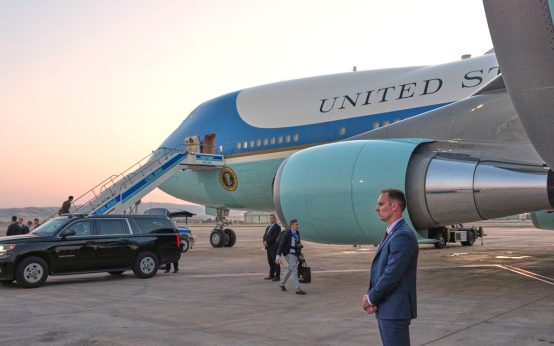 President Trump’s Covert Flight Amid Security Concerns
  Complex Strategies and Political Shifts: A Recap of Recent Developments