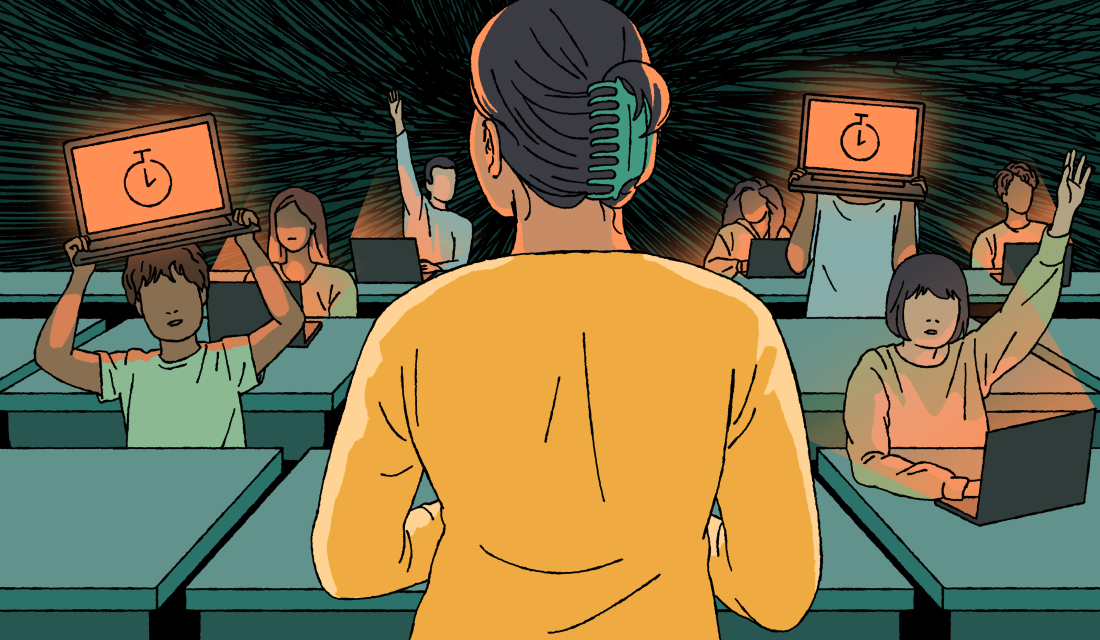
This school year presents a fresh challenge for Armaghan Khan and other teachers in Los Angeles Unified School District (LAUSD), the nation’s second-largest. The district has decided to eliminate screen time for young students and significantly limit it for older ones. Khan, a science teacher at Johnnie L. Cochran Middle School, notes, “This is going to be a big impact for me.” Approximately 75% of his teaching involved screens.
Khan previously relied on technology in his classes. It enabled students to perform experiments like car crash simulations on laptops to grasp Newtonian forces. “My hands are kind of tied,” Khan explains, due to limited lab resources.
Similar restrictions are being adopted by other districts and states. However, the swift implementation in LA, affecting over 400,000 students, stands out. The school board decided last spring. Starting this week, 1st graders will experience no screen time. In November, limits will apply to other elementary grades, with middle and high school students affected later in the year.
This policy marks a shift for LAUSD, once a leader in classroom technology. Khan was surprised by the policy and the lack of support, stating, “I don’t feel like I’m being set up for success.”
A Rapid Rollout
Pia Sadaqatmal, the district’s new chief academic officer, oversees these regulations. “There is no perfect solution on how to roll out to a school district the size of ours,” she acknowledges. She encourages viewing this as a transition year, with gradual improvements expected. “We are among the first school districts nationwide to adopt this scale,” Sadaqatmal adds. “We know we are learning as we go.”
Students will have software on tablets or computers tracking weekly screen time. Although the software doesn’t shut devices once limits are reached, it compiles data for district evaluation. The goal is to refine the rules based on this data, understanding what succeeds and what doesn’t. Some items, like virtual textbooks, are exempt, but teachers are working to categorize other materials.
Addressing the Gaps
“I have more questions than immediate concerns,” shares Kirti Baranwal, a teacher librarian at William Jefferson Clinton Middle School. In her 28th year with the district, she regards screen time limits as generally beneficial. Last year, cell phones were banned by the district, following a national trend. Baranwal engaged students with a screen addiction lesson, revealing many logged 8 to 10 hours of screen use daily, despite the ban. “And I was like, when are you sleeping?” she asks.
Research suggests that children lacking extracurricular engagement often resort to screen time outside school hours. Baranwal, similar to Khan, questions simply unplugging. Baranwal asks, “What is it that we want kids doing?” With the academic year underway, LAUSD seeks to find out.
 Understanding Misperceptions and Inaction in Sexual Assault Prevention
  Understanding the Impact of Race-Conscious Admissions Changes on College Enrollment
  Cornell University Faces Scrutiny Over Handling of Sexual Assault Case
  Gen Z Freshmen Opt for Online Classes Over Traditional Campus Life
  Democratic Governors Under Pressure to Join Federal School Choice Program
  Former Cornell Instructor Speaks on Sexual Harassment