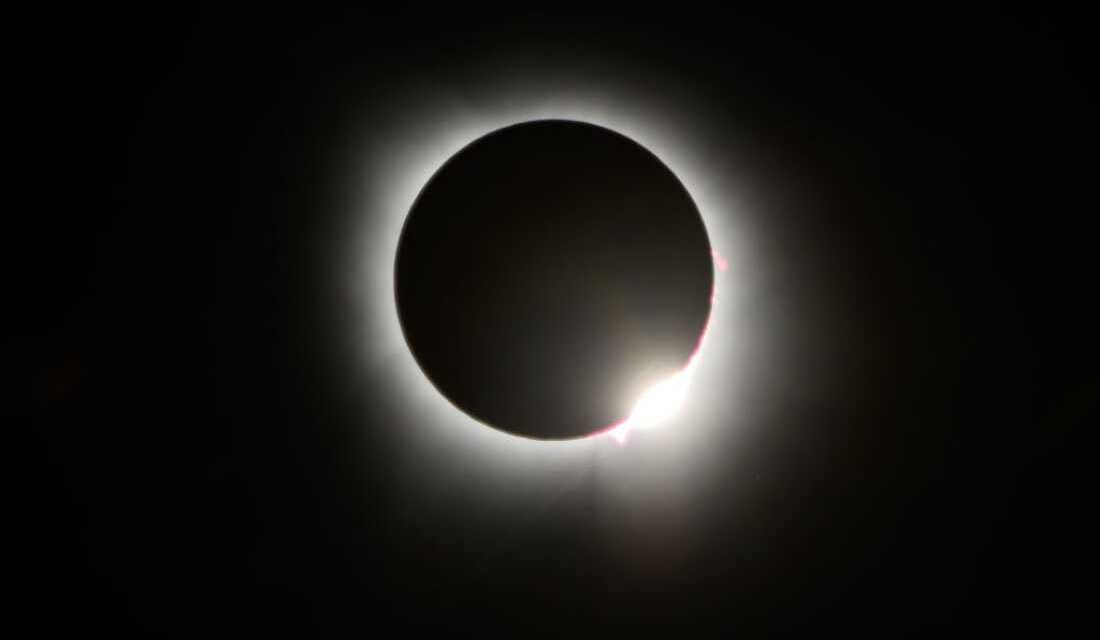
A total solar eclipse will captivate observers as the Moon crosses in front of the Sun on April 8, 2024, at Lake Monroe, Indiana, USA. This celestial event, captured in images by Edward M. Pio Roda for Getty Images, offers a remarkable chance for skywatchers in Europe and parts of the United States to witness a solar eclipse.
In Iceland, Greenland, northern Russia, as well as parts of Spain and Portugal, people will witness a total eclipse. During this event, the moon completely blocks the Sun’s face, a phenomenon that intrigues astronomers. For those in the northern regions of the United States, from Alaska to North Carolina, a partial solar eclipse will be visible.
A partial solar eclipse occurs when the Moon passes between the Sun and Earth without perfect alignment. As a result, only parts of the Sun are obscured, creating a crescent appearance. In Washington, D.C., the partial eclipse will start around 1:17 p.m. ET, with 4% of the Sun covered by the Moon, as noted by NASA.
In Reykjavík, Iceland, the total eclipse begins at 5:48 p.m. local time. Meanwhile, in León, Spain, totality will commence at 8:28 p.m., lasting for two minutes. This event marks the first solar eclipse visible from Spain’s mainland since 1905, according to the European Space Agency.
For viewing the eclipse, special eclipse glasses or handheld viewers with filters are essential to safeguard your vision. Regular sunglasses will not protect your eyes effectively, even during a partial eclipse. The American Academy of Ophthalmology warns that looking at the Sun, even briefly, can inflict significant eye damage, including burns and vision loss.
This eclipse not only fascinates skywatchers but also presents scientists with an opportunity to study the Sun. NASA plans to deploy scientific balloons and a high-altitude jet to analyze how a briefly darkened sky impacts Earth’s atmosphere. Kelly Korreck, NASA’s eclipse program manager, highlighted that during a total solar eclipse, Earth’s unique perspective enables the study of the Sun’s corona unlike any other vantage point.
The next partial solar eclipse visible across parts of the U.S. will occur on August 2, 2027, while totality views will be available in Spain, the Middle East, and parts of North Africa. Additionally, a total solar eclipse will grace parts of the contiguous U.S. on August 23, 2044.
 Investigating France’s Student Protests: A Web of Far-Left and Socialist Influences
  Recovery of Stolen Renoir Paintings
  Washington’s Strategic Choices Amidst Gulf Tensions
  Nobel Peace Prize Awarded to Navi Pillay
  South Africa Withdraws Asylum Order After Protests
  Escalating Conflicts and Diplomatic Efforts in the Middle East