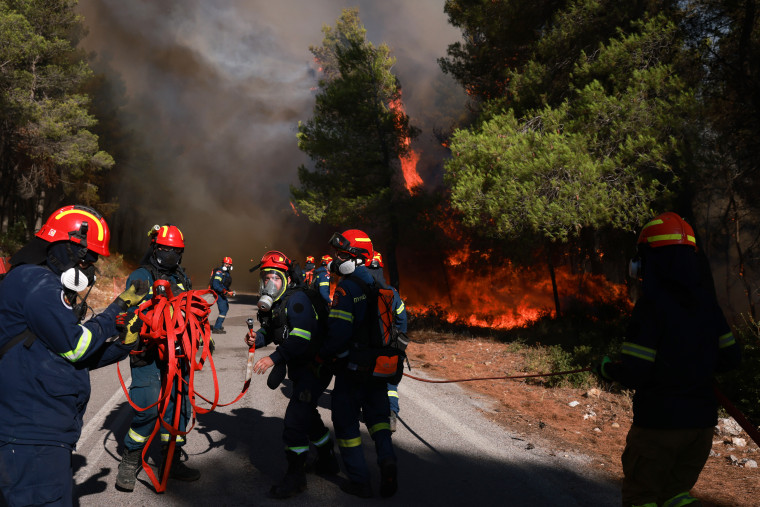
Greek firefighters are working tirelessly to control a massive wildfire that has destroyed over 100 homes northwest of Athens. Another blaze has led to evacuations on Kefalonia, a popular tourist destination. Europe is grappling with intense wildfires following record-breaking heatwaves and minimal rainfall, which scientists link to climate change.
In France and Spain, fires showed signs of calming down, but Greece is now facing fresh outbreaks. Previously calm conditions have been disrupted by these new fires. Strong winds, which had fueled the fire around Porto Germeno, have weakened. Yet, the flames have moved south, reaching the settlement of Veniza and a military firing range, interacting with unexploded ordnance.
Nearly 500 Greek firefighters are fighting the blaze, using vehicles, heavy machinery, and aircraft. France and Romania have sent reinforcements to support Greece’s efforts. In the village of Agios Konstantinos, residents, including Tasos Tzempelikos and his son, are actively working to stop the fire’s spread by pouring water on it. Local media reported that efforts aim to prevent the fire from reaching the nearby town of Megara. The fire has likely destroyed more than 38 square miles of land so far.
On Kefalonia, several settlements were evacuated as a fire broke out in the Pastra area overnight.
In France, authorities observed minor flare-ups in the Gironde area. The fire in the Var department did not spread further overnight.
Central Spain’s wildfires, affecting tens of thousands of hectares the past week, are mostly under control. Firefighters continue to manage sporadic re-ignitions. In Caceres, a forest fire prompted the evacuation of about 800 people. While they returned home by Sunday, they remain confined due to ongoing fire activity.
Other European nations face drought and low water levels in major rivers such as the Rhine and the Danube. Hungary recorded the Danube’s lowest levels in history, affecting multiple countries, including Serbia and Romania. Prime Minister Péter Magyar warned of a critical period for Hungary as reduced water levels led to the shutdown of the country’s sole nuclear power plant, the first in over four decades, anticipating another heatwave.
Lower water levels have disrupted shipping and tourism in Hungary, and more than 100 cities are experiencing water-use restrictions. In Serbia, declining Danube levels have reduced the daily output of the largest hydropower plant to 20%, according to the country’s energy minister.
 California Prepares for El Niño-Fueled Storms with Emergency Declaration
  California’s Growing EV Adoption: Challenges and Benefits
  Data Centers in Virginia face Growing Opposition
  EPA Dismantles Greenhouse Gas Rules, Causing Concern
  How Battery Innovations Transform Renewable Energy
  Data Centers Stir Controversy in Texas Amid Growth Boom