On July 29, 2026, a magnitude-7.1 earthquake struck southwestern Japan, resulting in at least 13 deaths, according to Prime Minister Sanae Takaichi. Rescue teams are actively searching for survivors at a shopping mall and paper mill. Prime Minister Takaichi stated, “Even now, there are people waiting to be rescued, and this is a race against time. We will marshal all available resources on the ground to save and rescue as many people as possible.”
The earthquake occurred Tuesday afternoon in Kumamoto prefecture, located on Japan’s southern main island of Kyushu. It struck at a shallow depth of 6 miles, leading to tsunami warnings and prompting evacuations from coastal areas. The epicenter was situated about 12 miles south of Kumamoto city, which has a population of around 700,000.
Although the tsunami warning was quickly lifted, the quake caused significant damage across the prefecture. Historic buildings, such as Kumamoto Castle, suffered extensive damage. This site, a popular tourist attraction, was still undergoing repairs from a previous deadly quake in 2016. Roads were ruptured, thousands of homes lost power, and authorities cautioned residents against heat stroke, as temperatures soared into the 90s.
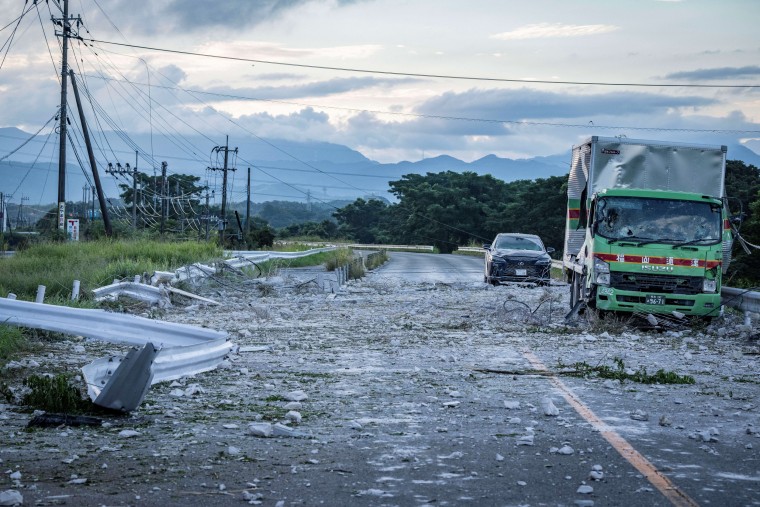
A debris-covered road revealed damaged vehicles following an explosion at the Aeon mall in Kashima, Japan. Two women in their 20s lost their lives at the partially collapsed mall near Kumamoto. Eight people have been rescued from the wreckage. Mall officials reported that four individuals remain missing, and the cause of the explosion is under investigation.
Seven individuals are missing after a chimney collapse at the Nippon Paper Industries factory in Yatsushiro city. Thousands of soldiers have been dispatched to aid rescue operations across the affected regions. Hospitals are treating dozens of injuries, including those of high-speed train passengers. Train services in Kyushu were halted immediately post-quake.
A freight train derailed at Yatsushiro station due to the intense shaking. NHK’s aerial footage showed overturned carriages and collapsed pillars at the Yatsushiro Shrine. Bullet trains and certain airport operations remained suspended, while about 35,000 homes were still without power, according to Kyushu Electric Power.
Japan’s meteorological agency alerted the public about the possibility of further quakes of similar magnitude. It stated, “For the next week or so, especially the next two to three days, we would like people to watch out for potential earthquakes with a maximum seismic intensity of 7.”
No damage was reported at nuclear reactors within the area. Japan’s nuclear authority notified the International Atomic Energy Agency that the Sendai nuclear power plant was unaffected. The IAEA indicated continuous monitoring of the situation.
Japan’s nuclear plants are scrutinized during earthquakes following the 2011 disaster when a 9.1-magnitude quake and subsequent tsunami caused meltdowns at three Fukushima Daiichi reactors. Japan, situated on the “Ring of Fire,” experiences frequent earthquakes and volcanic eruptions. Nearly 20% of global earthquakes measuring 6.0 or higher occur in Japan.
 Tensions Escalate in Iran Conflict as Global Leaders Weigh Options
  White House Approves F-35 Sales to Saudi Arabia Amidst Regional Tensions
  Inside the Secret Deals Powering the President’s Push to Deport Migrants to Countries Not Their Own
  Navigating the Challenges of Third-Country Deportations
  Midair Altercation on Bangladesh to London Flight
  Ukraine Missile and Drone Barrage Hits Russia Amidst Elections