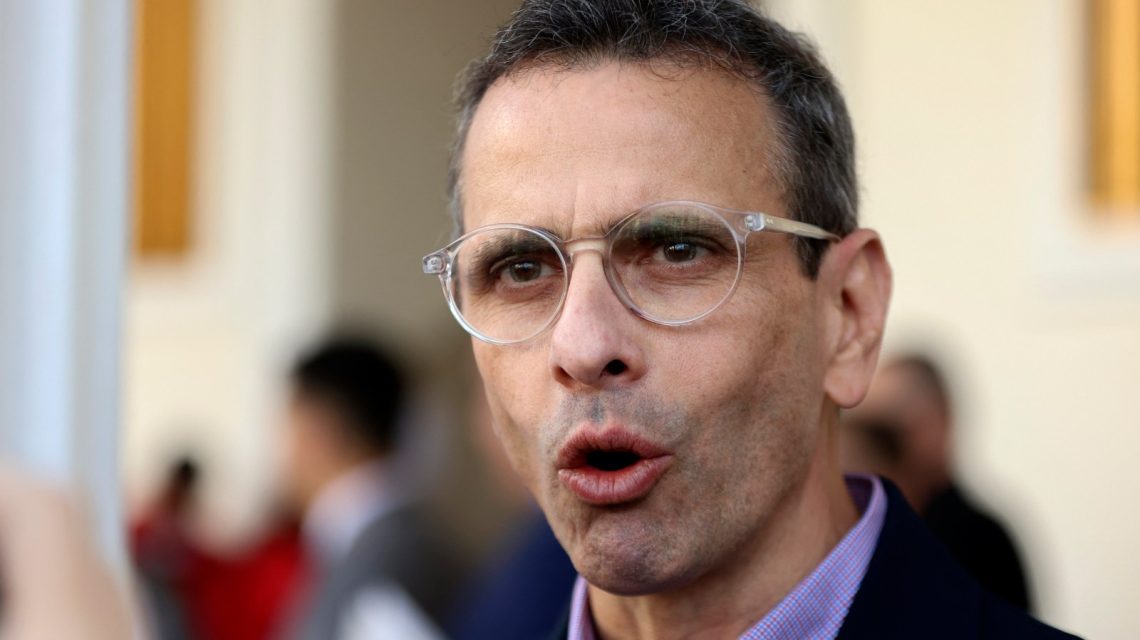
Henrique Capriles, a notable Venezuelan opposition leader, has twice sought the presidency and posed a significant challenge to Chavismo. With a U.S.-engineered transition underway in Caracas, Capriles offers insights on Washington’s role, differing from common perceptions.
Amid shifting U.S. policy under President Trump toward Venezuela’s interim President Delcy Rodríguez, Capriles, now a National Assembly member, emphasizes discerning Trump’s public statements from actual policy actions. In an interview, he remarked on Trump’s inconsistent messaging, advising caution in interpreting his statements as decisive actions.
Following a significant January 3 operation, where U.S. forces seized President Nicolas Maduro, Trump initially threatened Rodríguez with repercussions. However, his tone later shifted to praise for Rodríguez and support from Washington in legal matters. Capriles views Trump’s unpredictable messaging as a pattern, illustrating with pre-raid communications between Trump and Maduro despite rising tensions.
Capriles acknowledges Trump’s decisive action in removing Maduro when elections failed. The contested July 28, 2024 election, where Maduro claimed victory, is noted by independent observers, like the Carter Center, as a loss to opposition candidate Edmundo González.
“Flowers, sanctions, none of that got rid of Maduro either. The game was completely locked. And then Trump came in and did what he did,” Capriles stated.
A Gamble Pays Off
The January 3 operation, named Operation Absolute Resolve, involved U.S. Special Forces capturing Maduro and his wife, Cilia Flores, from Caracas. They were charged in New York on narco-terrorism and other counts, with trials set for 2027.
Capriles speculates the operation might have been avoided if Maduro conceded the 2024 election. He reflects on the unexpected nature of Washington’s military intervention in 2025, crediting Trump with a successful gamble that led to change.
After Maduro’s removal, Rodríguez was installed as interim president, marking her as Venezuela’s first female in presidential power. This was part of a U.S.-outlined three-phase plan for stabilization, recovery, and political transition, led by Secretary of State Marco Rubio.
Capriles commends Trump for his role in Maduro’s ousting and highlights the ongoing political shift driven by Rubio, rather than Trump’s declarations.
The Sovereignty Debate
U.S. involvement has spurred criticism beyond Chavista circles. The operation was labeled an assault on Latin American sovereignty by Colombian President Gustavo Petro. Reports describe Rubio’s significant influence in Venezuelan political affairs, urging purges of Maduro-aligned officials and policy moderation.
Capriles disputes the loss of sovereignty narrative, arguing past rhetoric served power in Caracas over citizenry. He downplays fears of U.S. control, anticipating a future of bilateral relations.
Despite economic dimensions, Capriles stresses that measuring the transition by revenue overlooks the long-term democratic development and electoral renewal necessary in Venezuela.
Rubio’s Three-Phase Plan
Rubio introduced a three-phase transition beginning with stabilization, advancing to recovery, leading to comprehensive change. Talks starting August 1 signify the plan’s progression.
Internal opposition divides have surfaced, with figures like María Corina Machado and Edmundo González criticizing the exclusion in transition design. Capriles, despite past differences, underscores the necessity of integrating Machado’s perspective in negotiations.
Capriles clarifies the reluctance of Venezuela’s political class to confront U.S. policy, emphasizing a preference for progress over reverting to Maduro’s era.
He differentiates Rodríguez’s interim role from legitimate governance, emphasizing her appointment as temporary and administrative rather than an expression of popular will.
Challenges from Natural Disasters
Venezuela’s transition faced unforeseen challenges. Twin earthquakes in La Guaira claimed thousands of lives, disrupting emerging economic recovery post-Maduro. Capriles highlights the setback’s impact on the country’s fragile stabilization.
Despite securing IMF aid, the earthquake revealed Venezuelan unity beyond political divides, showcasing resilience and an evolving national cohesion.
Addressing reconciliation, Capriles stresses institutional accountability over retribution, advocating for a robust judiciary to ensure lasting justice and deter past authoritarian practices.
Contact Newsweek editors on this story: Jason Lemon and Sam Wilson.
 Don McCullin’s Final Book: A Pioneering War Photographer’s Legacy
  Rep. Alexandria Ocasio-Cortez Defends Macklemore Amid Tour Controversy
  Google Fined for Breaching EU Privacy Rules
  South China Sea Tensions Rise after Collision between Chinese and Philippine Ships
  North Korea’s Hypersonic Weapon Test Amid Global Tensions
  Austin Tice: A Search for Answers