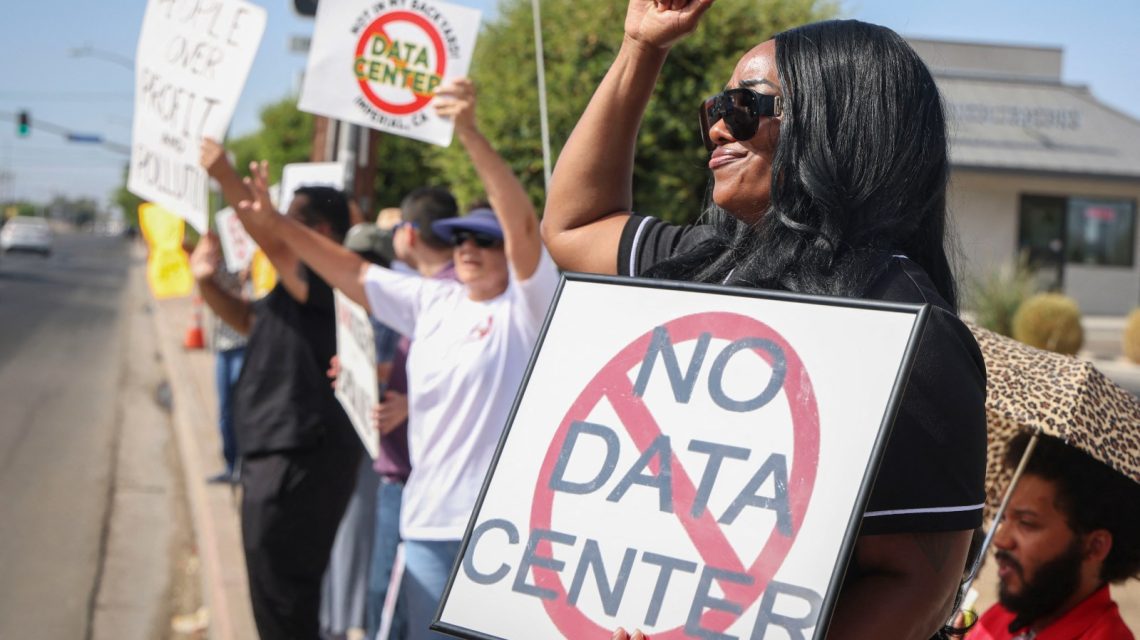
According to a recent Emerson College poll, 63 percent of U.S. voters now oppose the construction of AI data centers in or near their communities. This is a significant increase of 21 percentage points since December 2025, signaling a shift in public sentiment against a technology once touted for its potential economic benefits.
Public Sentiment on AI Data Centers
The Emerson College poll, conducted between July 19 and 20 among 1,100 likely voters for 2026, reveals that a majority of Americans are more concerned (63 percent) than excited (14 percent) about artificial intelligence. A smaller portion, 22 percent, remain neutral. When focusing on the facilities necessary for AI and machine learning, skepticism increases among more educated voters.
Findings show that 79 percent of those with postgraduate degrees oppose AI data centers, up 27 points since December. Among individuals with college degrees, 72 percent express opposition, marking a 25-point rise. For those with a high school education, 37 percent are against such developments, a 9-point increase.
Overall, only 27 percent support AI data centers in their community, with 10 percent neutral on the matter.
Additional Survey Insights
A Redfin survey conducted in May informs us that 53 percent of U.S. residents oppose building a data center nearby. Meanwhile, 34 percent support such developments. It highlights generational differences—65 percent of baby boomers and 60 percent of Gen Xers oppose their construction, whereas opposition is lower among Gen Zers (42 percent) and millennials (43 percent).
“A buyer recently asked me, unprompted, to make sure there wasn’t a data center planned near a home she was considering,” stated Matt Ferris, a Redfin agent in northern Virginia.
Many residents fear the impact on noise, traffic, water, and electricity usage, along with potential changes to neighborhood character. The perception is that data centers could negatively alter communities.
Data Center Opposition Movement
Local opposition to AI data centers is growing, with at least 430 groups in 40 states mobilizing online. Since December, these groups have grown significantly in members.
State Responses to Data Center Growth
Previously, states offered tax incentives to attract AI data centers. However, concerns over resource demands and community impacts have led to a change in approach. New York recently announced a one-year freeze on new hyperscale data centers as it develops environmental standards. Other states like Maine and Virginia have tried implementing moratoriums, facing varying success.
Oregon has prevented new data centers from entering its major Enterprise Zone tax-break program, pending further study. Illinois proposed the POWER Act to regulate large data centers more stringently. States including Delaware and Pennsylvania are also considering restrictions.
Benefits of Hosting Data Centers
Despite opposition, data centers bring certain benefits to host communities. Redfin analyzed financial records and found that Virginia’s Loudoun and Prince William Counties, major data-center hubs, have seen strong growth in education spending. Computer equipment in data centers constitutes the largest personal property tax revenue source in these counties.
Over 15 years, Loudoun County’s personal property tax revenue per resident surged 639 percent and 349 percent in Prince William County. Education spending per resident increased by 82 percent in Prince William and 77 percent in Loudoun. A report from the Federal Reserve Bank of St. Louis indicated that the AI construction boom has stimulated local economic activity in these areas.
Contact Newsweek editors on this story: John Fitzpatrick and Shakeema Edwards.
 Experts Warn Against Alarmism in AI Governance
  AI and the Changing Nature of Google Searches
  Data Centers Stir Controversy in Texas Amid Growth Boom
  The Technology Rivalry: Trump’s Meeting with Xi and the AI Ecosystem Clash
  Ways to Protect Your Finances from Cyber Threats
  Interview with Nvidia CEO Jensen Huang: AI Outlook and Business Strategy