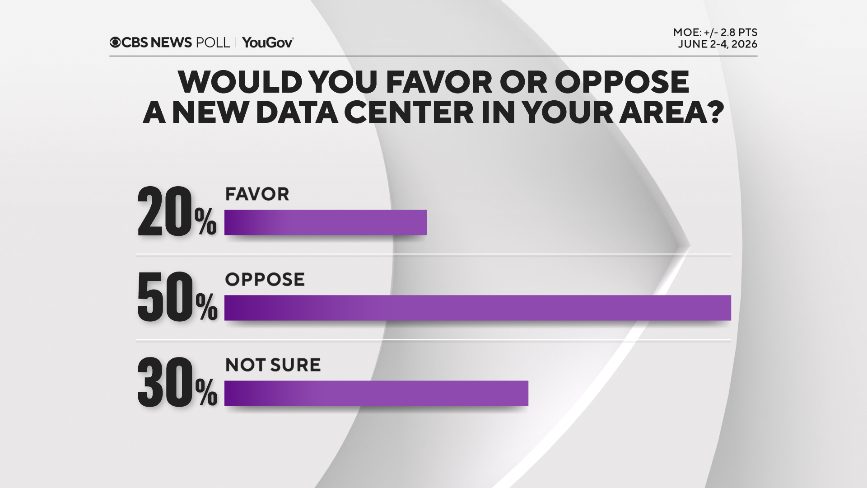
Many Americans express skepticism about accommodating data centers in their areas. This sentiment often stems from concerns over potential negative environmental and resource impacts.
The pace of data center construction in the U.S. has increased recently. However, a significant number of Americans feel uninformed about these facilities. This unfamiliarity contributes to their discomfort about having a data center nearby. Regardless of their knowledge level, most Americans are generally disinclined to support local data centers. Those who know less about them are even less likely to favor such developments.
Overall, more than twice as many Americans oppose than favor the construction of new data centers locally.
The minority, 16%, who claim extensive knowledge on the subject recognize some local advantages. Still, they are more likely to oppose than support having one in their vicinity. Conversely, those oblivious to data centers mainly express uncertainty about welcoming such projects.
The nation’s opinion is split on the necessity of more data centers to keep the U.S. competitive in technology and AI. Those supporting local data centers strongly believe they are vital for competitiveness. While more Republicans than Democrats view data centers as important for staying competitive, even amongst them, many are hesitant about proximal developments.
Overall, majorities view data centers as detrimental to the environment, resource consumption—specifically water and electricity—and local energy or utility costs.
On a brighter note, slightly more Americans perceive data center construction as beneficial for local economies and tax revenue. Those who foresee these economic benefits are more likely to support than oppose these establishments. Specifically regarding employment, half of the surveyed Americans believe data centers enhance short-term job opportunities, though fewer anticipate long-term job growth.
Sizable percentages admit to being “not sure” on several local impact questions, highlighting the unfamiliarity of data center topics among Americans.
This CBS News/YouGov survey sampled 2,023 U.S. adults between June 2-4, 2026. It reflects a nationally representative demographic profile, considering gender, age, race, and education, alongside the U.S. Census American Community Survey and Current Population Survey benchmarks, including the 2024 presidential vote. The margin of error rests at ±2.8 points.
 Briahna Joy Gray Accuses Alexandria Ocasio-Cortez of Misrepresenting ‘Woke 1 Was Crazy’ Comment
  Concerns Over Trump’s Impact on Politics and Christian Witness
  The American Dream: Preserving Freedom for Future Generations
  Readers Express Views on AI, Historical Associations, Endangered Species, and Genetic Testing
  Athlete Controversy: The Case of Sophie Cunningham
  Elon Musk: The Fifth Musketeer in Modern Geopolitics