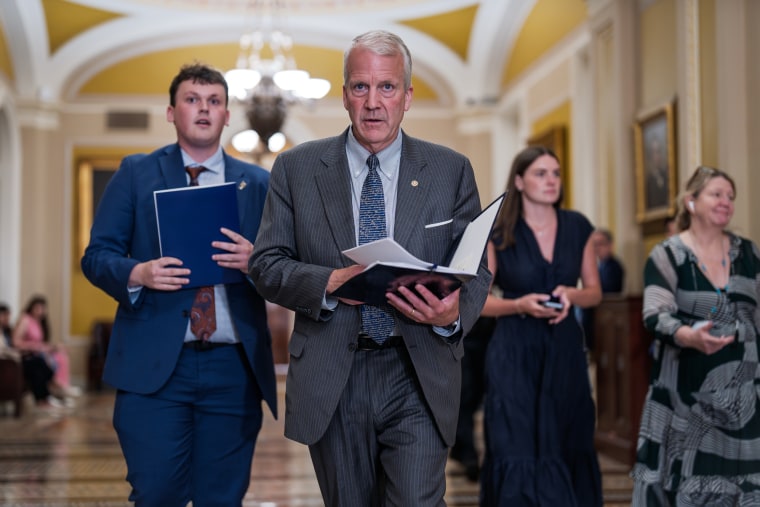
In Juneau, Alaska, a man sharing the name and political affiliation of Republican U.S. Senator Dan Sullivan has challenged a decision by a state elections official to disqualify him from the August primary ballot. The challenger, also named Dan Sullivan and a retired teacher from Petersburg, argues that the decision by Division of Elections Director Carol Beecher violates both state and federal law. His attorneys have filed a court petition to have him reinstated on the ballot.
The U.S. Constitution specifies three qualifications for Senate candidates: age, citizenship, and residency. The attorneys for the challenger, including Jeffrey Robinson, Bryn Pallesen, and Zoe Eisberg, argue that Alaska law does not govern individual motivations for declaring candidacy.
Senator Dan Sullivan is a key figure in one of this year’s most significant Senate races. Days before the filing deadline on June 1, the challenger’s entry drew criticism from Sen. Sullivan and the National Republican Senatorial Committee. They branded the challenger a ‘sham candidate,’ alleging collusion with Democrats to benefit Democratic ex-Rep. Mary Peltola’s campaign. These claims have been denied by all involved, including the challenger Sullivan.
Sen. Sullivan and Peltola are among over a dozen candidates in this important U.S. Senate race. The outcome is crucial to both parties in their bid to control the chamber. Steve Kirch, a spokesperson for the elections division, declined to comment on the case, while Alaska Department of Law spokesperson Sam Curtis stated the agency will support the division’s decision in court.
A week after Republican Lt. Gov. Nancy Dahlstrom initiated an investigation into the challenger’s candidacy, Beecher disqualified him on June 15. Beecher determined that the challenger did not file a genuine candidacy and sought to confuse the ballot’s integrity. Dahlstrom emphasized the ‘credible allegations’ of coordinated efforts to deceive voters, yet Beecher found no evidence linking the challenger to Peltola or Democratic officials.
In an interview, the challenger Sullivan denied any contact with Peltola’s campaign. Beecher cited his voter registration as Daniel J. Sullivan Jr., a recently changed Republican party affiliation, and similarities between his campaign site and Sen. Sullivan’s. She noted his association with a consultant who has worked with Democrats.
The form completed by congressional candidates in Alaska includes optional fields for ballot name and party affiliation. Beecher adhered to a regulation against misleading voters with confusing ballot names. However, legislative attorney Andrew Dunmire clarified that this regulation does not preclude the placement of Sullivan’s name on the ballot, suggesting a differentiated ballot design to distinguish between both Sullivans.
Initially, the state certified the challenger as Dan J. Sullivan, while the senator appeared as Dan S. Sullivan and was marked as the incumbent. Alaska’s open primaries allow the top four candidates, irrespective of party, to proceed to a ranked-choice general election.
 Mayor Mamdani and President Trump Discuss Major Housing Project in NYC
  Poll Reveals MAGA’s Increasing Popularity Over DSA as Democrats’ Future Debated
  North Korea’s Hypersonic Weapon Test Amid Global Tensions
  Debate Over ICE Action in Austin Escalates
  President Trump Warns of Escalating War with Iran at UN Assembly
  Tariffs and Their Impact on Everyday Products