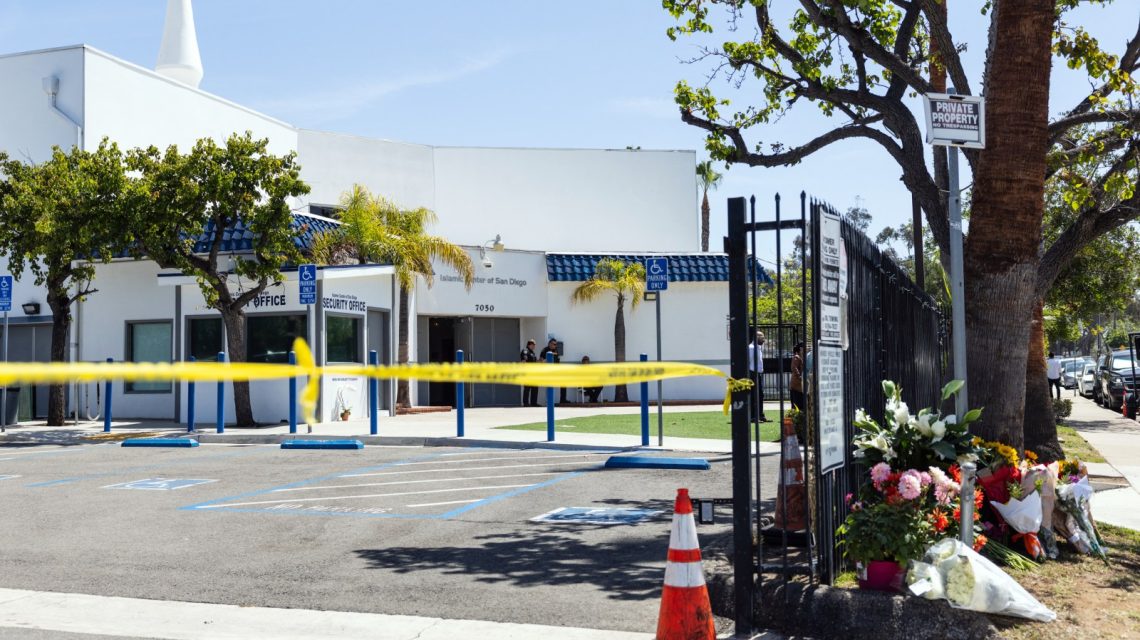
As the United States reaches its 250th birthday, themes of freedom, pluralism, and religious liberty feature prominently in speeches. One of the most powerful declarations of these ideals is found in George Washington’s 1790 letter to the Hebrew Congregation of Newport, Rhode Island. In his letter, Washington emphasized the nation’s commitment to “give to bigotry no sanction, to persecution no assistance.” More than 200 years later, it’s essential to evaluate our adherence to this vision.
Recent events have prompted reflections on this commitment. On the fourth Friday after the attack on the Islamic Center of San Diego, I attended prayers at a mosque in Los Angeles. Five armed guards were stationed there as more than a thousand worshippers gathered. Families arrived with children, and volunteers assisted with traffic. The presence of security felt routine.
Three weeks earlier, during a visit from Canada, my daughter accompanied me to Friday prayers. She halted and took a photo of a security guard wearing a bulletproof vest and carrying a semiautomatic rifle. Her inquiry, “Is this normal?” prompted an honest response: yes. This normalization is troubling.
The attack in San Diego resulted in three fatalities, including a security guard who reportedly died protecting people at the mosque. At the time, over 130 children were present on the premises.
The attack at the Islamic Center may be the first ideologically driven lethal assault on a U.S. mosque this century. This marks a grim milestone that aligns America with past deadly mosque attacks in Christchurch, New Zealand, and Quebec City, Canada.
Despite the preparations at the Islamic Center, which included federal and state security funding, surveillance cameras, bullet-resistant glass, and trained personnel, the tragedy unfolded. These preemptive measures may have prevented a larger catastrophe, yet the incident highlights how such security precautions have become routine at worship places nationwide.
These challenges are not exclusive to the Muslim community. Jewish, Christian, Sikh, Hindu, and other religious groups have faced similar threats. Across faiths, the challenge remains: how can religious spaces remain open and inviting without exposing them to danger?
Security is costly. Funds allocated for guards, cameras, and security evaluations are diverted from education, charitable activities, counseling, and community initiatives. After prayer, I increased my donation to help cover security costs, a decision many worshippers are compelled to make as institutions fundraise for protection over service.
The Muslim Public Affairs Council reports that anti-Muslim attacks have risen elevenfold. UC Berkeley’s Othering and Belonging Institute suggests that more than 80% of anti-Muslim harassment goes unreported, indicating a larger issue than official statistics reflect. Fear is not captured in government data; it manifests in daily decisions, such as the safety of children attending classes and worshippers assessing their surroundings before entering religious sites.
California’s Council on American-Islamic Relations questions the distribution of nonprofit security grants among Muslim institutions amidst rising threats. The greater concern lies in why many religious entities require substantial security funding.
Since the events of 9/11, American Muslims have faced increased scrutiny. Mosques have experienced surveillance, vandalism, threats, and occasional attacks, while anti-Muslim rhetoric has permeated mainstream dialogue. Though most exposed to such rhetoric do not resort to violence, it delineates community belonging and targets those viewed with suspicion. Violence does not exist in isolation; it thrives in environments where fear and dehumanization are normalized.
The attack in San Diego underscores the broader need for security, which is tied to the current climate. As America celebrates its 250th anniversary, successes should be acknowledged, but it is also a period for contemplation. The situation in San Diego highlights the overarching challenge: ensuring not only Muslim safety but safeguarding religious freedom throughout America.
Many religious communities feel urged to reinforce themselves. This inclination moves us away from the nation’s founding promise to “give to bigotry no sanction, to persecution no assistance.” At this foundational milestone, we must question the necessity for guards, cameras, and security allocations in places of worship. It’s a pressing issue regarding why so many Americans feel they can’t worship securely without them.
Faisal Kutty is a professor of law at Southwestern Law School, an affiliate faculty at the Rutgers Center for Security, Race and Rights, and a contributing editor for the Washington Report on Middle East Affairs. The opinions conveyed in this article are the author’s own.
 Life Through Cancer: A Family’s Journey of Love and Resilience
  The Curious Case of Mark Jackson’s NBA Hoops Card
  Communities Continuing Recovery from Hurricane Helene Explored through Graphic Novel
  Art Institute of Chicago Returns Nazi-Looted Painting to Heirs
  ICE Officer’s Shooting of Venezuelan Driver Without Body Camera Raises Concerns
  Chicago History Museum Responds to Protest with Aquí en Chicago Exhibit