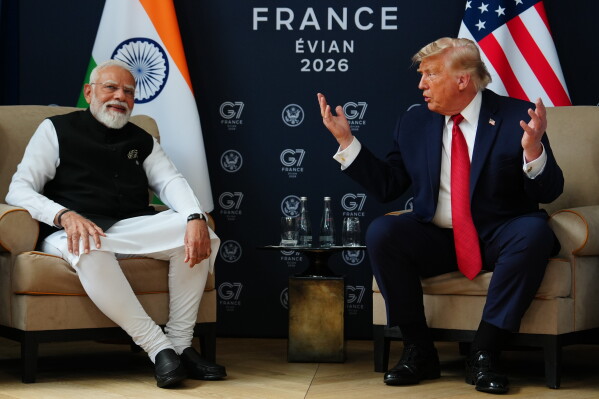
The Group of Seven summit in Evian-les-Bains, France, concluded with strong backing from leaders for U.S. President Donald Trump’s tentative agreement with Iran. The agreement aims to open the Strait of Hormuz and reinforces a fragile ceasefire.
French President Emmanuel Macron expressed his approval, describing it as a beneficial deal that addresses instability affecting global economies. Trump labeled the deal as historic and noted other G7 leaders’ approval, emphasizing their desire to end the situation.
The accord’s text, outlined by U.S. officials, is set for official signing in Switzerland. It includes the potential lifting of U.S. and UN sanctions on Tehran, contingent upon reaching a comprehensive agreement on Iran’s nuclear program. Trump expressed optimism, stating the agreement would allow Iran to return to normalcy.
The G7 summit in the French Alps covered future topics like artificial intelligence and economic growth. They also discussed concerns over China’s economic practices, specifically regarding subsidized export products. Leaders from India, South Korea, Kenya, and Brazil participated in the discussions.
Trump addressed internal challenges, needing to assure some Republican party members of the deal’s effectiveness in curbing Iran’s nuclear ambitions. Concurrently, there’s a global expectation for reopening Hormuz Strait to oil tanker traffic, maintaining stability.
The leaders proposed a maritime mission led by France and the U.K. to safeguard merchant vessels and ensure the Strait remains clear of threats. Iran, having closed the strait due to conflicts beginning February 28, is urged to comply.
The deal also insists on an immediate cessation of hostilities between Israel and Hezbollah in Lebanon. Israeli incursions resulted in numerous casualties and massive displacement. G7 leaders supported Lebanon’s sovereignty and efforts to disarm Hezbollah.
The leaders reaffirmed support for Ukraine amid its conflict with Russia and committed to enhancing air defense capabilities. They aim to strengthen sanctions against Russia’s oil and gas sectors.
Efforts to combat global drug trafficking formed another key topic, as U.S. military actions targeting drug transit routes in Latin America have faced legal scrutiny. G7 leaders also reaffirmed their stance against human trafficking and migrant smuggling.
At the summit, Trump engaged with Indian Prime Minister Narendra Modi, praising him while hinting at a potential U.S.-India trade agreement. However, tensions rose over a recent incident involving the death of Indian sailors during a U.S. military operation.
Modi highlighted the importance of mariner safety during their discussion, suggesting it as a priority in U.S.-Iran deal implementation.
 Challenges for GOP as Working-Class Voters Show Signs of Shifting
  Vance Chooses Focus on U.S. Midterms Over Israeli Elections
  Rising Tensions in France: Protests Highlight Migration Debate
  Veteran Anchor Christiane Amanpour Announces Departure from CNN
  Researchers Face Setback in Search for Amelia Earhart’s Plane
  Matthew McConaughey Sparks Debate on Independent Voting