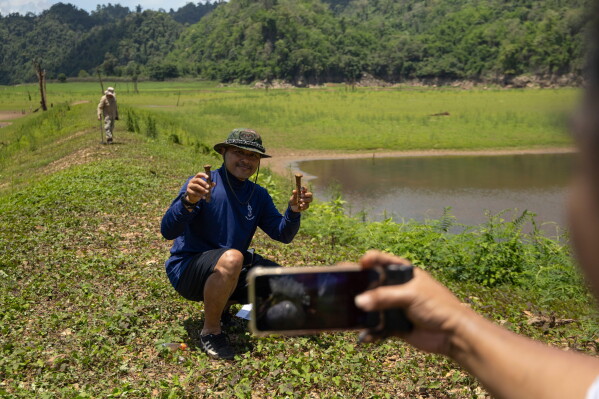
A section of the historical ‘Death Railway’ from World War II has emerged from beneath the waters of a reservoir in Kanchanaburi, Thailand. The discovery happened because the Electricity Generating Authority of Thailand drained the reservoir at Vajiralongkorn Dam for maintenance. This opportunity allows historians and researchers to explore the remnants of Nithe Station, long submerged.
During World War II, thousands of Allied prisoners of war (POWs) and Asian laborers constructed the 415-kilometer (257-mile) railway between Thailand, then known as Siam, and Myanmar, known then as Burma. The construction cost the lives of over 12,500 POWs and 75,000 laborers. The ‘Death Railway’ is famous today, featured in films like ‘The Bridge on the River Kwai’ and ‘The Railway Man’.
Martyn Fryer, an independent Australian researcher whose grandfather perished as a POW on this railway, traveled from Perth to explore the site. Despite the sweltering 38 degrees Celsius (100 degrees Fahrenheit) heat, he used a metal detector to find historical items like iron spikes and bridge staples. Fryer compared wartime aerial photographs and maps to locate key areas and POW camps.
Andrew Snow, also a researcher, worked alongside Fryer using aerial images from the National Archives in London. Snow’s father, much like Fryer’s grandfather, was a POW forced into labor on the railway. The dry season in Southeast Asia has made the study of Nithe Station feasible, as water levels dropped significantly, leaving the site bare with minimal vegetation regrowth.
Local interest has surged. Kitti Laokham, a resident, shared Nithe’s exposed remains on social media, garnering millions of views. Visitors, like Channarong Noimala, have traveled from afar to pay respect to those who died during the railway’s construction.
Nearby is Hellfire Pass, a notorious area where many POWs lost their lives. It is now home to the Hellfire Pass Interpretive Centre, which sees high visitor numbers. Mick Clarke, an Australian Army veteran, states that such sites maintain personal war stories and educate future generations on the horrors of war.
The preservation of these locations serves as a critical reminder of the past. Nearly 22,000 Australians were POWs during the war, with 13,000 working on the railway and 2,800 losing their lives. These sites are emotionally significant to many Australians, connecting personal and national histories.
 Google Fined for Breaching EU Privacy Rules
  South China Sea Tensions Rise after Collision between Chinese and Philippine Ships
  North Korea’s Hypersonic Weapon Test Amid Global Tensions
  Austin Tice: A Search for Answers
  U.S., Denmark, and Greenland Forge New Security Agreement
  Secretary Rubio Discusses Middle East Conflict and NATO Relations