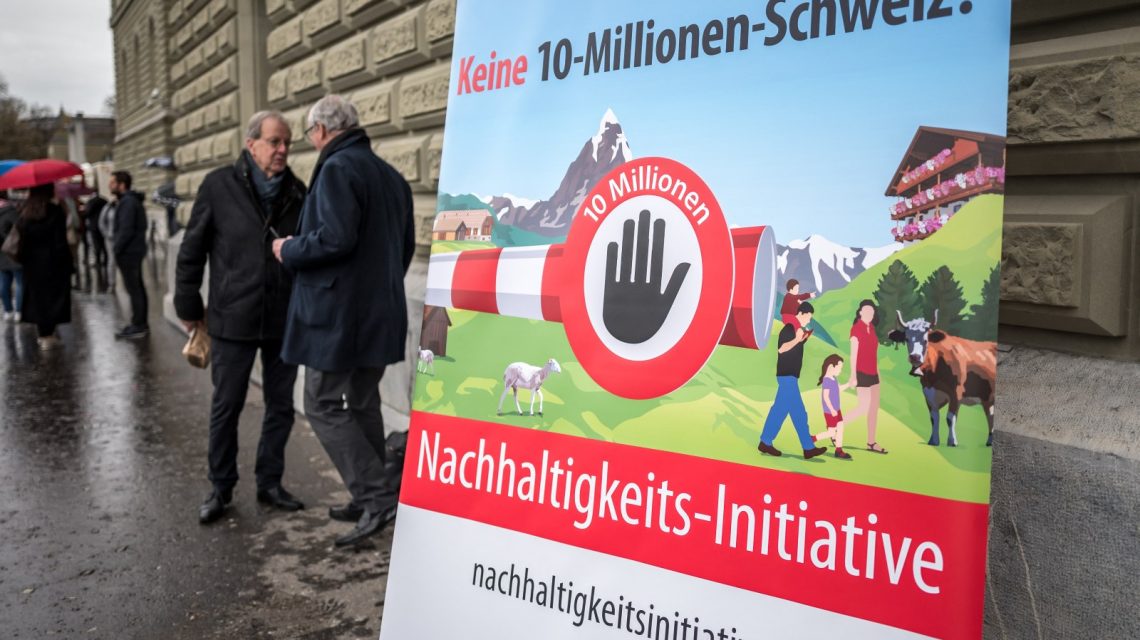
Swiss citizens have decided against limiting their country’s population to 10 million, choosing economic security and strong European connections over efforts to constrain growth and migration.
The plan, championed by the Swiss People’s Party (SVP), aimed to compel governmental actions, including possibly revoking vital European Union agreements, if Switzerland’s population surpassed 10 million by 2050.
Echoing sentiments seen across Western nations, the SVP claimed swift population increases were challenging housing, infrastructure, and public services. However, approximately 55 percent of voters opposed the motion in Sunday’s referendum, a count reported by Reuters, while 45 percent supported it.
Cloé Jans, a senior project manager at gfs.bern, a public opinion analysis firm, informed Newsweek that voters perceived the measure as excessively radical. Jans noted, “While the electorate largely acknowledges issues like growth, housing expenses, and infrastructure strain, the majority rejected the proposed remedy.” She added that opposing campaigners effectively highlighted potential economic and European relationship risks.
The Problem Resonated, the Proposal Didn’t.
Despite the initiative’s defeat, a significant segment supported it, indicating persistent political strength of initial concerns, even amid the measure’s failure to attain majority backing.
Since 2002, Switzerland’s population surged by nearly 2 million—from 7.3 million to more than 9 million in 2025—following eased movement between Switzerland and the EU, as per the Federal Statistics Office.
The SVP presented its motion as addressing increasing demands on housing and services, cautioning continued growth might threaten Switzerland’s cultural identity. The 2025 UBS Worry Barometer, an annual survey monitoring Swiss voters’ pressing issues, revealed immigration as a major concern (30 percent), ranking after health problems (50 percent) and environmental issues (31 percent).
Jans commented, “There is significant apprehension.” However, the proposal was viewed as too radical and impractical. Gfs.bern’s recurring surveys show Swiss voters favor EU ties and free movement but also desire control over immigration.
Jans described a deep-seated inclination to maintain sovereignty, intrinsic to Swiss political ethos, valuing direct democracy as central to national identity.
Economic and EU Concerns Shifted the Debate
Jans noted the campaign opposing the measure adeptly refocused discussions from daily frustrations to broader risks associated with adopting the proposal.
The ‘No’ campaign unified the Swiss government, major political entities, business organizations, and unions, warning potential proposal impacts on the economy and EU relations.
Though Switzerland is outside the EU, bilateral agreements grant it partial single market access and free movement. Opponents warned that a population cap may jeopardize these arrangements.
Jans explained, “Fears concerning bilateral EU agreements, labor market effects, and healthcare system caps dominated closing debates and proved persuasive.”
Voter awareness of Switzerland’s structural realities, such as industry labor shortages—including healthcare—was high. “Without foreign professionals, our hospitals would face challenges,” Jans remarked, adding that most understand this necessity.
Foreign-trained doctors form around 43 percent of physicians working in Switzerland, as the Swiss Medical Association’s 2025 report reveals.
Most of the 165,386 foreign nationals relocating to Switzerland last year cited employment as a reason, reported the Swiss State Secretariat for Migration’s 2025 study. Two-thirds came from the EU/European Free Trade Association (EFTA).
Swiss voters cherished their EU relationship. “Amid uncertainty, a nation with European proximity was unprepared to risk EU ties, perceived as an ally,” Jans stated, adding that a flawed situation outweighed uncertainties.
 Don McCullin’s Final Book: A Pioneering War Photographer’s Legacy
  Rep. Alexandria Ocasio-Cortez Defends Macklemore Amid Tour Controversy
  Google Fined for Breaching EU Privacy Rules
  South China Sea Tensions Rise after Collision between Chinese and Philippine Ships
  North Korea’s Hypersonic Weapon Test Amid Global Tensions
  Austin Tice: A Search for Answers