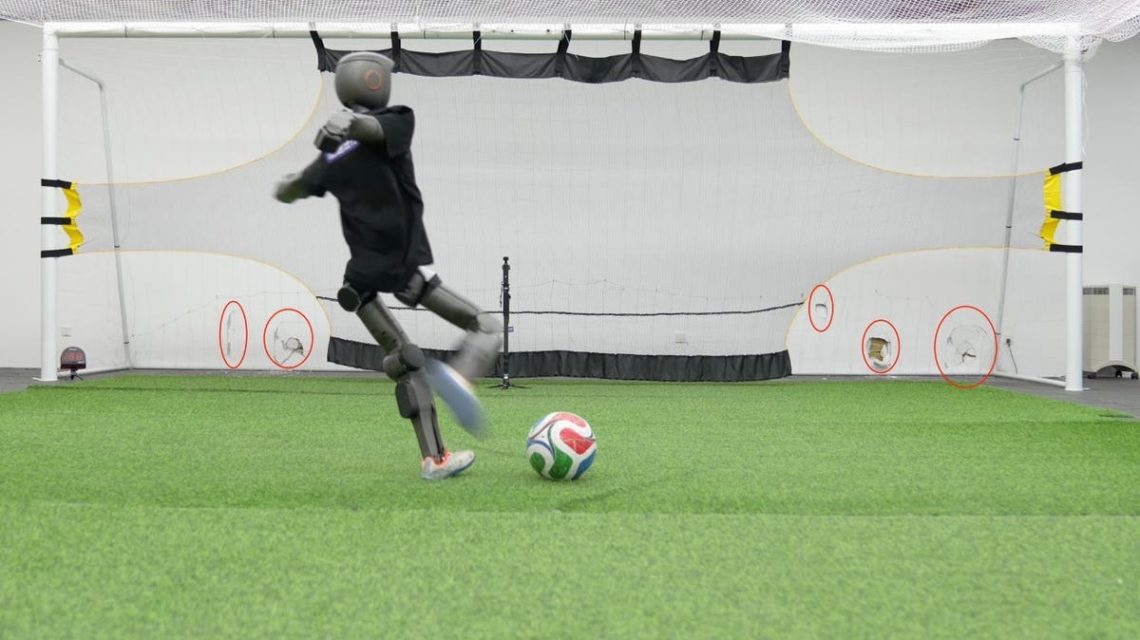
A recent video has drawn attention to the capabilities of robot soccer players, sparking new discussions about their power and safety. Booster Robotics released footage of its T1 humanoid robot displaying impressive strength in kicking soccer balls towards a goal.
Most shots reached the net, but noticeable damage to the wall emphasized the robot’s force. This raises important safety questions: what would happen if a soccer ball kicked by such a robot struck a person?
Booster Robotics’ T1 Robot
The Booster T1 is developed by the Beijing-based Booster Robotics. It stands approximately 3 feet, 10 inches and weighs around 66 pounds. The robot offers between 23 to 41 degrees of freedom, depending on its setup, allowing it to walk, balance, and perform athletic movements.
On a full charge, the T1 can walk for about two hours and remain standing for four hours. Its compatibility with open-source tools and APIs aids developers in training the robot for various tasks. Over 50 robotics teams and research institutes reportedly use this platform.
Training Robots Through Soccer
Testing robots in sports environments, like soccer, provides valuable insights into their movement, balance, and reaction capabilities. These tests help engineers understand how robots can adjust to dynamic situations, which is crucial for developing robots meant for human interaction.
Such skills are transferable beyond sports, potentially benefiting warehouses, laboratories, or disaster zones. As robots learn to adapt and recover, their utility in real-world applications increases.
Development Goals and Safety
Designed primarily for R&D, the T1 serves as a development platform for schools, labs, and robotics teams. It supports testing of software, motion models, and behaviors.
Through RoboCup competitions, developers enhance robots’ abilities to balance, perceive, and react autonomously. Although the idea of robots outperforming human athletes may seem distant, these competitions have led to advancements in robotics applicable in various fields.
The power of robots like the T1 raises safety concerns, underlining the need for stringent safety measures in environments where these machines interact with people. Developing robust rules and emergency protocols becomes critical.
Impacts on Everyday Robotics
Although the T1’s video is striking, it represents broader progress in robotics, indicating potential applications in health care, logistics, and emergency response.
As robots grow more capable, new questions arise regarding regulations, liability, and safety assurances. The current phase of robotics demands transparency, testing, and accountability to address these challenges.
This development urges an examination of how humanoid robots will be integrated into society, ensuring safety without undermining the potential benefits of these advancements.
 The Challenges of Regulating AI Unveiled
  Challenges of the Digital Markets Act in the EU
  Scientists Discover Enormous Crater on Moon
  AI Chatbot Concerns: Families and Legislation
  NPR Launches AI-Focused Podcast ‘Machine Gods’
  Trump Proposes ‘AI Force’ to Oversee Artificial Intelligence