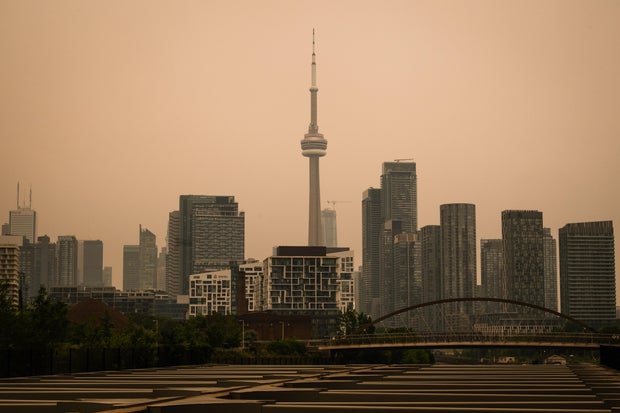
The United States is experiencing a faster rate of wildfires this year, compounded by massive smoke plumes from Canadian wildfires that are affecting air quality on both sides of the border. Experts attribute the severity of the current fire season, impacting millions of acres across both countries, to climate extremes.
In Canada, more than 100 wildfires were active on Thursday, with strong winds carrying smoke from these fires—and several large fires in Minnesota—across the Upper Midwest and northeastern U.S., exposing millions to dangerous pollution levels. The Canadian Climate Institute has noted how climate change exacerbates wildfire risks, potentially multiplying the likelihood of extreme fire weather several times over.
About 3,500 fires in Canada have consumed roughly 2.3 million acres this year, which aligns with the country’s 10-year average of acres burned by mid-July. Although this figure is lower than Canada’s five-year average, it reflects recent extreme fire seasons. Fire seasons worldwide are starting earlier, lasting longer, and becoming more difficult to contain. Climate change contributes to these challenges, as fires continue smoldering through winter as “zombie fires.”
“From a landscape point of view, from a fuels point of view, and from a weather and climate point of view, everything has kind of converged,” said Jon Meyer, Utah’s assistant state climatologist.
In the U.S., close to 40,000 fires have burned over 3.6 million acres so far in 2026, including half a million acres in the last two weeks alone, as per the U.S. National Interagency Fire Center. This increase of nearly 10,000 fires and a million more acres than the 10-year average for mid-July highlights worsening conditions. Severe drought and high temperatures, coupled with historically low snowpack levels, have created optimal conditions for one of the worst wildfire seasons in a decade.
Colorado and Utah have been hit hardest, with three firefighters dead and two injured in the Knowles Fire along the states’ shared border. Of the 48 large wildfires still active nationwide, 10 are in Colorado or Utah, with others scattered across Arizona, California, Idaho, Nevada, New Mexico, Oregon, and Washington state.
U.S. experts caution that while climate change impacts fire seasons, factors like forest management also play a role. Noah Diffenbaugh, a Stanford University climate scientist, notes research attributing roughly half of the long-term increase in burned area across the western U.S. to climate change. However, even with ambitious carbon reduction targets, trends are likely to continue.
Western U.S. states recently endured their warmest winters on record, exacerbating the snow drought. Tim Brown, a climate researcher, explains that “climate is enabling fire, and weather is driving fire,” highlighting the complexity behind increasing wildfires. The National Interagency Fire Center warns of above-normal wildfire risk in the West into the fall, although El Niño influences make forecasts beyond August less certain. Despite potential monsoon relief, the West is still early in its fire season, with potentially dangerous winds yet to come.
 Market Reactions to U.S. and Japan Currency Intervention and Middle East Developments
  Iran’s Internal Struggle Amid Conflict with the U.S.
  Call for Investigation into Scientific Manual Sparks Debate
  Shifts in Denuclearization Strategies on the Korean Peninsula
  Israel Expresses Security Concerns Over Hamas Disarmament Deal
  Lifeguards Perform Dramatic Ocean Rescue in Florida