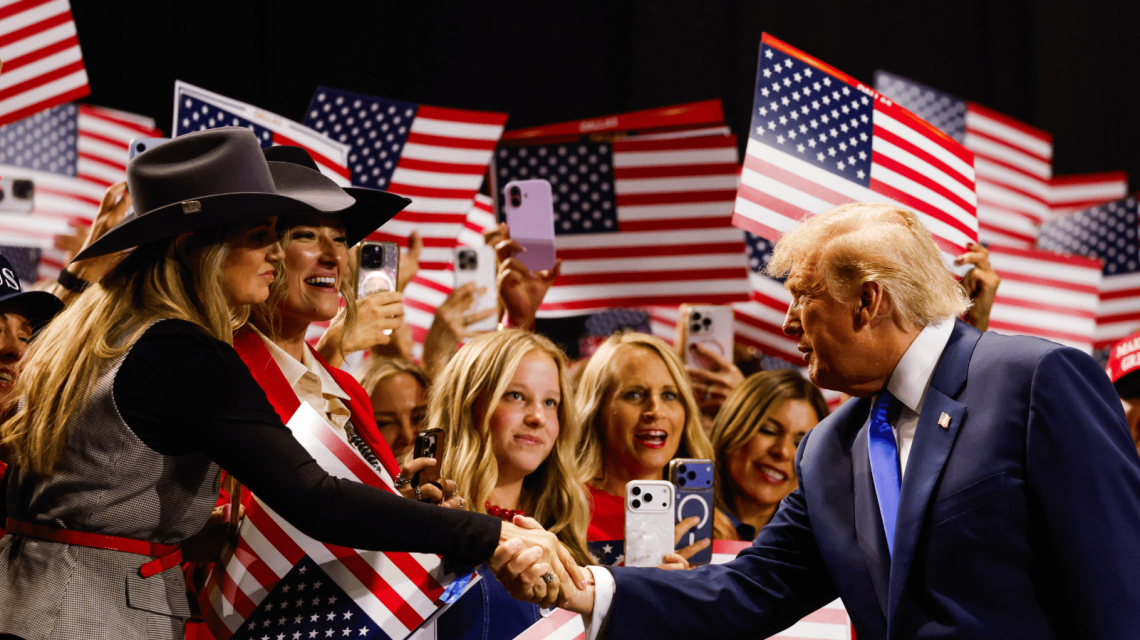
President Donald Trump’s net approval rating in the Midwest has decreased by five points within a month, as reported by Emerson College Polling. His national disapproval rating reached its highest level of his second term. This decline occurs as Republican candidates in key U.S. Senate races face challenges due to rural discontent over fuel costs, the Iran war, and a beef-import policy opposed by some cattle producers.
The September survey by Emerson highlighted the Iran conflict, jobs, and tariff policy as the top concerns for voters when selecting a midterm candidate. Voters in states such as Iowa, Kansas, Michigan, and Ohio may play a critical role in determining whether dissatisfaction with Trump spreads further within the GOP.
In Iowa, Trump-endorsed Republican Ashley Hinson has opposed the increase in beef imports and has called for an end to the Iran war, as she runs for an open Senate seat. White House spokesman Davis Ingle previously stated to Newsweek that the 2024 election served as the ultimate measure of success, with nearly 80 million Americans supporting Trump’s agenda. Ingle claimed significant progress had been made in areas like jobs, inflation, and housing affordability, with further benefits anticipated as more policies are implemented.
Trump managed to win Iowa, Kansas, and Ohio in 2024, while Michigan was closely contested. Any political weakening in these areas is significant. Emerson’s figures from August showed Trump with 43 percent approval and 52 percent disapproval among likely Midwest voters, resulting in a net rating of -9. By September, approval decreased to 42 percent, and disapproval increased to 56 percent, widening the deficit to -14 points.
This rise in opposition appears fueled by discontent rather than a widespread loss of support. As the Midwest data is a subset of the national poll, it has a smaller sample and larger credibility intervals than the entire survey. This change acts as a warning but not definitive evidence of a long-term shift.
The national trend reflected similar results, with Emerson’s September poll placing Trump at 39 percent approval and 58 percent disapproval, marking him 19 points underwater. This was the highest disapproval rate during his second term. Both the August and September surveys involved 1,000 likely voters and carried margins of error of plus or minus 3 percentage points for national samples.
Political tensions are particularly evident in Iowa, where Hinson and Democratic state representative Josh Turek compete to succeed retiring Republican Senator Joni Ernst. Hinson criticized Trump’s decision to increase beef imports to counter rising prices, an issue of significant concern in a cattle-rich state like Iowa.
Turek, known for his success in wheelchair basketball, provides Democrats with a candidate whose profile extends beyond party lines. Polling painted a competitive race, with Emerson showing Hinson ahead by 5 points, while different polls showed varied leaders.
Another point of debate is fuel prices. Hinson opposed Iowans paying more due to the Iran conflict, suggesting gas-tax relief and a pause in diesel exports to alleviate burdens. Increased fuel prices affect farmers and freight businesses, influencing multiple aspects of daily life.
According to Emerson, 41 percent of national voters prioritized economic concerns. The Iran war, jobs, and tariff policy were highly rated in midterm issues. These factors might explain Trump’s decline in the Midwest.
Senate races in the Midwest are causing Republican concerns. In Kansas, Democrat Adam Hamilton held a narrow lead against Republican Senator Roger Marshall in a September Emerson survey, unusual for a traditionally Republican state.
In Michigan, Democratic physician Abdul El-Sayed challenges former Republican Representative Mike Rogers. Emerson showed El-Sayed leading narrowly in mid-September.
Ohio presents a clash between former Senators, with Republican Jon Husted and Democrat Sherrod Brown competing. Husted called for an end to the Iran war and proposed a temporary suspension of Ohio’s gas tax, highlighting concerns as average gas prices rose from $2.76 to $4.48 per gallon by late September.
Collectively, these races indicate that the Midwest approval change may hold broader implications beyond regional interest. Republicans don’t require vast voter defection; reduced enthusiasm, lower turnout, or minor shifts among independents could be impactful in close contests.
 Supreme Court Blocks Missouri Congressional Map Favoring Republicans
  Heidi Overton Defends Vaccine and Abortion Pill Safety
  White House State Dinner to Honor Chinese President Xi Jinping
  The Forgotten Americans and the Role of Civilian Aides in Strengthening U.S. Military
  Investigation into St. Paul Mayor Kaohly Her Over Harassment Allegations
  Economist Criticizes Socialist Figures for Profiting in Capitalist System