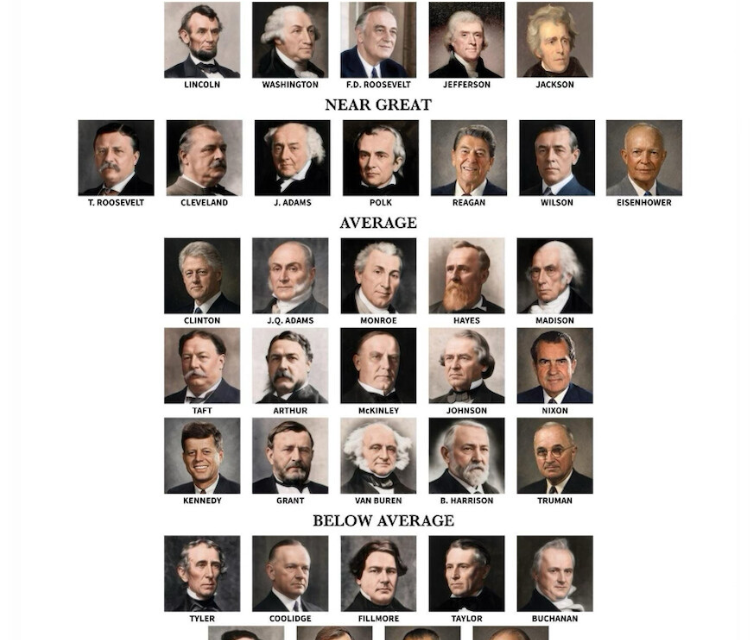
President Donald Trump has shared an updated version of his ranking of U.S. presidents, modifying a chart he previously posted. This revised ranking maintains Trump alone in the top category labeled “The Greatest,” placing him above other notable figures such as Abraham Lincoln, George Washington, and Franklin D. Roosevelt.
Changes in the Revised Presidential Rankings
The updated version includes several former presidents not present in the original chart. Newly added are Ronald Reagan, Dwight D. Eisenhower, John F. Kennedy, Richard Nixon, Gerald Ford, George H.W. Bush, and George W. Bush.
Reagan, previously absent from Trump’s list despite his reputation as a conservative icon, has been added to the “Near Great” category along with Eisenhower. Kennedy and Nixon now find themselves labeled as “Average,” while Ford and George H.W. Bush have been categorized as “Below Average.” Lyndon B. Johnson, who didn’t appear in the initial ranking, also joins them in the same tier.
Herbert Hoover’s position has changed; previously listed as “Average,” he now appears in the “Failures” category alongside George W. Bush. Despite these adjustments, Trump remains alone at the top, categorized as “The Greatest.” Lincoln, Washington, Roosevelt, Thomas Jefferson, and Andrew Jackson continue to hold positions in the “Great” tier.
Reagan’s Initial Absence Explained
Reagan’s absence from Trump’s original ranking drew significant attention, especially since Reagan is often hailed by Republicans as a key figure in the conservative movement. Comparisons between Trump and Reagan are frequent, particularly concerning the direction and leadership within the Republican Party.
Polls have indicated that Trump may be viewed more favorably than Reagan by current GOP voters. Reagan’s exclusion from a list featuring presidents admired by conservatives, such as Washington and Jefferson, therefore seemed unusual. While Trump hasn’t explained the changes, the revised chart now places Reagan among “Near Great” presidents, just below Trump’s lone top category.
Omissions in Trump’s Revised Ranking
Trump’s updated ranking includes 43 presidents, leaving out some commanders in chief. Missing from the list is William Henry Harrison, John Tyler’s predecessor, whose presidency lasted just 31 days before his death in office in 1841. Also absent is James Garfield, who, after being assassinated in 1881, served less than a year.
U.S. Presidential Count
The United States has had 45 different individuals serve as president, from George Washington to Donald Trump. Grover Cleveland, who served as both the 22nd and 24th president, and Trump’s nonconsecutive terms contribute to the 47 presidencies with 45 distinct presidents.
Trump’s revised list covers many of these presidents, spanning from those he deems “Great” or “Near Great” to those he consigns to the “Failures” category. Trump continues to occupy the unique top spot labeled “The Greatest.”
Comparison with Historians’ Rankings
Trump’s rankings are considerably different from historians’ perspectives. In the 2024 Presidential Greatness Project survey, historians ranked Lincoln as the greatest president, followed by Franklin D. Roosevelt, Washington, Theodore Roosevelt, and Jefferson. Trump, in contrast to his self-ranking, was placed last.
The revised chart also elevates figures who spark debate among historians. Woodrow Wilson remains in the “Great” category despite rising criticism concerning his administration’s record on racial segregation and civil liberties.
On Trump’s list of “Failures” are Biden, Obama, Ulysses S. Grant, Warren Harding, Carter, and Hoover. The revised ranking highlights Trump’s view of presidential history while reflecting his unique status within today’s Republican Party, where many GOP voters seem to favor Trump over other Republican presidents traditionally held in high regard, including Reagan.
For inquiries related to this story, contact Newsweek editors Rebecca Flood and Cristina Diciu.
 A Mother’s Tragic Journey Under Abortion Ban
  U.S. Strategic Goals Remain Unmet Amid Prolonged Conflict
  The Impact of Arts and Closure on Democracy
 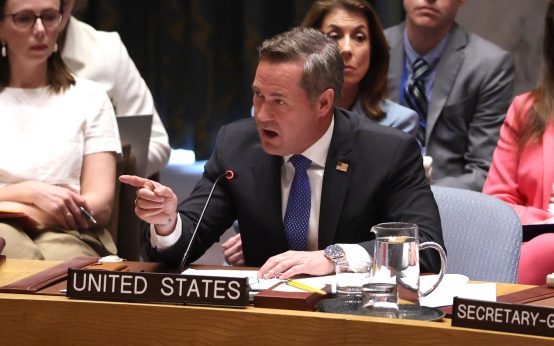 U.S. Ambassador Comments on Iran War Duration Amid Political Concerns
 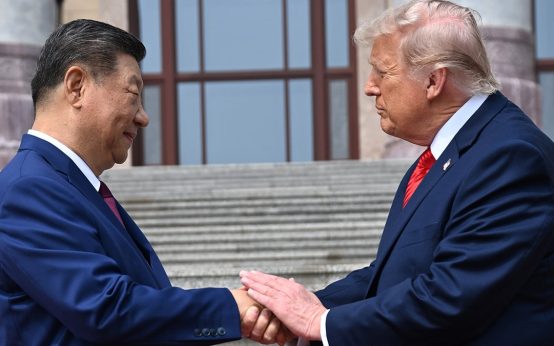 US-China Relations Under Scrutiny: Expert Warns of Escalating Tensions
  No Timeline for End of Iran Conflict