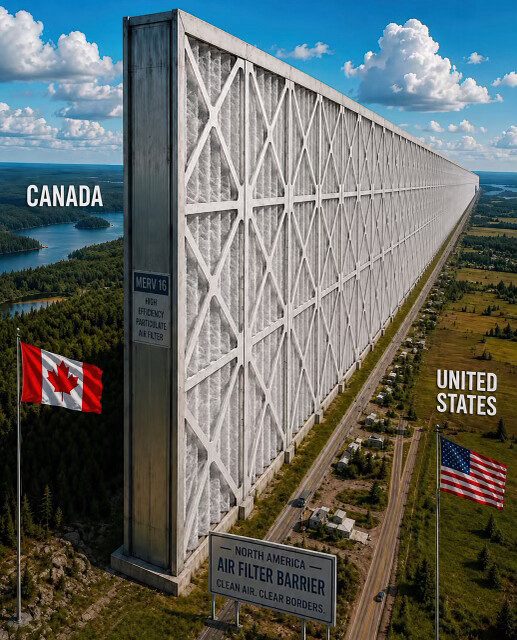
President Donald Trump recently shared an image that appears to be generated by artificial intelligence. It depicts a large air filter at the U.S.-Canada border. This image was intended to criticize Ottawa as smoke from Canadian wildfires affects air quality in the United States.
Historically, the U.S. and Canada have collaborated during wildfire emergencies. Trump’s comments came after he blamed Canada for declining air quality in the U.S. He mentioned that the economic impact of the smoke should influence tariffs on Canadian products.
In response, Canadian representatives highlighted decades of cooperation, involving personnel, aircraft, and resources moving across the border to manage intense fire seasons.
The image posted on Trump’s Truth Social account shows a huge filtration barrier between the two nations. Above it is a sign saying, “North America Air Filter Barrier. Clean Air. Clean Borders.” The filter is labeled as a “MERV 16 High Efficiency Particulate Air Filter,” with national flags; Canadian on the left and American on the right.
Canada’s Prime Minister Responds
Trump has often claimed that Canada’s severe wildfire seasons occur due to poor forest management. His criticism grew last week when smoke reached the U.S. from Canadian forests, causing hazardous air quality alerts in states like Michigan and New York.
On July 17, Trump accused Canada of “willful negligence” in a Truth Social post, describing the smoke as “filthy, polluted, and unhealthy air.” He argued that the U.S. should factor these costs into tariffs on Canadian imports.
Earlier, Prime Minister Mark Carney affirmed that Canada is striving to control the wildfires. He communicated to Trump the vastness of Canada’s forests, which are eight times the size of Texas, and how drought conditions span from an area similar to Texas to Minnesota.
Causes of Canadian Wildfires
Wildfires are common in Canada’s expansive boreal forests, and fire seasons have intensified due to rising temperatures and drier conditions. Scientists attribute prolonged fire seasons and intense fire behavior to increasing temperatures.
Wildfires in Canada arise from natural and human activities. The largest ones are often ignited by lightning in remote boreal forests. Human actions like unattended campfires, discarded cigarettes, sparks from equipment, and power-line failures can also start fires.
Many current fires are in remote areas of Ontario and northern regions, where access is difficult, complicating suppression efforts.
Smoke Impact on the U.S.
Recently, smoke from these fires affected the Great Lakes and Northeast regions. Cities including Chicago, Detroit, Cleveland, New York City, and Boston experienced widespread air quality alerts. Residents noticed orange skies, reduced visibility, and a strong smell of smoke as pollution reached hazardous levels.
Although much of the smoke has lessened, it is expected to affect the U.S. again soon. A Washington Post meteorologist noted that smoke from the Northwest will spread across the U.S. and Canada. In the East, smoke will be noticeable by Sunday and Monday, though air quality will face fewer issues.
Future Outlook
Canada’s wildfire season remains active primarily from May through September. Typically, fire activity decreases in fall, with cooler temperatures, more rain, and snow reducing new fire risks and slowing existing fires. Air quality concerns could persist across parts of Canada and the northern U.S. for weeks should dry conditions continue.
 The Cost of Challenging Beijing
  Tensions Escalate in Iran Conflict as Global Leaders Weigh Options
  White House Approves F-35 Sales to Saudi Arabia Amidst Regional Tensions
  Inside the Secret Deals Powering the President’s Push to Deport Migrants to Countries Not Their Own
  Navigating the Challenges of Third-Country Deportations
  Midair Altercation on Bangladesh to London Flight