Andrew and Casey Kowitz first encountered each other on the inaugural day of a biology class nearly ten years ago at Trinity Christian College. She inquired if the seat beside him was free. Soon, they were assigned as lab partners for the semester. A year and a half later, Andrew organized a romantic scavenger hunt for Casey across the Palos Heights campus. The trail led her to numerous sentimental spots, including the place where he proposed with an engagement ring. “I said yes immediately,” Casey remembered. They now have two children and celebrated their sixth anniversary recently.
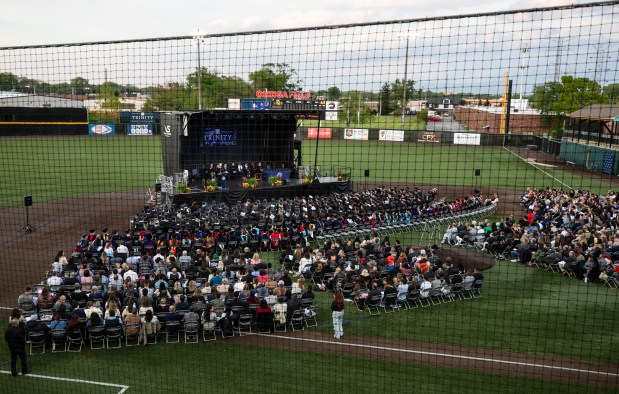
However, the college that played a pivotal role in their lives is closing. Trinity’s board of trustees announced the shutdown, citing dwindling enrollment and financial issues. “The board has worked hard and considered every option,” stated Jeanine Mozie, Trinity’s acting president. “But there is no viable path forward for our beloved institution.” The school’s final commencement occurred on May 8.
The announcement was shocking for many students and alumni, prompting them to make new academic plans. Casey and Andrew expressed grief over the loss of the institution that was integral to their identity and their experiences together. “Trinity played a crucial role in our story,” Casey said. “Our family wouldn’t be the same without it, and it will always hold meaning for us.”
Trinity’s closure is part of a broader trend affecting small, faith-based institutions. Recently, Lincoln Christian University ceased operations after 80 years, while Trinity International University sold its campus. Across the country, 40 Christian colleges have closed or merged since 2020, reflecting nationwide challenges. Many religious colleges face issues common in higher education, such as reduced enrollment and financial struggles, compounded by pandemic-related disruptions.
Perry Glanzer, an educational foundations professor at Baylor University, noted that “there is a lot of alarm, but it’s the same for all higher education institutions.” A smaller pool of potential students tightens competition, resembling business challenges.
Some believe the impact of losing faith-based colleges is different because these institutions are deeply tied to student culture and spirituality. Andrew and Casey attended the college’s last Outcry worship service, a tradition held for decades. “It’s bittersweet,” Andrew reflected, while Casey added, “Trinity was vital to our faith and friendships, shaping who we are.”
Reactions and Adaptations
Julia Leidecker was partway through her commute to an early morning class when she learned via email about Trinity’s closure. “I sat at my kitchen counter and cried,” the sophomore recalled. The college environment transformed dramatically, as students scrambled to arrange transfers. “Campus went from fun and upbeat to sad and sensitive,” she said, highlighting that even professors were suddenly facing unemployment.
Trinity established “teach-out” partnerships with other Christian colleges, aiming to facilitate smooth transfers. Leidecker plans to continue her studies at St. Xavier University in Chicago, though she admits to feeling anxious about starting anew. “At Trinity, we were like family,” she said. “Creating new relationships is daunting.”
Tracy Schorle had recently visited her daughter at Trinity for “Family and Friends” weekend when the closure news shocked their family. “My daughter and her roommates were devastated,” Schorle recounted. Though her daughter plans to transfer to Olivet Nazarene University, the move was emotionally challenging. “The college was a setting for faith expression and fellowship, making the closure hit differently,” Schorle said.
Broader Impact
The closure of religious colleges extends beyond Trinity. Institutions like Providence Christian College in California, Siena Heights University in Michigan, and St. Andrews University in North Carolina faced similar fates due to financial crises. However, not all religious institutions are struggling. Christian colleges have seen enrollment growth, partially driven by online course offerings that appeal to students wanting to remain in their communities.
Prospective enrollment declines due to lower birth rates post-2008 recession concern many. Public opinion about higher education’s value has also waned. A Pew Research Center survey indicated that 70% of Americans believe the higher education system is misaligned, and only 35% view college as essential, according to Gallup.
Trinity alum Kylla Hutcherson never anticipated the closure of her cherished alma mater. She valued the personal connections and spiritual life at the college. “Once they’re gone, you may be left with memories alone,” she lamented, reflecting on the transient nature of these formative settings.
 Dedicated Educator Stays On to Support Growing Program in Rural Missouri
  College Podcast Challenge: A Catalyst for Change
  NPR College Podcast Challenge Returns for Another Year
  Cristo Rey Jesuit High School’s Unique Approach to Education
  New Civics Education Requirements and Student Self-Censorship
  Missouri’s Educational Pioneering Efforts