The Sculptor’s Vision
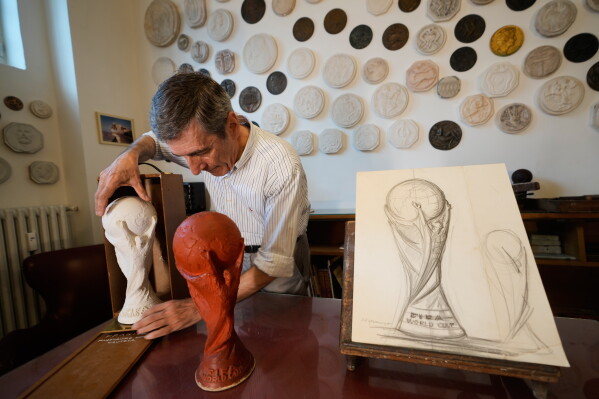
In his Milan studio, Italian sculptor Silvio Gazzaniga crafted the now-iconic FIFA World Cup trophy. His design aimed to embody three key emotions: the athlete’s struggle, the fan’s jubilation, and the moment of victory. This year, the trophy will be lifted by Spain or Argentina after the 2026 World Cup final.
Creating a New Design
Following Brazil’s permanent acquisition of the original trophy in 1970, FIFA sought a new design through an open competition. Gazzaniga’s winning design features two figures spiraling upward toward an orb symbolizing Earth. This structure suggests a double helix, representing the unity and elevation of the sport.
Giorgio Gazzaniga, son of the late sculptor, recalls his father’s extensive sketching process. Finally, his father developed this symbolic design that has become familiar to generations of soccer fans. Silvio Gazzaniga, who passed away in 2016, also created other prestigious trophies, including the UEFA Cup and the European Super-Cup.
History of the Jules Rimet Trophy
The original World Cup trophy, known as the Jules Rimet Trophy, was introduced in 1930. It depicted the Greek goddess Nike and was stolen twice. First, it was stolen in 1966 in England but later recovered by a dog named Pickles. It was taken again in 1983 from the Brazilian Football Confederation and never found, likely melted down.
Gazzaniga’s Design and Impact
Gazzaniga’s design was chosen from more than 50 proposals because he presented a complete model. This allowed the jury to appreciate its form and the story it expressed. Giorgio Gazzaniga notes how his father’s creation conveyed the athlete’s effort and struggles, depicted with rough textures symbolizing hardship.
With arms resembling wings, the trophy captures not only athletic triumph but the joy of the fans. Gazzaniga’s office, now located on Milan’s outskirts, preserves his original drawings and prototype.
The Trophy’s Legacy
The official World Cup trophy is 36 centimeters tall, made of 18-carat gold with a green malachite base symbolizing playing fields. After each tournament, FIFA retains the original in Switzerland, while winners receive a replica.
This year marks the 14th World Cup to feature Gazzaniga’s design, which will remain until at least 2038. Giorgio Gazzaniga fondly remembers witnessing the 1974 final when the trophy debuted. West Germany’s victory marked the moment his father’s creation became an iconic symbol of soccer.
 The Cost of Challenging Beijing
  Significant Events in Chicago History on September 21
  Tensions Escalate in Iran Conflict as Global Leaders Weigh Options
  Patriots Rookie Gabe Jacas Shines Against Aaron Rodgers
  Pittsburgh Steelers Face Offensive Struggles in Post-Tomlin Era
  White House Approves F-35 Sales to Saudi Arabia Amidst Regional Tensions