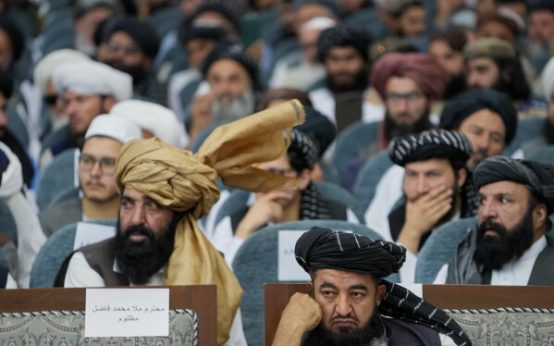
Kabul, Afghanistan (AP) — Taliban leaders and officials gathered on Saturday in the Loya Jirga assembly hall to mark the fifth anniversary of their return to power. They boasted about bringing stability and an end to decades of turmoil. However, a senior United Nations official has warned of a serious human rights crisis in the country, where girls over 12 years old are denied education.
The Taliban took control on August 15, 2021, following the withdrawal of U.S. and NATO forces after a costly two-decade war. The retreat led to chaotic scenes at Kabul airport as crowds desperately tried to flee the country.
Shortly after taking over, the Taliban government barred girls from education beyond sixth grade and later banned higher education for women, despite earlier promises of access to education, jobs, and public participation for women.
Women were also banned from public spaces such as gyms and parks, forbidden from participating in sports, and restricted from traveling long distances without a male guardian.
Taliban Celebrate ‘Liberation’ From U.S. Forces
In the Loya Jirga, senior officials, foreign representatives, and thousands of citizens gathered to hear speeches celebrating Afghanistan’s ‘liberation’ from U.S. forces.‘We pray to Almighty God to protect our homeland from occupation, aggression, wars, and insecurity forever, and to allow our people to enjoy peace, tranquility, and prosperity under a government based on Sharia,’ said Hamdula Fitrat, deputy spokesperson for the Taliban government, during the ceremony.
Abdul Salam Hanafi, Deputy Prime Minister for administrative affairs, claimed that the Taliban government ended external interventions and internal conflicts in Afghanistan ‘over the past half century,’ restoring security.
‘At least 300 young Afghans were martyred or killed each day,’ Hanafi asserted. ‘Three hundred sisters were widowed, several children orphaned, and 300 mothers mourned. Praise be to God, under the Islamic Emirate of Afghanistan, this tragedy has been eliminated from the Afghan nation.’
No women attended the ceremony.
Taliban Official Urges More International Engagement
Five years later, the Taliban government remains internationally isolated, with Russia as the only country formally recognizing it.
Foreign Minister Amir Khan Muttaqi stated that countries which have engaged with the Taliban government have benefited and urged others to reconsider establishing contact.
‘They should move towards a policy of mutual treatment and interaction,’ said Muttaqi.
Celebrations Held Under Tight Security
In Kabul, some men took to the streets carrying Taliban flags and chanting slogans supporting the government. Convoys of vehicles traveled through the city, causing traffic jams.
Security was tight with a strong presence of Taliban security forces and multiple checkpoints on a main road leading to the Loya Jirga.
Celebrations also occurred in provinces across Afghanistan, where Taliban flags and posters praising their return to power were displayed along main roads and markets.
UN Warns of Worsening Human Rights Crisis
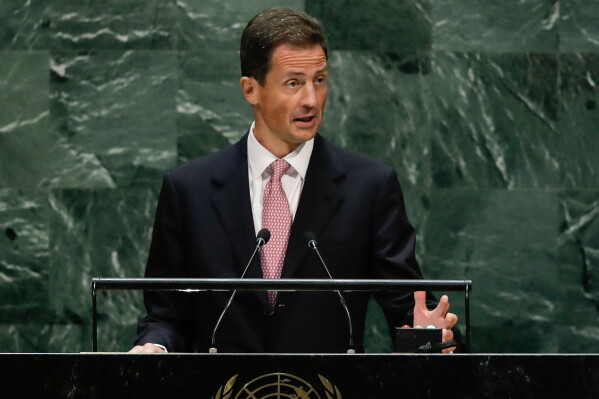
In a video message, Richard Bennett, UN Special Rapporteur on human rights in Afghanistan, stated the country faces a severe human rights crisis.‘Although the era of war is over, it is questionable whether there is real peace, and human rights situations have steadily deteriorated, most dramatically for women and girls,’ Bennett said. ‘My mandate has concluded that this system amounts to the crime against humanity of gender-based persecution.’
‘The crisis extends far beyond gender discrimination, even beyond gender apartheid,’ he continued. ‘Across Afghanistan, we continue to document arbitrary detentions, torture, ill-treatment, extrajudicial executions, corporal punishment, enforced disappearances, restrictions on freedom of expression, attacks against journalists and human rights defenders, persecution of ethnic and religious minorities, discrimination against LGBT+ persons, and the shrinking of civic space.’
Bennett cautioned the international community against ‘normalizing’ Taliban policies, noting that it would legitimize discrimination and suggest to ‘victims that their suffering is negotiable.’
In an interview with The Associated Press this week, Molvi Hayatula Mahajar Farahi, Deputy Minister for Broadcasting in the Taliban Ministry of Information and Culture, claimed that despite ‘challenges and difficulties,’ the government has provided security, infrastructure, and created jobs over the last five years.
2.4 Million Girls Excluded From Secondary Education
When asked, Farahi did not address the issue of girls’ and women’s education but asserted that ‘the level of investment in universities exceeds anything seen in the past.’UNESCO estimates about 2.4 million girls have been excluded from secondary education. The UN World Food Program reported that child malnutrition has reached critical levels in one-third of Afghanistan’s provinces, expected to worsen due to lack of funding.
UN Women stated this week that Afghan women and girls face the world’s harshest restrictions, and bans are harming Afghanistan’s future. The absence of teachers, doctors, nurses, and midwives threatens the country’s social and economic foundations.
Fraser reported from Ankara, Turkey. — This story was translated from English by an AP editor with help from a generative AI tool.
 Cuban Crisis and U.S. Policy: Challenges and Implications
  Alberta Fisherman Uncovers Potentially Ancient Bison Skull
  Cyberattack Shakes Quiet Suisun City
  Christians in Israel Face Rising Tensions and Violence
  Yasukuni Shrine: A Sacred and Controversial Site
  Bolivia Strengthens Border Security with Brazil to Combat Crime